
ITUNES | SPOTIFY
Most working moms can’t remember the last time they did something just because they enjoyed it. No goal, no finish line, no finished product to share. No wonder we reach for our phones every spare minute. If we're not crossing something off the to-do list, what else is there?
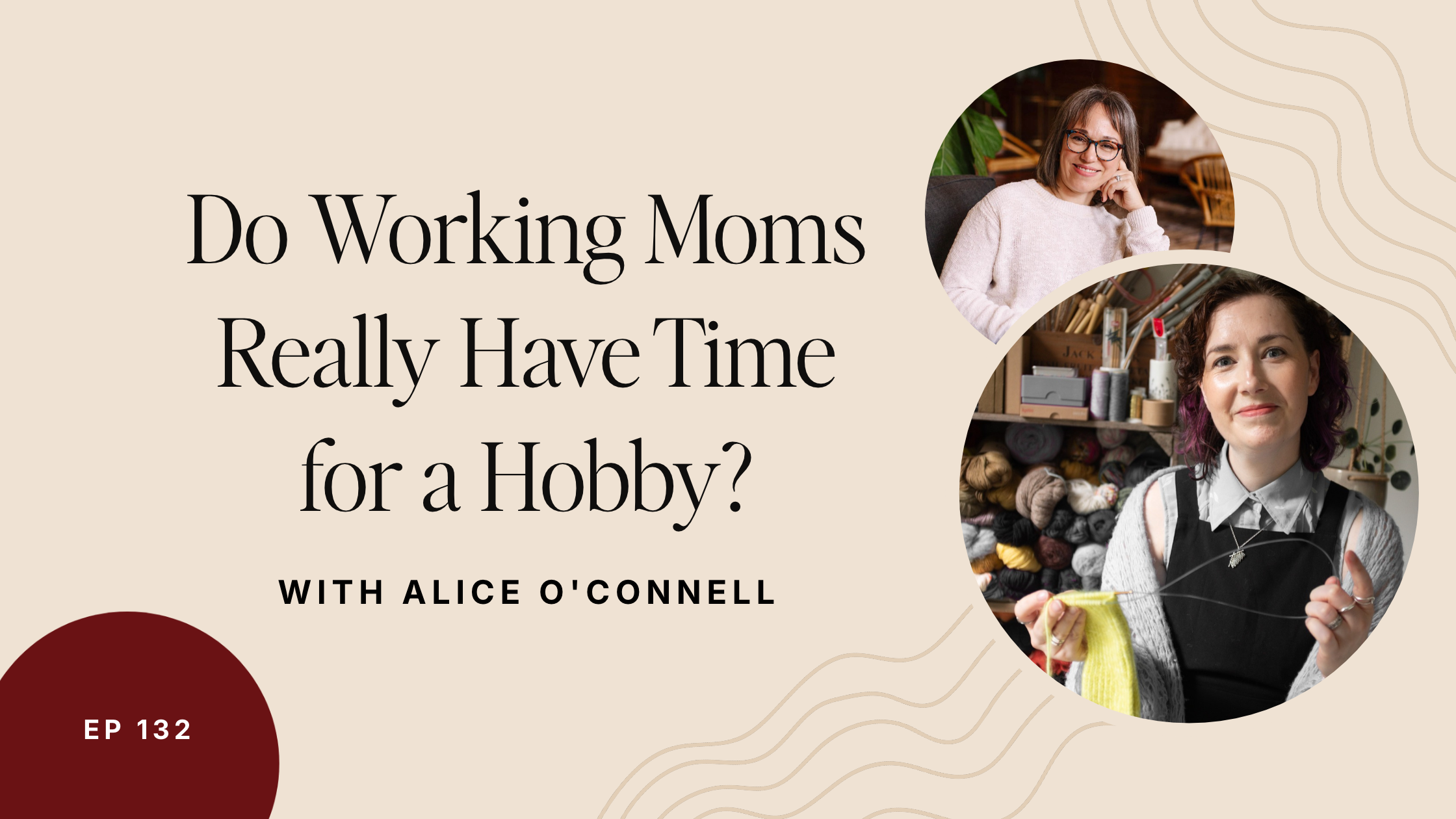
My guest this week, Alice O’Connell, is a knitting teacher, a former TV and theater actress, a mom, and the founder of Learn to Knit Online. She teaches busy, high-achieving women around the world, and what she sees most of her students struggle with isn't really about knitting. It’s about what happens when we let ourselves slow down and be a beginner.
You’ll hear why a hobby doesn’t have to be productive to be worth your time, why "slower" hobbies are the perfect antidote to our screen-heavy lives, and how being bad at something new builds resilience that carries over into all other areas of your life. And if you're not even sure what hobby you'd pick up, you'll learn how to start the search even if you think you have no time.
This episode is a must-listen for any working mom who wants a real break from her phone and her to-do list.
And if you don't want to wait until the holidays are over to find time for something like knitting, come join me for Stress Less This Holiday - my holiday planning workshop. You'll organize your lists, make your plan, and ensure it all fits on the calendar so that you might actually have a little space to relax or do something for yourself. It's happening on Nov. 5th. Get your ticket at www.themothernurture.com/holiday.
Links and resources mentioned in this episode:
Find Alice's knitting resources at www.learntoknitonline.com
Follow Alice on IG at www.instagram.com/learntoknitonline
Get your ticket to Stress Less This Holiday - www.themothernurture.com/holiday
-
You are listening to the Life Coach for Working Moms podcast, the show where we are talking about what it actually takes to make life work as a working mom. I'm your host, Katelyn Denning, a full time working mom of three and a certified life and executive coach. I'm so glad you're here and I hope you enjoy this week's episode. I want you to think about the last time you did something purely because you enjoyed it. Not to get better at it, not to finish it, not to post about it, just because you liked it. If you had to think hard about that, you are in good company. I have three kids and a full-time job, and when I look honestly at my days, almost every spare minute is either productive or spent on my phone. Somewhere along the way, we decided that rest has to be earned and that hobby is frivolous, or if you have one, that it needs to be turned into something. Well, today's guest on the podcast has a different take. Alice O'Connell is a knitting teacher based in Amsterdam. She's a mom and also a former TV and theater actress. She teaches busy, capable, high-achieving women from all over the world how to knit, and here's what I found most interesting: what she sees as a challenge for her students in her classes has very little to do with knitting. Now, I am a knitter myself, and yes, we do chat a little bit about knitting, but please don't skip this one if knitting is not your thing. You can swap in painting, journaling, cross-stitch, playing a card game, diamond art, whatever you like. The conversation works the same way. Here's what you'll get by listening all the way through. Alice and I talk about why giving yourself time for something that isn't productive might be the most productive thing you do this week. We talk about why doing things slowly matters now more than ever, about some simple ways to get off your screen without a big time commitment And we also talk about something that I think most of us rarely get to feel as adults, and that is being a beginner. Alice explains why so many women rarely allow themselves to be bad at something, what that actually costs us, and then how getting through those awkward first attempts builds resilience that shows up in every other area of your life. She also gives us a simple way to figure out what your thing might be, whether it's knitting or something else So if you are someone who thinks that you don't have time for a hobby or it's not valuable enough to devote time to it, this episode is going to be for you. As always, you can find all of the links that we mention, plus Alice's website and Instagram handle in the show notes at themothernurture.com/podcast. Please enjoy my conversation with Alice Welcome, Alice, to the Life Coach for Working Moms podcast. I'm so thrilled that you're here, and I can't wait to talk with you about so many things, knitting being just one of them. I'm delighted to be here. Thank you so much for making time and space for me. So I'd love for you to just tell us maybe in a few words a little bit about yourself, what you do, your family, and then we'll get into the- Yeah, sure ... the whole basis for our conversation today. , so my name is Alice O'Connell. I am an Anglo-Irish, , gal who has found myself living in Amsterdam, where I feel like I grew up. Like, I came here in my 30s and just married. I became a parent here, and I also, , formalized a business that I had been, , doing for many years, which was teaching people how to knit. So I founded a platform called learntknitonline.com, and, , I teach people how to knit all over the world whether they learn from my prerecorded classes, my live online sessions, or my in-person classes here in Amsterdam. I'm a very proud mum to a nearly eight-year-old, and yeah, I'm just, you know, managing the juggle of life. Yes. And for anyone who hasn't heard me talk about it before, , I am a knitter myself. I have been knitting since- I learned the very basics from my grandmother when, I wanna say I was, a freshman in college, so I was 19 years old, and then learned alongside my roommate, who also decided to jump in and learn with me, and we had a couple of books and taught ourselves how to knit scarves, and then we were so excited to knit ourselves hats. And it is a hobby that has lasted. Obviously, I'm well beyond my college years now, and life has changed so much, but, , it's something that still exists and we'll talk a little bit about that. And so for anyone listening, don't worry, we're not gonna get too nerdy here talking about- ... knitting and the basics and how to, but more this idea of creating space in your busy days for something that is for you. And I love your take on having this creative outlet and, and sort of a meditative practice, which I view- Mm-hmm ... knitting as for me, is, is- Mm-hmm ... definitely a place where I go to calm myself. And so just know that as you're listening along, , that we could insert any number of activities in place of knitting. We just happen to be two knitting nerds who love to- ... have our needles with us wherever we go. Yeah, absolutely. I'm very passionate about sharing with people the amount of benefits that... Obviously, knitting is my craft of choice, so what knitting can offer people. But in fact, the same benefits could be applied to embroidery or crochet or tapestry or cross stitch, anything that you're doing with a repetitive motion with your hands. My daughter is even into this I think you call it diamond art, where you have these- Oh, yes ... do you know what I'm talk- Yeah, these tiny- Is that what you call it? ... little... Yeah, yeah, yeah, my daughter does that, too. Even that, you know, you're just back and forth sticking the pen- Yeah ... in the little bit of wax or glue dot and then putting it on the thing and putting it where, you know. It's really just giving ourselves a singular focus. Yeah. Something that is not about productivity or not necessarily to be monetized or, support us in any other way. It is simply a gentle creative practice that allows us to just focus on one thing at a time. Whether that's a little diamond or whether that's a stitch it's, it's enormously beneficial for our brain, particularly in the kind of fast-paced world that we all live in now- Mm-hmm ... where there is constant demand for our attention, and our attention span is, is threatened basically. It's just getting shorter and shorter. You described, or have shared that this is something, you picked up while you were pursuing an acting career. Yes. Can you tell us, like, what, what did that give you on set, , that maybe other activities or just sitting around waiting for your next call didn't? So yes, that's, that's right. My first chapter of professional life was a TV and theater actress in the UK. And when when you are filming things you are waiting a long, long periods of time, , while they get things set up. And in my case, I ended up filming quite often on location in the autumn/winter. It would be dark, it would be cold. , I would be up very early, then in a makeup chair and in costume, and then sitting in an overheated trailer, often with a big cozy warm-up coat around me, trying not to fall asleep. Because once they're ready for you, they're ready. Mm. And on one occasion, I failed miserably at this. What I used to try and do was I would obviously read my script, but I'd be trying not to over-rehearse myself. I had supporting research materials, but I was, again, trying not to sort of oversaturate myself, so yeah, one day I failed miserably at this and I fell asleep. And they knocked for me, and when I woke up, I had a big zip mark across my face. And so they, we had to... Obviously, they're not gonna wait, so we were walking on our way to set, my makeup artist, , and I rubbing frantically at my face, and I was apologizing and so on. And the assistant director said to me, and it was fine, just, just just so you know, we managed to sort it out in time. But she said, "You should learn to knit. It's a really good way of, , being present, , staying focused but relaxed. It's a nice productive way to pass the time." I just thought it sounded, yeah, that sounds nice. That sounds kind of quirky and nice. I was in my 20s. And so I took it up. And I started an incredibly long, lumpy, bumpy scarf where I made so many mistakes but learnt so much from them. Somebody took pity on me on another job and helped me cast it off, finish the stitches, take it off my needles. , and then I was desperate. I literally had, like, itchy fingers to knit again because I had found it so soothing and so, enjoyable, and I loved, , working things out, and I loved, exploring creativity in a very gentle way, putting colors together and yarns together. And that started my self-taught journey. And very similarly to you, this was pre-YouTube. So, I was learning from books. , I was learning from anything I could, and it was quite an isolating experience because I didn't know anyone else who knitted. , and I would often find yarn stores quite intimidating as a young knitter- Yes In my 20s. A lot of the spaces I was not made to feel necessarily welcome. And so, and, and friends would were asking me to teach them because they saw how addicted I was to it. Yeah. And my whole experience as a self-taught knitter really shaped the way I teach people. It really became a passion to demystify things for people, , to, you know, n- not skip over the messy, lumpy, bumpy bits because I do really believe that you need that in order to learn, , and to really have an understanding of what you're doing, but certainly to make it more enjoyable and- Mm and less isolating. And anyway, became friends of friends, and then it was suddenly complete strangers in my living room. And yeah, then It just organically grew. I started knitting for designers. I started teaching at a knitting store and working, , there. And yeah, just kept picking up people from word of mouth of teaching groups, individuals, , until eventually I formalized the whole scheme. And, , yeah, now I offer all sorts of classes all, to people all over the world, which is amazing. Mm. I do wonder sometimes, so it sounds like we were similar in that this is something that we learned When we were a little bit younger Mm-hmm And I wonder what that experience would be like if I were to come in today, I'm in my 40s, I have three kids, a f- you know, full-time job, and try to pick up something that probably I would also, as I remember when I first learned it, be not very good at, and, and- Mm-hmm have a lumpy, bumpy scarf or- Mm-hmm ... all of the dropped and added stitches. And I'm curious if you notice that in your students. Absolutely. Or maybe it's more about ambitious or, high achieving people, what is that experience like to come in and be not great at something? Obviously my, my job is to teach people how to knit. And now as you know yourself, people who don't knit think that we're geniuses, but you know yourself that actually it's very simple- ... 'cause it's the same thing over and over again. We just prefer that people who don't knit don't necessarily know that. But, but actually the thing that I'm so interested in is the mindset challenge that I come across with teaching a lot of the women that I teach. I don't teach exclusively women, but it is primarily women. Primarily very capable, very successful, very busy women who have decided that they want to explore knitting as a way, , to create space for themselves outside of their very demanding, days, whether that's work, family, both. , they want to give themselves something that stops them scrolling mindlessly- Mm ... you know, for hours and wasting time, and maybe they want to create things for themselves. Maybe they're more interested in the sustainable aspects of it. So there's all sorts of reasons that people come to the class. When I say the class, it could be my in-person or my pre-recorded or whatever. But yeah, the mindset issues that we come across in my, , in-person classes particularly, I find fascinating, and what that is is a perfectionist mindset- Mm-hmm ... Imposter syndrome quite, , harsh self-criticism. , and it's definitely something that I work hard to disrupt, to, , draw attention to, to bring out into the light to find the humor around, to dissipate it. I do think that the reason it happens is because society, the world that we live in, values us as women of being capable, of being productive, of being able to manage multiple things, , and be successful at it. We just don't get the space to be a messy beginner. Mm. And the people who give themselves that experience, it really is an act of bravery, , and it requires self-compassion. It does not last. That discomfort, that messy beginner stage, it doesn't last because as I said previously, knitting is actually a lot easier than people think. But it certainly creates barriers that, , I'm really fascinated in disrupting and taking the charge out of to allow people to actually just enjoy the process. Yeah. Enjoy the process. I would agree with everything you just said about inner self-critic and perfectionism and all of these things that people bring to the table or to the needles if they are- Mm-hmm ... learning. And, I would imagine that these women feel that their time is so precious- Mm ... we have so very little extra of it, that if we are going to spend it doing something, we want to fast-forward to that point where we have something to show for it. Yeah, I, yes, I would agree with that, but I also think that we have to be very conscious of the fact that we are being shaped by the world that we live in, to live at a faster pace- Yeah ... than maybe actually serves us and is necessary. So y- you know, everything is this sort of instant thing, whether that's, quick reels or, things that have to capture our attention within, I mean, eight seconds now is the recommended reel length to be able to have- Right you know, real engagement on Instagram. That is crazy. But when we're surrounded by this, and we're surrounded by, you know, people can email us, , outside of the office, and everything's just moving fast. Mm. And so I think that people often continue that pace into any kind of leisure activity. , and there is also an, an interesting, experience, I think, going on in the knitting world right now, where people are sort of showing off huge amounts of knitting that they have done, in a short space of time. This is everything I knitted in August, or whatever. Yeah. And for many people, that's just unrealistic. We don't necessarily have that much free time. , but it also sets a, a pace that I just don't think is aligned with all the benefits that any kind of handicraft offers us. Any handicraft is a slow craft. Mm. It gives us the opportunity to step out of that pace, to slow down, to ground ourselves, to regulate ourselves, to process our thoughts, our feelings. And I think applying this sort of high productivity mindset to it which i- is where I think, as you say, this, , approach of like I'm giving it this time, I have to produce this- Mm ... I, I just, I just don't agree with it, and I end up, really challenging it and pointing out that if you're going to turn this into another high productivity activity, then you're going to miss out on so much that actually nourishes and restores us. . I just yesterday followed this account on Instagram who's largely posts about designing an- Mm-hmm ... , your home aesthetic, but she also happens to be a knitter, and she did a cute little reel- Where she held up sweater after sweater of all of these things she knit, and I fell into that trap. I thought, "Oh my gosh." Mm. And just for, for everyone to know, we were talking before we hit record that I'm currently knitting a sweater that I cast on two years ago. I remember I bought the yarn for my birthday, which is coming up next week, two years ago, and I'm maybe not even halfway through. And so we don't see those or hear those- Yeah stories of how long these things actually take. It's like my favorite series to follow right now is someone who is making her home better 1% at a time, because it actually looks like the progress or the amount of time it takes me in my real- Yeah, yeah ... life with all of my responsibilities to, paint a room or make a change of any kind, that- Mm-hmm it's not this quick eight second reel or these before and after- Yeah ... TV shows that happen, in a short span of time. That, one, it takes real time, and I love your point of there's so much value in the process, not just the output or the outcome. Yeah. Absolutely, yeah. And it's also, it's not fast fashion. It is about the process. It's not about the , finished product. For that reason, it is a sustainable, a more sort of, I don't know, lovingly heart made process. Whether you're making that sweater for yourself or for someone else, your hands will have been on that. You w- that will have accompanied you through many different days, many different challenges. There'll be a lot knitted into that. Mm. And, and , I think there's a lot of beauty that we need to appreciate in all the slow crafts. Mm. And seize the opportunity to not make, you know, our, our creative activities yet another thing on our to-do list, yet another thing that we feel we have to be performative about. So yeah, that's- Yeah ... that's definitely me flying my flag. Yeah. No, I, I love it. How, , how do you teach someone- to focus on the stitch in front of you- Mm. Yes ... and not the whole piece. So I liken the philosophy, , to life basically. So if we're gonna use a knitting analogy, you don't approach a sweater, , as a whole project, as you know yourself. You knit it in pieces. You knit it in sections. , you don't approach a blanket like that. It can be a very simple knit or it can be a more complicated knit. And we do the same thing with life. We do not, , approach a whole year as one big block. We break it down into months, weeks. Sometimes when we're having very challenging times, we are just focusing on the five minutes ahead of us, and it's the same thing with knitting. If you break it down to simply the stitch in front of you, a row by row, it allows everything to become so much more manageable, whether that's the actual making of whatever the project is, or whether that is, getting through a challenging season in your life. Mm. Do you recommend, this is a selfish question, of reading through an entire pattern, like as we're thinking about the big picture. Mm-hmm. If we think about- I, I do ... our year, do you look at the whole year and then you break it down? Do you read the whole pattern and then you just start with the section that you're on? Yes. S- so a service that I offer people that's very popular increasingly now, and people are picking up their needles again- Mm ... is called a personal project session, and it's where somebody has a project, maybe it's a first pattern of some type, but a project that they need help with, and then we break it down into manageable chunks. I demonstrate all the techniques. It's a recorded session. It's often online, , and so they can use it as a resource afterwards. And, , I do find that there's a lot of benefit in reading a pattern all the way through, because you have an understanding of the shape that you're trying to achieve, and you have a way of, , orientating yourself of where you're at so that you're not blindly knitting just hoping, you know, I'm putting all this time in, to your earlier point, I don't know if this is gonna turn out okay. At least when you break it down into the chunks and you have a sense of the construction of the piece, then you know where you're at in each section, and then you feel like you can actually enjoy it. Maybe you need to take a deep breath for some of the techniques or challenges that are coming up, but overall, you understand where you are in the map of the garment. Going back to this idea of, of slowing down and what knitting or some of these repetitive crafts , and creative outlets that we can do, do you ever notice with some of your students that that can be a very uncomfortable experience in the beginning to slow down in that way, to turn off? Oh my goodness, yes. Yeah. I recently had a lady in one of my group classes I always say to people, always remember when you read a pattern through that this is a set of instructions that the person who wrote it thinks is the clearest way to communicate this. If it doesn't make sense to you immediately, that is not because you are not good enough it's simply that you receive instructions a different way, and you have to navigate your way through and make it make sense to you. So, , similarly, I teach in exactly the same way. Some people benefit from me putting my hands on their hands so that they can feel the movements, some people need to understand the, , kind of logistics of what's going on. , and so I always ask people, you know, is it all right to touch you? Yeah. But there was a lady that I had where I said to her, "I have to put my hands on your shoulders." I'd always talk to people about, I check in, are you breathing? Mm. Where are your shoulders? Because if we are tense, it travels down into our hands, it makes our knitting tight. The whole experience then becomes a vicious cycle of- Yeah discomfort. So we always check in on breathing and on shoulders. Anyway, this particular lady, she was vibrating. She came in with an energy which I have seen many times before, which is a fear that she was going to be the one in the group that didn't get it, that held things up, that was gonna frustrate me or whatever it may be. But you could see this sort of anxious energy vibrating off her, and I had to say, I had to put my hands on her shoulders and ask her to drop them for me, and ask her to register where they needed to be. And ask her to find, in her seat, the comfortable way to sit. So yeah, I've definitely come across that many times, and it's totally manageable, and it's always so interesting when in my group classes in particular, the energy everyone comes in with, particularly when I teach in a weekday evening. You know, everyone's had a- Mm ... crazy day They've, you know, whatever, they've battled their way there. It's not necessarily public transport, it's probably a bike, 'cause I live in Amsterdam. Yeah, yeah. But there's an energy, and then within about 10 minutes, because this repetitive action of knitting, it compels us to regulate. Mm. It just compels us. You can't sustainably knit stressed. Mm. It's just not possible. You just end up getting tight, and then everything sort of stops. So it's amazing to see this drop, this kind of- Mm ... ah, this breath come down across the group. And I always remember my very first classes, which I would host in my London apartment, again, people would come in from the tube after busy days. There'd be this bustle of energy as everyone came in, and then there'd just be this zen, and everyone would leave in this very zenned out way. And I remember people saying to me, "I feel like I've been at a yoga class." And that's what knitting does. Yeah. The Koreans actually call knitting yoga for the hands. Oh, I love that. Which I like. Yeah. Yeah. I was teaching in, in South Korea recently, so I learnt that that's how it's regarded. Yeah. That makes so much sense. And it's- Giving it enough time to settle into that- Yeah ... state. But at the same time, I want to be very clear that I don't want anyone listening to think that in order to knit you have to have two-hour blocks of time. Yeah. It actually doesn't take that. It doesn't take lots of expensive equipment or, you know, a whole time block in your life. You can do this f- in five minutes, in 10 minutes. I knit throughout my day. I have two jobs essentially. I am a parent. , I'm often solo parenting. When you run your own business you have an endless to-do list. Yeah. And I knit in s- I take it with me everywhere and I knit in the little moments. It could be that my daughter's at a swimming class, and I will knit while I'm watching her swimming class. It could be that while I take her to the library I might pull it out for five minutes. I use it as a therapeutic practice to just find my breath, ground myself, reconnect with myself, and also just to enjoy it, 'cause I just really do enjoy It's like a physical pause button, isn't it? Mm. It's this soft, tangible yarn. Mm-hmm ... so yeah, it doesn't need big blocks of time at all. It reminds me when you talk about bringing that with you , to have at the ready, wherever the opportunity presents itself that you might pull it out. I love this concept, and one of the beautiful upsides of social media is we get exposed to ideas that do land, and this idea of an- Mm-hmm ... analog bag for those of us- Mm who do wanna spend less time scrolling, less time caught up in the quick and fast pace of all of the notifications coming at us. Can we have some go-to activities that we can do away from our phone, away from a screen, whether it's art or knitting or- Yes ... a book- Or a book, yeah ... or a journal or a deck. Yeah. I love to take a deck of cards if I'm gonna be with my kids- Yeah ... and, you know, play a quick game of something, or whatever it is. And just having those there for you in those moments- Yeah ... to grab or reach for instead of a device. I also the other reason I take my knitting everywhere is, , because it's a really socially acceptable way of creating some space for myself in public spaces. So, particularly on public transport, not so much here I will say, but in London, , traveling on the Tube, it was very common for the space I was entitled to on the Tube carriage to be taken by, you know, generally men on either side spreading out. And knitting became a really gentle and yet radical way of reclaiming the space I'm entitled to. Mm. Whether that is mentally, whether that is, you know, allows me to kind of get into a a flow state in the five, 10 minutes, or, , whether that's physically, you know, enables me to... It's a very non-confronting way, , of taking up space that we're entitled to. , and you can take it into, all sorts of social situations, things you might find challenging. And , it's , just a way of protecting yourself, and of course, it allows you to also switch any tricky conversations to "I just need to count my stitches. Excuse me." Yes. You know, whatever it may be. I took it with me not too long ago. My mom was having surgery, and normally I would carry a book with me, but I knew I would probably have trouble focusing on actually absorbing anything I was reading. Mm. Not to mention you're often, while you wait for someone in surgery, you're often chatting- Yeah ... with family and whoever else is around, and that was actually what brought my sweater back out of, of hibernation. Oh, nice. Yeah. ' Cause I thought, "You know what? This would be the perfect thing. I can sit. I can have it going while I'm talking with people." Yes. It's very relaxing in a day where I knew- Mm-hmm ... my stress levels would be very high. It was the perfect thing. I guess, one of the things that I hear a lot with my clients and, and the working moms that I talk to is going back to time and how little of it we feel like we have. Mm-hmm. I mean, the number of women who say, "I don't have time for a hobby or to learn something new like this," what do we say to that? I'd like to take a quick break to talk about the holidays because they are closer than you think. Every year, working moms tell me the same thing, "I keep meaning to make a plan, to think ahead about everything that's coming and how I'm going to fit it all in, and I never get around to it." So here's my solution. On November 5th, I'm hosting Stress Less This Holiday, my live holiday planning workshop, and the ticket is really a spot on your calendar. You show up, I guide you through it, and by the end, you have your priorities, your decisions, your lists, and a draft calendar for the whole season. Women tell me they would never have made this time without signing up, and that's exactly the point. For $29, you're getting 90 minutes that actually happen, plus the workbook and my step-by-step plan. Go to themothernurture.com/holiday and get your ticket today Well, there are so many ways to learn something new now, so there are so many ways to make it work around, , the time that you do have. I think ultimately I would ask people to consider what value learning something new is going to bring to their life. Mm-hmm. You know, and have curiosity about that. Because if you are feeling like you are just giving all the time and you are not replenishing yourself, , in whatever way that w- works for you, but if you're not exercising your, your inspiration and your creativity, and creativity is not an innate skill. It is a muscle. , it needs exposure. It needs exercise. You don't have to create a masterpiece. , you don't have to knit a sweater. , but I would ask people to consider whether you think that any kind of creative activity Would bring something nourishing and restorative, and even energizing to your life. And I always say to people, "Just give it one go. Just give it a class. Just see how you get on with it." Mm-hmm. And of course, yes, now there are so many ways. You can attend a class in person, you can attend online classes. I have lots of students, particularly in California, who book me because the journey that it would take for them to find somebody in person is not worth... They can just, you know, learn with a teacher from the comfort of their own home. And then I have a huge amount of people who buy my prerecorded classes, you know, so you can follow along self-paced You know, five, 10 minute increments if you want. , it's unlimited access. I've had people tell me that they've found it in the early hours of the morning while they've been worrying about something. Mm. And they've ended up diving in and, and used it as a way to kind of, not distract, but, as I say, , to process, to regulate. So yeah, I always would say to people, move forward with curiosity. Mm. , don't close doors to yourself, and just try things. And I, I'm yet to meet anyone who has not found the thing that they love, you know, whether that's knitting or crochet or coloring in or whatever. I'm yet to find anyone who says, "This does nothing for me," you know? Right. They're actually inspired and revitalized, and it allows them to create some space for themselves in a, in a very demanding world. Mm. I think a lot about as well what my kids see, and I want them- Mm ... to see me trying new things or learning- Yeah new things, or even being terrible at the new things that I learn, right? Because it is hard, and it's, doesn't come naturally to me, and I have to work for it. And- That's such a valuable point. Yeah, absolutely. .. We always say, my husband and I to my daughter, that we don't necessarily value being successful at something, being, , capable of something. It's the, what we value is the trying, is the, the giving it a go, being open-minded. So yeah, but I, I that's a , very, , important point that we have to ask ourselves, what are we modeling? And we definitely want our children to be curious and- Mm ... open and inquisitive but we can't expect that if we're not necessarily modeling that in any way. But at the same time, I feel like moms have so much pressure, you know? Yeah. Parents in general. Like, we have to be all things all the time and so on. But I, I think that there's a huge amount of value in exploring where you find your joy. Mm. And whatever that may be for you, , I think that it is just as important, if not more, than being highly capable and highly productive. Yeah. You shared something recently on Instagram, I think it was, and it was something to the effect that, that knitting or insert, whatever your craft of choice is, is a very tangible reminder that you are a creator and not just a manager of life. Mm. And I love that distinction- Yes ... too. Yes. It's in the logistics, it's in the remembering all the things, the birthdays, the, you know, what needs to be in the school bag. There's endless things, and I think that anything that gives us the opportunity to recognize that all of us are creative and as I say, I don't mean that to be, you know, you have to set up an Etsy store , creativity can be very personal, , it can be very quiet, and it can take the shape of s- so many things, there's just endless amounts of things to try. And in my case, trying knitting out of purely a curiosity of a way to pass time when I had very little responsibilities, it opened my world so much. I would never guessed the experiences that I've had, the people that I've met, the community that I've been able to build wherever I've traveled and gone, , plus the support that it has given my mental health during, big milestone moments of moving to a new country, of becoming a new parent far from any extended family, and even going through breast cancer treatment two years ago. Mm. It it has just, it has just given me so much, and I really just encourage everyone to explore what that could be. You don't have to change your life. Yeah. You don't have to take it up as a career. But, , it could give you something really exciting, really interesting. Mm. How would you direct someone if, if they're listening to this and feeling like, "Okay, yeah, I, I do want that. I, I would love to find something that- I can carve out some time for myself that might energize me, that might get me off of my phone, or whatever the reasons are Mm-hmm How do you go about finding what your thing is? I think there's an increasing response to, , the sort of screen heavy lives that we lead there are, , offline clubs, there are, , craft afternoons, evenings creative workshops. I think it wouldn't take very long in anyone's area, whether that's an in-person experience or an online experience, to find something or at least a, a sort of menu of things. And then I would simply say just give them a go. Just give it a try. I mean, it doesn't have to be anything more than... I, there are some people who will come to my classes who don't actually want to be knitters, but they use , the time that they have to explore different creative pursuits. You know, sometimes they're doing a ceramics class. You know, this season they're going to learn how to knit. That doesn't mean that they're necessarily continuing it, but they're on the search for what speaks to them and what- Mm or maybe it's various things. But yeah, it's always interesting. If you put it out into the universe, whether that's a bit of a Google or just mentioning it to friends, family, I'm looking for something, creative, doesn't have to be anything serious then I really am a firm believer in things come back to you- Mm and opportunities present themselves. . I am a, a lover of lists, and if I were starting out trying to figure out what my next hobby or, creative, , pastime might be, I would probably start with just anything that I've noticed. I mean, I'm scrolling- Mm-hmm ... I'm seeing people doing things, like, oh, that's interesting. Yeah. Or I see the kids making these things, you know, the key chains- Yeah ... or the bracelets or the diamond art or the dot marker books or paint by numbers, who knows? Yeah. I would probably just start with a big, long list of anything that I, you know, not going through the logistics. That caught your eye. Yeah, anything that caught my eye. Yeah. Don't, don't, don't figure out, oh, well how would I fit that in, or how much would it cost? Yeah. Or, you know, what would I have to learn? Just what catches my eye? Yeah. What sounds even remotely like, hmm, maybe. And then just start somewhere ' Cause that's what it needs, that little spark of like, "Ooh, that's interesting." Yeah. Yeah, I, I think that's a great idea. And interestingly, the more you probably write that list, the more you will find that you are repeating things in a sort of similar vein, and you're really being able to hone what's, what really does seem to interest you. You know, whether it's a textile kind of art, or whether it's a fine art or, you know, ceramics or whatever it may be. But yeah, there's so many things out there because there is a very necessary response and, and alternate to the tech-heavy lives that we, lead. Yeah. I totally agree and a- again, going back to this idea of, you know, maybe You have your list. You have these things that you're like, "Ooh, maybe I might try that." I think that skill of, you used the word brave very early on. Mm. I think being brave enough to try something, to be a beginner, to challenge- Mm-hmm ... maybe if you have perfectionist tendencies, to experience what that's like, I, I am a believer that those experiences, those skills that we develop maybe because we decide to pick up knitting and learn that, or whatever it is, that that transfers over into our- Yes professional lives, into our relationships, all of these things. It's such a great experience. There's really no downside to picking something up, being a beginner, testing it out. Even if it's not your thing, just the act of picking something from a list and being willing to go for it, I think is valuable in so many other ways. I, I completely agree. I also think that the messy beginner hurdles that you come across, the.. I don't really like the word mistakes, but, the things that maybe go awry in whatever craft practice that you're exploring, they build resilience. You know, , they build a deeper understanding because when you get into a pickle, you have to find your way out, and that, that route out ends up making you understand how it happened in the first place, , and making adjustments and changes because maybe you don't want that experience again. But yeah, it, it builds resilience. And I think in all things, I mean, to use a knitting analogy of course, but if we make a mistake in knitting and we undo, we haven't destroyed the yarn. We've just taken it back to its essential form, and it's the same in anything that we do, anything. We just take it back to its essential form and make an educated decision from that experience of , what we want to do next. Mm. Beautifully said. Thank you. Sometimes it comes out well. It did that time. I'd love to wrap us up with just a few rapid fire questions. We call this Off the Clock 'cause we're big about time and planning and, and- Mm-hmm ... being intentional with how we use our time. So if you're game for that, I'll just- Yeah, absolutely ... ask away. Okay. Yeah, sure. Let listeners know, , a little bit more about you. So are you a night owl or an early bird? I'm a night owl. I really am- Mm ... a night owl. I've been trying so hard to be an early bird- ... but I really get my second wind around, like, 10 o'clock at night, and I can- Ooh get into a complete flow state, and I mean to go to bed in half an hour, and I look up and it's 1:00 AM. That's me. Wow. Yeah. Okay. But I- does life require you to also be up early then? Yes. Unfortunately. Yes, of course. School is not gonna wait 'cause I- No ... ended up having a late night. Yeah. Yeah, definitely not. Definitely not. When then do you do your best, most focused work? Is it that late night shift? Yeah, although I've really tried to change that. I used to work a lot in the early hours. I used... It's come from, , my childhood. I used to really like when everyone was a- asleep, you know, then I felt a real sense of freedom. But, , I've really tried to change that and give myself sort of a, a first aim of a bedtime and then a second time. Because yeah, I, it's definitely... I, I know the benefits of sleep, so yeah. Yeah, yeah. Know , our schedules, our life circumstances don't always align with what we would most prefer. Yeah. Do you prefer, when thinking about your calendar and your planning, are you a paper or a digital person? Ultimately I'm a paper person. I really enjoy writing things down. It, it also helps me visualize things a lot better. I like a sort of monthly view of things. It, it like gives me a better shape. I guess going back to that sort of pattern analogy, I like seeing the whole thing and then breaking it down into manageable chunks. But obviously, the way life is, and it's better for me to be able to communicate plans with my husband better, I end up having to make sure I transfer over to a digital calendar. Mm-hmm. So that it's not my natural place. Yes. Yes. I think that's pretty common these days. Yeah. And then lastly, what would you do with an extra hour each day? Knit. Okay. Which if it was like a magic hour- Yes ... where everything, you got to press pause- Yes ... and the world stopped, then I would totally knit. I would light a candle, I would have a cup of tea. Mm. I would knit and listen to a podcast, because- Ugh ... that's my favorite thing to do. That sounds so lovely. It is. Perfect. I know, it is. Yes. Well, where can listeners go to learn more about you, the classes, the prerecorded trainings that you offer? Tell us where we should go check all of that out. Yeah, absolutely. You can find me at learntoknitonline.com. Literally says what it does. Where you'll find all my classes, project tutorials, my booking calendar if you want to learn online with me. But also lots of, , resources, , lots of free video tutorials for very common sort of beginner hiccups, , and lots of blog posts explaining things about knitting that can feel confusing and, yeah, just really sort of demystifying it all. You can also find me on Instagram where I share, , inspiration and, , all sorts of tips at learntknitonline. , and I also share insights about my, my life here in Amsterdam. I love it. It's been so fun to follow along. Thank you so much , for being here, to inspiring us all to find something that, , gives us some energy and also a little bit of respite from daily life, and to prioritize making the time for those creative endeavors. Yeah. Thank you so much for having me, and I wish you very happy knitting. Thank you. Thanks for listening. As always, you can find everything from this episode in the show notes at themothernurture.com/podcast. And if you've been meaning to plan the holidays, this is your sign. Stress Less This Holiday is live on November 5th. Buy your ticket, hold the time, and we will plan it all out together. Go to themothernurture.com/holiday to save your seat, and I can't wait to plan with you
If you enjoyed this episode, you won’t want to miss what’s coming next! Make sure you hit the subscribe button to tune into future episodes.
If you love the Life Coach for Working Moms Podcast, I’d be so grateful if you’d rate and review it on iTunes! Simply scroll down, tap to give it a five star rating, then tap “Write a Review.” Your rating and review will help more busy working moms discover helpful episodes each week!
