
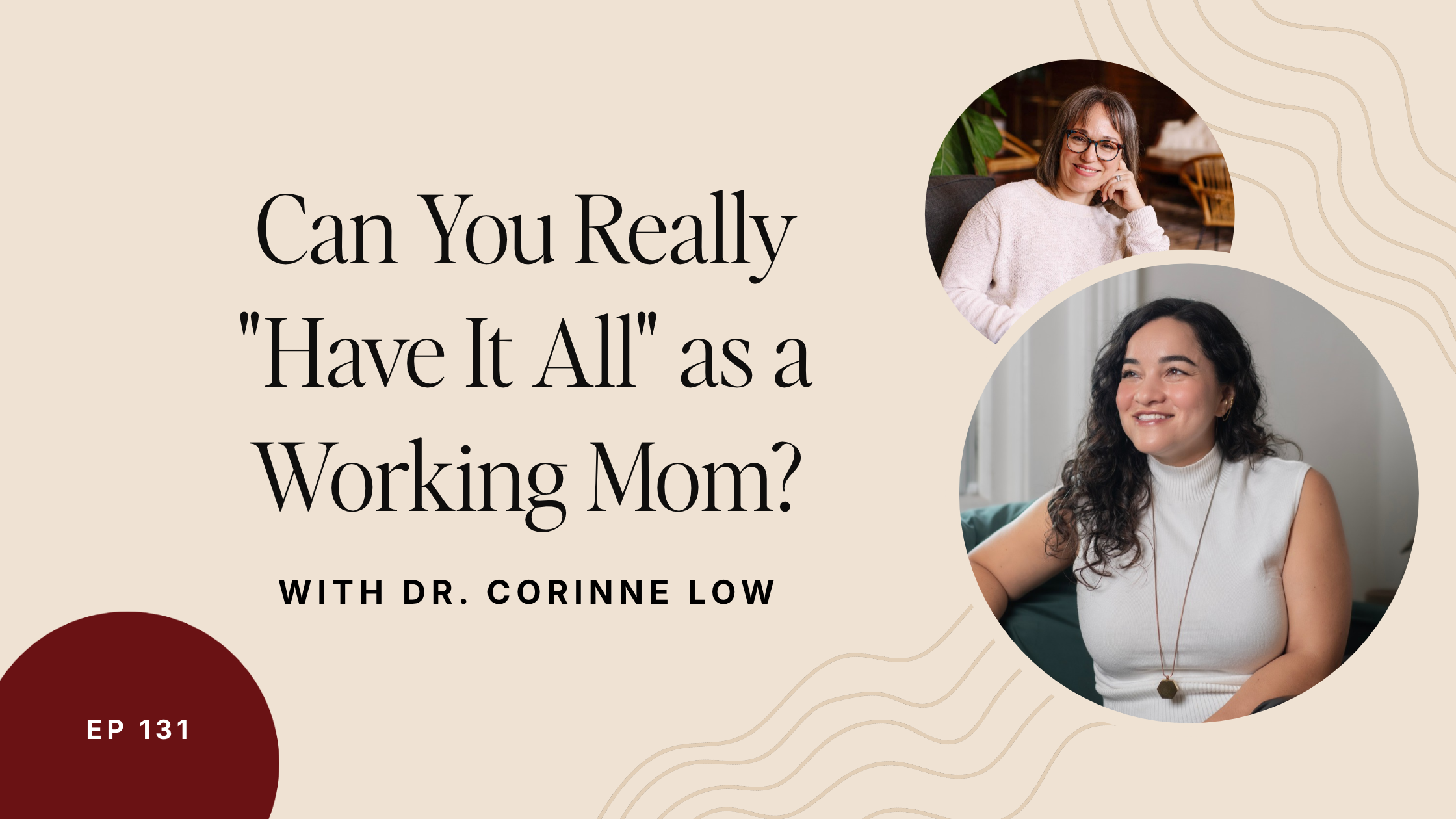
Episode 131: Can You Really "Have It All" as a Working Mom?
ITUNES | SPOTIFY
Working moms today spend more time with their kids than stay-at-home moms did a generation ago, while men’s time on housework has barely changed. No wonder so many of us are exhausted.
My guest, Dr. Corinne Low, is an economist, a Wharton professor, and the author of Having It All: What Data Tells Us About Women's Lives and Getting the Most Out of Yours. She uses data to show where our time really goes and what we can change about it. You’ll hear why chores are divided less equally than parenting, how to track your time and your partner’s without starting a fight, and why not outsourcing a task means hiring yourself to do it. You’ll also learn why most working moms want boundaries more than flexibility.
This episode is a must-listen for any woman who appreciates understanding the data behind how the system actually works, especially for working moms who are doing more than we've ever done before.
Links and resources mentioned in this episode:
Save Your Seat for Stress Less This Holiday on Nov. 5th - https://www.themothernurture.com/holiday
Get Corinne's book: Having It All
Download her Time Tracking resources - https://www.corinnelow.com/resources
Subscribe to Corinne's Substack - https://corinnelow.substack.com/
-
You are listening to the Life Coach for Working Moms podcast, the show where we are talking about what it actually takes to make life work as a working mom. I'm your host, Katelyn Denning, a full time working mom of three and a certified life and executive coach. I'm so glad you're here and I hope you enjoy this week's episode. I remember sitting in a sales meeting once back in my corporate days surrounded by a mostly male team listening to a colleague tell a story about something going on with his family and his personal life. And in that moment, it clicked for me. His wife was at home handling everything. All he had to do was walk in, do his work, be his best self. Meanwhile, I was not only doing that, but I was also juggling multiple kids, daycare drop-offs. I had no one at home taking care of those things for me. And I remember thinking we are not playing the same game. That moment resurfaced for me recently when I was reading today's guest's book. Dr. Corinne Low is a Wharton professor and economist, and the author of the book Having It All: What Data Tells Us about Women's Lives and Getting the Most Out of Yours This book, which I read earlier this year, gave me a new perspective on how I think about my time, and also gave me a new language for things that I have noticed and felt for years in myself and with my clients. Here's just a taste of what you're going to hear in our conversation. Working moms today spend more time with their kids than stay-at-home moms did a generation ago, while men's time on housework has barely moved. Chores are divided less equally than parenting, and that gap is wider than you would expect. If you have ever wondered why you're so tired all of the time, the data has an answer, and it isn't that you are bad at time management. As I said, Corinne is an economist, but she's also very practical about what to do. You'll hear how to track your time and your partner's without turning it into a resentment battle, a simple three-category list for deciding what to outsource, and why most women actually don't want flexibility. I will let her explain that one. So be sure to stay all the way to the end. Again, this is chock-full of not just fascinating data and information, but also perspective shifts and things that you can actually do in your real life that will change how you see your time and your calendar. As always, you can find everything that we talk about in this episode, including links to Corinne's book, her free time tracking spreadsheets, and so much more at themothernurture.com/podcast. All right, let's get into it Hello, Dr. Corinne Low. May I call you Corinne as we go through? Yes. Hi. Great. I'm so excited to have you on the show. , thank you so much for being here on the Life Coach for Working Moms podcast. Thanks for having me. And on a big day, no less. But we were just chatting about your huge announcement you won the Workplace Innovation Now Challenge, or one of the awardees for that, which is a significant amount of funding towards your Workforce Futures Lab, which is super exciting. Thank you so much. Yeah, it's really exciting, and it's gonna be an opportunity to take the work that I do about making the workplace work for women, work for working parents, and really scale it up and get it out to firms and policymakers. So yes, it is a big day. We're very excited. A big day, and of course my first thought was, "How does she do it? How does she do it all?" Which is so funny, because we're gonna get into your discovery and the data and your research that all is found in your amazing book, Having It All, , which I read earlier this year. As a Fair Play method facilitator, your b- book was, of course, recommended in our chat group. And then I had a client quote it to me in session, and I was like, "Okay, I have to read this book." Well, thank you so much. And yeah, I- it's funny 'cause it is ironic that I think the book was about my process of, I call it like Marie Kondo-ing my time, of really figuring out, like, what did I want this chapter of my life to look like, and being really intentional, and making changes to things that weren't working, and then sharing that wisdom of how I used economics to do that. But I am in a period right now where things aren't adding up. Mm-hmm. And I talk about that in the book, too, that it's like there are gonna be some periods in life where you're operating at minimum viable product, okay? I have not cooked a home-cooked meal for my family in a very long time. Yeah. Because right now there's big things happening, and, you know, we're just, , holding it together with spit and glue. Yes. Yes, yes. And I wanna jump right into that because I think what I wanna focus on most, and I wanna use the word tension, but maybe you have a better word for it, between personal choices, which I think we do a lot of focusing on here on this podcast and in the work that I do with my clients, focusing on the things that we have control over to change. But the difference between that and the systemic factors, , that influence or even constrain our choices. And I think I've heard you reference it as, , optimizing within realities, Yeah, or subject to constraints. Yeah, exactly. Yes, exactly. And so, one, I would love for listeners to hear from someone who isn't me what are those constraints. I of- often think of it as, like, the air that we are breathing- Mm-hmm ... The sea that we're swimming in- Yeah ... , that are the broader factors that are at play here. , and then we can get into, like you said, what are the choices, what are the things that we can consider when we make those choices within it? So I'm so excited to get into that. Maybe a good place to start, in your intro in the book you ask this question of, "Why am I so tired all of the time?" And maybe you're feeling that right now- Mm-hmm ... in this season where you have a lot of things going on. What did the data show you about that, that maybe your own personal exhaustion couldn't? Yeah, great place to start, and also just such a good framing because I think when I talk about making personal choices or, like, how you can try to find a little bit more expansiveness in your time, I really wanna be clear that I'm not putting the onus back on women to say, like, "You can solve this," or, "You can, , life hack your way out of this." What I try to do is to say, like, because the constraints are so real and because the deck is stacked against us in so many ways, I wanna give you permission to solve this however you want to and to pick and choose the things that work for you instead of putting that pressure on yourself to be all things to all people and to be the ultimate optimum that you can possibly ever see yourself being in that world without constraints, 'cause that's not the world that we live in. And so it's almost like a little bit of a pushback on that girl boss era that said, like, "Climb the corporate ladder," like, "That's the only thing that matters," and, like, "If you're not leaning in hard enough, that's on you." And I'm saying no, no, no, 'cause women are coming to the table with half a deck of cards, which is that the data shows that while we've had a gender revolution in women's time of women spending so much more time in the workforce, we have not had a gender revolution in men's time. So men's time doing housework has not changed. It's been entirely flat. And when you look in couples where the wife earns more money or even is the sole breadwinner, we still do not see the adjustment or the support from the lower earning male partner. One data point that, , really makes it stand out is that- , you know, a female CEO will tell me, "Well, the reason that this is possible is because I have an amazing husband. He really does half." And when you look in the data, if you look at female sole earners, their husbands do the same amount of housework as them, which is a miracle because every place else in the data, you know, women are doing twice as much housework as men are even when she earns four times as much as him, right? Mm-hmm. But when she's the sole earner, he does half. But when you look at a male sole earner, his wife's not doing half. His wife's doing 95%. Yes. So then think about how sh- she gets to show up to her job every day in the C-suite compared to the C-suite man who has all of that support being poured into him at home. Yes. I... Will never forget the moment that clicked for me. I used to be in a sales role, a very male dominated team, and I sat there with a male colleague hearing him speak about personal life things, and it clicked and I was like, "Oh, my gosh. His wife is at home doing everything. All he has to do is walk in here, show up to work and, like, be his best self while I'm juggling, multiple kids and daycare drop-offs and all the things." And it just, it clicked for me and I was like- Yeah ... this is not the same game. No, it's not. I mean, they have literally never thought of how do clothes get on my children's backs or how does a meal plan get made for the week that makes sure that we eat, everybody has snacks, there's whole milk for the one who drinks whole milk, there's 2% for the one that drinks 2%. Right. None of these thoughts occupy any space in their brains, right? And then you add to the fact that we haven't had this gender evolution for men, the fact that parenting time has skyrocketed across a generation. Working moms today spend more time with their kids than stay-at-home moms did a generation ago. So, you know, when I think about my mom who was a working mom with three kids and had a career and I'm like, "Well, how did she do it?" Well, m- my bedtime routine was go to bed, right? She sent us upstairs- And then she did whatever she needed to do, and then she had time. Yeah. And so we are still trying to play the same game at work, but the game at home has actually changed. And not for the better, right? Mm-hmm. It's actually gotten harder. We are actually trying to do more. , parenting time has doubled- Yeah ... across that generation. So where are those hours supposed to come from? Well, what they come out of is they come out of our sleep, they come out of our caring for ourselves, they come out of us being able to read books or you go for walks or do the types of things that, like, make us feel whole. Yeah. Can you walk us through or differentiate for us, the difference between parenting time and I'm gonna call it chore time, right? Like, the cleaning around the house. Because you're right, I hear that sentiment a lot of, like, "Well, my husband or my partner is doing so much. He's a great dad. He's really involved. He does the drop-offs or he's there for, you know, whatever." Yeah. But how that's different from- So- ... actually a lot of the examples you gave. So this was the data point that shocked me the most when I looked at the data, but then I found, I was like, "Oh, now I see some things about my own experience that I didn't even understand until I saw the data." That childcare and parenting is actually divided more equally than housework, than household chores. And you know working on Fair Play, talking about the mental load, I actually think things like sweeping, laundry, are a really good stand-in for the mental load of parenting, which also is not divided equally, because it's this routine, tedious, everyday work. It's not the thing that gives you that personal satisfaction of like, yeah, we like throwing the ball with our kids, or we like going to the park with them, right? Mm. And so dads do that, and on weekends they do it. On weekends, we see dads parenting time go up a lot, and their chore time barely move at all. So mom's- Hmm ... chore time goes up on the weekends, right? And then she's the sort of like un-fun, un-cool mom who's not outside throwing the ball, and Dad's parenting time goes up. And so that was the data point that I would never have predicted it going in, because I said, "Well, I get parenting," because at the time I was married to a man, and I had given birth, , to our son, and I was like, "I'm the one who gave birth, and, I'm breastfeeding, and I took more time off of work." And so like you form that, like you're the default parent. And so I was like, I get why economically speaking, biologically speaking, women might be doing more parenting, but I don't sweep the floor with my uterus. And so I don't understand. There is no justification, and yet when you look in the data, it's the chores that are most unequally divided, and that's what hasn't budged at all over time. So dads have increased their parenting time a lot, but I think they're patting themselves on the back a little bit too much because they're saying, "Well, I'm so much better than my dad because I read the bedtime stories and I drop off at daycare." But when you look at the gender gap in time, it hasn't closed because everyone's time has increased. Yeah. So they don't see that their wife is also doing way more than her mom, and so he's not sharing the load as equally as he thinks. I remember reading that and like rolling my eyes at myself, because I hadn't made that connection either. And again, I'm like I live in- And you were giving the gold star, right? You were like, "Oh, yeah, yeah. He's so involved." Yeah. Yes, and I, and I didn't think about the fact that I also was probably doing more than the generation before me, and so that gap, if, if at least stays the same, but probably is widening. Yeah. So it's that parenting has changed. It's not that the gender relationship in parenting has changed. Yeah. Where does this new- standard come from? I think the easiest answer is, like, social media, we're all trying to keep up with each other. But what is your perspective on that? I think it's a little deeper than that. I think there's some of that, and that's the stuff that I most want women to, , just, , let themselves off the hook for and just get out of there. Yes. Like, cross that off your list right now, right? Like, the bento box lunches- Yes ... and you know, the, like, oh, you've gotta, , make these, , handmade activities for your toddler to do. Make your own Uncrustables. I'm like, "No." Yes. Like, cross that right off, right? But there's a deeper change, which is just that we understand way more about child development now than we did when we were growing up. Mm-hmm. And so we understand that, like, holding your infants and talking to your toddlers and processing emotions with your, grade schoolers is important. And so economists would call this human capital development, right? We're actually investing in our children's human capital. And then there's a piece of it that is related to the structure of the economy, which is that the economy is very unequal, and it's become more unequal as the service-based economy has come to dominate. Now getting into the Harvard is gonna set your kid up for life in a high-paying job compared to the manufacturing job, which you can't buy a house with anymore, right? And so now there's more return to trying to help your kid climb up that ladder by making sure they have the grades and the extracurriculars to get into that school, and so that's what, , economists, , Valerie and Gary Ramey have called the Rugrat Race. It's like an arms race, so it's not actually productive, but it's also not something that you as an individual can stop doing, 'cause if you stop doing it, now your kid is behind. Yes. It feels never-ending. It feels relentless in a way. So what do we do with that, right? We could opt out of social media or recognize that we don't have to do all of the things, but at some point we have to make some decisions about what is valuable, what are the investments that we want to make in our kids, which does come with a time cost. And that's exactly right, is that I want moms to give themselves permission, and that's where knowing the constraints is important. I want them to give themselves permission to say, "This is what's important to me. This is what I think is valuable, and this is what's not," recognizing that there are trade-offs. So you might have an image of how you show love that's like, oh, the house has to be perfectly decorated for every holiday, and it has to be a big homemade meal, right? But you're not updating, the same way we're not updating about how dads are doing more, but moms are doing more. You're not updating, but saying, "No, no, no. I'm spending so much more time with my kids than my mom spent with me, so the way I show love is every night by their side reading them a story before bed." So maybe it doesn't need to be the homemade meal. It doesn't need to be those special occasions, right? So it's editing. It's saying like, "Give myself credit for all the things I'm doing, that I'm choosing very intentionally," mm-hmm. And then choose the things that I'm gonna say, like I have an image in my head that this is what love looks like, that this is what being a good mom looks like, but that's actually not the one that I'm gonna choose 'cause it's not the most impactful or the most meaningful for my family, mm-hmm. And then it's choosing the support that you need in this reality, the structure that you need to say like, "All right. I'm gonna choose that each kid can have one activity that requires driving a week," you have to pick one. Or I'm gonna choose if we have another activity, it's gotta have a carpool. And so yeah, it means you might like soccer less than flag football, but there's a family that we can carpool with for soccer, so guess what? That's the one that fits into our lives. And being willing to say, "My needs have a place in this equation, because meeting my needs is how I show up for you also." Mm-hmm. And so I'm not going to guilt myself into saying that this makes me a bad mom or this means I don't care about my kids. And I think that this is someplace we have lost the plot a little bit in modern parenting. Our kids are the protagonists of our households, our households revolve around them. And if you think about your parents, they were the protagonists of their lives. Yeah. You were the side character, right? You wandered in. You made, you said something cute. They were like, "Aw," and then you left again. And we need to reclaim our role as being a protagonist, and what I tell people is, you know, if part of what you wanna do with your kids is spend time with them so you're processing and you are building those socio-emotional skills, well, build it around going to the garden that you love or going to the art museum, and not always around them as the main character, because, , ultimately, that's actually not good for them. Yes. I 100% agree, and love how you articulated that. I was just laughing because I think it was two weeks ago, literally, I told my daughter we were gonna take a break from gymnastics for no other reason that our carpool buddies were taking a break from gymnastics. Yes. And I was like, "I- we can't do it. We can't do it without a ride." Mm. One of the things I'm curious about, because I love that you recommend time tracking- Mm-hmm ... which I am a huge advocate for that as well, and especially this idea of maybe tracking your time alongside your partner, too. Yeah. And I would imagine that as you look at that data, that information about how you're spending your time, you might also be able to see some of these things. Like, where are we centering our children before ourselves? And that's exactly right. Like, I tell people to, , take note of how you're feeling during that time, and also, , how does it feel with your kid? We'll get back to your partner in a second. But , sometimes what I notice is, like, when I am prioritizing my kid so much and trying to, , get him to the activity and make this happen for him and do this, I'm not actually being very nice to him. Mm. Because I'm saying, this is my nine-year-old. I also have a, a one-year-old daughter. Yeah. But yeah, so, and, like, I'm often like, "Okay, come on. We gotta find your shin guards. Let's go. Put this food in your mouth." Right? Yeah, yeah, yeah. And so it's interesting to just notice that, right? And to say, like, which moments of our day are the moments that feel like how I want our family to feel? Mm. And how do I create more of that? And so it's, , tracking your time, but also tracking the emotional content of that time, and then figuring out, like, put those smiley faces. And I have a tool on my website to do this, right? So you put those kind of smiley faces and sad faces, and then figure out, , all right, how do I get us more smiley faces? And make that a goal that as you track your time, to get more of that relaxed, connected time with your kids, , because there's these times where you're kind of mechanically putting them first, but you're not actually connecting with them. Yeah. And then getting to your partners. So I have two different spreadsheets for these two purposes. Okay. So one to just kinda think about how your time feels, and the other one to track your time with your partner. Mm. And both of these are experiments. They're not things I want you to do all the time. It's something that I want you to say, "I'm gonna try this for a week," or, "I'm gonna try doing this once a week for a month to see how it changes over time, and I'm gonna get the data." Because as I said, for me, I didn't realize some things were true until I looked at the data, and then I was like, "Oh, that is true." And isn't that shocking, right? Yeah. That organizing the closet is more gender unequal than the things that are actually biologically related to me giving birth to a child. So with your partner- It's an experiment. It's investing in getting data to shed light on how is reality living up to your intentions. Because you're gonna have the conversation first that says, "How should we be dividing this? What do we believe about what's equitable and what's makes sense with our lives?" 'Cause maybe one person's job really is busier, right? And you say, "Okay, so we are kind of agreeing that you're gonna have slightly more, but we think it's 60/40," right? So you're gonna say, "How do we think that this should be divided?" Always talk about leisure time- Mm-hmm ... because I think when it's hard, and people say like, "Well, it is hard because my husband's job is busier and he also earns twice as much as me, so, I do do more with the kids." Okay, but both people should get equal leisure time. Mm-hmm. And by leisure time I mean time where you are prioritizing your needs. You're the primary beneficiary. Leisure time is not baking cookies with the kids. Even if you like that, that's not leisure time. Yes. So have the conversation about what are our values, and then get curious and track your time. And what's so helpful about that is that then this isn't an attack. This isn't like, "I don't feel like you're doing this." It's like, "We said these were our values, and now here's the graph," because my spreadsheet makes graphs for you. Yeah. " And look, oh my goodness, isn't this surprising that there was some invisible labor. There was an iceberg where you were dividing the tip of the iceberg and really trying to carry that load with me, but it turned out there's more underneath the surface that you weren't seeing that I've been carrying, and now we can figure out how to divide it." Yeah. In Fair Play, and I know you talk about this too, making the invisible visible, and I think this could be a really great tool because the question is often how do I get into that conversation? How do I help my partner see what they can't even see? Like you said, what is below the surface of the water? And if you could present it as, I'm curious, or let's- Yeah ... try this experiment, or I'm gonna track my time because I'm feeling like there's never enough of it. Maybe we could do it together to see where we might optimize or find some efficiencies, and let that be your inroad to- Yeah ... a deeper conversation. And efficiencies is such a great word, too, because I think sometimes there's some things where it might actually be cheap for the other partner to take it off your plate, right? Mm-hmm. And it feels really hard and expensive for you, and so then that's a profitable trade. Mm-hmm. And so, you know, when you can actually make all of that visible, and then you're like, "This is all the stuff that's exhausting me," and then he's like, "Oh, actually, it's not hard for me to grab groceries on the way home from work," or, "Actually, I like organizing the photos, 'cause I don't mind doing the digital stuff, and, , I can take that off your plate," and you don't even realize that until you name that that's part of what that huge task list, the invisible running ticker tape- Yes in our heads is. Yeah, yeah, yeah. So on those lines, when we think about redistributing tasks, I think another thing that often comes to mind when we review time tracking data as well, is there an opportunity to outsource? Do you need to own all of those things? And I love how you describe , and reframe outsourcing. I think you say, , not outsourcing a task is hiring yourself to do it. Can you talk about that and how we might think about that differently? I'd like to take a quick break to talk about the holidays because they are closer than you think. Every year, working moms tell me the same thing, "I keep meaning to make a plan, to think ahead about everything that's coming and how I'm going to fit it all in, and I never get around to it." So here's my solution. On November 5th, I'm hosting Stress Less This Holiday, my live holiday planning workshop, and the ticket is really a spot on your calendar. You show up, I guide you through it, and by the end, you have your priorities, your decisions, your lists, and a draft calendar for the whole season. Women tell me they would never have made this time without signing up, and that's exactly the point. For $29, you're getting 90 minutes that actually happen, plus the workbook and my step-by-step plan. Go to themothernurture.com/holiday and get your ticket today Yes. So I am a big believer in outsourcing because when I look at men in high-powered careers, they do not do the sort of tedious daily work of running a household, right? Mm-hmm. Their wives might do it, but they do not do it. Mm. And so again, for us to be equals in the workplace, we have to get it off of our plates. And, I try to free people up from this idea that you're not allowed to outsource things, and this ... And it applies even if you feel like your income is somewhat modest. I ask people to think about, well, does your husband change your oil? And almost nobody says yes, because even very modest income families do take their car to the mechanic to get the oil changed because we've decided that his time is expensive enough that it's not worth it for him to spend an hour on YouTube and then under the car getting dirty figuring out how to change the oil, even though in reality anybody can do that themselves, right? It's not actually something you can't do yourself. And so I feel like that is a reality check to say, well, how often do we treat our own time as expensive, we're, we say, "Oh, it's too expensive to hire this person," but we don't say, "It's too expensive to hire myself," because every hour that I spend doing a domestic task that could be outsourced is an hour I could be turning into either money through my career or into utility, which is this, you know, happiness, this value, , your kind of objective in life, your economic objective in life. And so it is costly to instead choose to spend it on this task. And so I ask people to divide work into three categories Shared work that genuinely everybody in your household does, meaning if it's when the laundry's done, the kids put their laundry away, your husband puts his laundry away, you put your laundry away, fine. That's truly shared work that everybody does. If it's everybody cleans up the kitchen after dinner together, that's shared work, okay? Category one. Category two, stuff that you genuinely enjoy. If you say like, "No, it's meditative for me to darn socks or to, you know, make Sunday breakfast." Okay, and I mean enjoy in reality, because, like, I love to cook, but I don't love the mad rush burning pasta before soccer practice. So I mean like really like in this moment you actually enjoy, okay- Yeah ... category two. Okay. And category three is everything else, and I want you to try to outsource as much as possible of category three. Because notice I first took away the stuff that everybody's sharing, so category three is stuff that you are doing for other people, which means technically it is outsourceable, you have just chosen to hire yourself. Oof. And the question is, is your hourly rate actually lower than the service that you could use to do that instead? Oof. I bet that list is probably long for people. Do you think- And I'm not saying it's all gonna happen at once- Yeah, yeah ... but I wanna, I wanna clarify that that's the list I want you to tackle, and I want you to start thinking about why is my time, why in this household have we decided that my time and my time alone is cheap enough to spend on these tasks? So maybe you move it out of that category because , it gets redistributed across the whole household, right? Mm-hmm. But that's the category I want you to tackle. Do you ever hear, because I do hear this regularly, that maybe the woman is on board with that? They see that list and, and agree that, "My time would be better spent earning more money, having more time to devote to my career, and I would like to outsource," and the male partner is suddenly like, "Oh, well, we can't afford that." Right? And it's an interesting example that you give of the oil change, where we- Mm-hmm ... everybody finds it in their funds- Yeah ... to get their oil changed. Yeah. Why w- that difference? , and I hear it enough that I'm like, "Okay, this is a broader belief that we have." Yeah, and I think that that's the conversation that comes together with the time conversation, because We're gonna invest in this one way or the other, and it's either we're gonna put money into it or we're gonna put your time into it. Yeah. So if you tell me that you want to invest your time into this and that you can do it at this level of quality, and that's where Fair Play is so good about saying- Right "No, no, no, there's a quality standard. It doesn't mean, like, the kids eat Taco Bell every night for dinner," right? Right. It is up to this standard. So either you're willing to put your time into it, or you're just telling me that my time's not worth as much as yours, and no, no, no, no, no. Right? Mm-hmm. So I think it is surfacing that to say, , "We can't afford it, but we can afford for me to do it." Mm, mm-hmm. Yeah. It was interesting, too, in the part of the book where you talk about winning the bread and baking it, too, and the discrepancy between wages that we see, that the data shows. Why doesn't a higher income also shift the load? Yeah, it's, it's shocking because I know that I do sometimes... And it is the reality. I hear from women who say, "Well, my husband does earn more, and so we've decided that, like, I will do these things," right? But I, again, I want that to be an intentional decision- Mm-hmm ... and I want you to do the checkup on your leisure time, that you are getting the same amount of leisure time, right? Mm. But it doesn't change when you go to the reverse. If the woman is the breadwinner, doesn't matter if she's earning two, three, four times as much as the man, we still see her doing twice as much housework, and that is what I want women to change for themselves, by redistributing this work with their partner, by outsourcing, or in my case, upgrading from a husband to an au pair. Yeah. Right. Yeah. And, and you give so many great examples in the book, of creative solutions to outsourcing, , that, yes, sometimes it is a financial investment, but that there are out-of-the-box ways that we can also consider or categorize as outsourcing. Yeah, I mean, I'll just give one example that's totally free, which is with your girlfriends, do an I'll clean your house party. So you go over to their house, you have a glass of wine, you put on Bridget Jones or a movie you've seen a million times in the background, and you clean her house. And then tomorrow she comes over and does your house. Because for some reason, it's so much easier to clean somebody else's house. And so you get two nights hanging out with a friend, and your houses are both clean now. Yes. That's brilliant. It is always so much easier. I had a friend help me, , declutter my closet. I just couldn't make decisions- Yeah ... on my own, and I was like, "Could you just come over here and help me make these decisions? And I'm happy to do the same for you." Yeah. It's amazing. So you can't hire a professional organizer maybe, but you know, you do this instead. But again, I also wanna reframe that can't, because if you are trying to invest, if women listening, if you are at a precipice in your career, if you are trying to invest in making partner at the law firm or getting that promotion at work, in economics terms, closing that gap, that deal, right, is going to increase your permanent income, the amount of money you can earn for the rest of your life. And so making this investment now and giving yourself back time to be able to do it is like taking out the loan to go to law school. Mm. Like, we all understand that that investment is worth it, but now you're stopping investing at the finish line, because somehow we don't believe that it's worth it just to invest in our time. So I think I do want people to reframe , what they can afford. And I would say, the best way to save for retirement is by increasing your income. Mm. And so if you have a chance to increase your income- I would rather you actually save a little bit less for these next couple years, give yourself some of your time back, increase your income, and then make sure you ramp up your savings once you get there. Yeah, which is what you describe as the squeeze , and thinking about the timeline of it, and making some of these sacrifices in the short term or in this season- Yeah ... knowing that it won't last forever. And another chart that I wish I had seen when I was living it myself, because I was in that zone of financial pressure and work pressure where I was trying to get tenure at Wharton. My husband had left his job, and I became a sole breadwinner, and so money was tight. We had made financial decisions with two incomes, now we just had my income. And so here I was taking the bus instead of the Uber or, trying to cook from scratch or trying to fix something that broke instead of buy a new thing, and I didn't have the zoomed-out bird's-eye-view picture that I had later when I looked at this data that shows this huge hump in your time squeeze, it's only gonna last a couple more years. And so if I had said, "This isn't permanent," and something feeling financially unsustainable now is actually okay 'cause I don't have to sustain it. Because in a couple years the kid goes to public school, you're not paying for daycare anymore. And you're gonna be earning more money because you invested and you got tenure at Wharton. And you're gonna get some of your time back because the kid's not as young anymore and doesn't need as much of that intensive, you know, laying in bed for two hours trying to get them to sleep and whatever else, right? Yeah. So I want to give women who are in it that bird's-eye view to say it's not going to last and you need to be focused on, how do I get through the now and get through it with my earning power intact? Because my earning power is forever. So powerful, and you're right. It's information or conversations that I feel like are not being had at the- Yeah ... frequency that maybe we would like for, , women who are making those decisions- Yeah ... about what to prioritize in this season. Since you brought up work and career, I remember writing this down, and I am so excited to hear you explain it a little bit more. I remember writing it down because it was the opposite of what I thought was true, in that most women don't want flexibility, they want boundaries. Whereas I have always thought, well, what we all want is flexibility, right? To be able to pick up the kid or to pop in and out to what we need to do. Can you please explain what you mean by that? Yeah. So this is a, definitely, it's a big shift. And of course, we all need that minimum amount of flexibility to be able to, , call in sick when our kid- Sure ... is home sick, right? Right. So that's not what I'm talking about. But employers often say, like, "Women want too much flexibility, that's why we can't hire women." And in fact, I had this client that was a logistics company that said, "Well, women don't wanna do shift work, and they can't work overnight, so that's why we can't hire women." Mm. But it turns out nursing is 90% female. And wait a minute, that's a very inflexible profession. Like, you are at the hospital for 12 hours a day, and it's sometimes it's overnight shifts, right? Yeah. It works for women because it's structured, and it's predictable, and so they can plan childcare around it. And so there was actually research done on this where they offered women different types of jobs, and it had the flexible work schedule or work from home or this other option that was, called employer discretion, which is the employer gets to decide, , when you need to work. And it turned out women were willing to give up very little pay to have flexible hours or to work from home, but they were willing to give up a lot of pay to avoid employer discretion. They needed to know when their time was protected so they could plan childcare around it. Mm. And so that's where I say it's actually not flexibility that appeals to women, it's that we have let work become all-consuming, and so women are asking for the basics back, and we're calling that flexibility, right? The women are like, "Oh, I wanna be able to have dinner with my family." That's not flexibility, okay? That is a boundary. And when you think about it that way, that it's about structure and predictability, it puts the onus on management to plan in advance to be able to give women those things instead of saying, "This is a woman problem." Yes. Because right now it feels like it is so much on us to draw those boundaries, and that's, that's exhausting work, especially if you're working in a workplace culture where that is not the norm. You're swimming upstream. So oof. I have to sit with that. And I think thinking about, like, what really are your needs, right, And so for some women they say, , "Well, no, I am choosing a path where I wanna be able to work part-time," or, "I want to be able to do something kind of different." And by all means, if you're able to give yourself an alternative schedule and that works for you, that's wonderful, mm. But I hear that archetype being applied when for a lot of women what they want is actually the basics, is that they want, "I want to know my evening is protected. I wanna know that I can go on a trip for the weekend." Yes. The basics. That's not too much to ask- Yeah ... I don't think. Oh, if you are listening and you have that mind-blowing emoji pop up multiple times in this conversation, you will feel that times 10 or more if you read the book, which is how I felt. It was just so many shifts in the way I've always thought about things or new words to use. The language of, economics, which is not my native language, , was so insightful and, , and illuminating and just, again, new ways of thinking about things that we've heard over and over again, but in a very relatable way. So I appreciate you putting this out in the first place for all of us to have access to it. I would be curious as we wrap up if for the working moms who are listening to our conversation today, if they could change one small thing, what would you say? Okay, so I usually tell people, 'cause I talk about this idea of your utility function, which is what you're really maximizing in life, okay? Mm. And to figure that out, I tell people do this exercise, which is to close your eyes and imagine a world without constraints. So you're a mega billionaire. What does your life look like? How are you spending your days? What surrounds you? Okay? Mm. And obviously in that picture people will name some things like, "Oh, okay. Maybe I have, like, a really nice house," or, "I, take really nice vacations and I fly first class." Mm. Those are things you can buy with money. But then people will name a lot of other things like, "I spend a lot more time with my friends. I read more books. I go for more walks. I do more yoga. I take care of my body and my health more," right? Those are things that you can't buy with money, but that you do need time for, okay? So reframe of your objective in life, because it means your career is not your objective in life. Almost nobody, even people like me who say, "I love my job, and I love my job," says, "I would be working 60 hours a week in that world without constraints." It's like, no- Mm ... no, no, no. If I win the lottery, I will do my job, but I will do it 15 hours a week. Right. Okay? Right. So then what is my tip? What is my one thing to change? That picture is true wealth, and it's more than just financial freedom And so I can make you richer right now by taking something in your picture, putting it on your calendar, and committing to doing it more often. So let's start with once a week. So you pictured something that you wish that you had more time and space for in your life. Literally take that thing, put it on your calendar, protect it with your life. Protect it the way you would a meeting with your boss, because a meeting with your boss is about maximizing your career so you can make more money, so you can buy the things in your picture that bring you value through money. But there are so many things in your picture that you don't need money to get, mm-hmm. So we should treat that use of time as equally protective, and we should protect it just as much. So take one of those things, put it on your calendar, and do it, and as you do it, say, "I am being so productive right now." Yes. I am being so productive right now. No one is gonna make that time for you. No, and it is productive because it is actually making you richer, because that is what you just told me that you valued, that if you were rich, that's what your life would look like. So you can actually have more of that right now. 100%. To just share a personal story to that point, I mean, I read over 100 books a year now. I'm a mom of three. I work full-time, dual income household, right? But it started with a chapter every other day while I was nursing, because that was something that I love to do. It's how I was able to read your book, right? I- You are so inspiring. I read so- I'm like, "Oh, my God, 100 books." I mean, there's a lot of romance and fantasy in there, too, , let's be honest, but, Which is great ... I love it Like, that's what we want to reframe is that that is productive because- 100% ... if you pictured what would my life look like if I were rich, you would read those books. Yes. So you are making utility. You are making the economic currency of your life, which is not money, when you go and read those books. Yes. Agree. I love it so much. That's a great one. If you have just a couple of minutes- Yeah ... I have a few questions for the Off the Clock series that we do at the end of any interview to just introduce you on a more personal level to listeners. So first one is, are you a night owl or an early bird? Right now, because I have a one-year-old who still nurses- Oh ... I'm both. You're both. You're up all the time. Oh my gosh. Okay. If- Up all. Well, wait, in your non, in your non-having an infant nursing at home, what would you be? I, I think neither in that I really like getting eight hours of sleep, and in fact, like, when I used to work at McKinsey, I, , got so burned out and I was sick all the time, and then at some point I was like, "Hello, I'm Corinne and I eat three meals a day and I sleep eight hours a night." So I am a in bed by 11:00 and then maybe I'll be up at 7:00 or 7:30, but, like, I'm not cutting it short on either of those ends. Me neither. Okay. We're just, we are a person who loves sleep. So I guess to that end, when do you find that you do your most, , productive or focused work? Oh, that's a great one, and I think for a lot of people they will say that it's at night because the distractions have gone away. Mm-hmm. And that was my habit for a very long time is it's like once it's nighttime and my email's not pinging all the time and the kids don't need things, then I'm gonna really do the work for me. , and while I was on the tenure track, I did this training program that really helped me rewire that to say, like, "Why are you giving everybody else your best time- Yeah and then you're saving the crumbs for yourself?" Like, flip your calendar to give yourself the most productive time. And so now I try to block out, , when I first get to the office when my brain is fresh, I'm not gonna sit down and answer emails right away. I'm gonna do the thing that is the most important to me first. Yeah. Yeah. I love that. That's, that's also me, right, first thing in the morning. When it comes to any planning or list-making, are you a paper or a digital planner? Paper. Paper girl. All right. Love it. It just feels more concrete, and I feel like when I write it on paper, I think and it solidifies in a way that doesn't happen when I write it digitally. Yes. Yes. I'm right with you. , and then what would you do with an extra hour each day? Right now I would go to yoga because having a baby and a book baby in the same year has meant that that's been one of the things that's fallen off of my, like, recharge, if I were rich, what would I do? So, like, if you- Yeah ... if I got it right now, I would go to yoga. Mm. Love it. And so what does that tell me? It tells me I've gotta find space on my calendar for it right now. I was gonna say, there you go. You gotta put it on your calendar. Yeah. Oh, I love it. Thank you so much. This was so delightful and insightful. I absolutely adore, , your book and everything that you're doing. And congratulations on the award as well. So where can people go to learn more about you and to find your book, which is out in paperback, as this is airing? Well, thank you so much. And, , my website is corinnelow.com, and if you go to resources on my website, you'll find those time tracking spreadsheets. There's also a companion workbook to go along with the book. The book is gonna be available wherever books are sold. It's available right now with the new paperback cover, which I love, is gonna be available in bookstores October 13th. You can get it on Kindle. You can get it on audiobook, so you can listen at the gym or taking a walk, so you don't actually have to read it. You can get it on the Libby app from your library. , so I hope that people do find it. And, , I'm also on Instagram, and I have a Substack, corinnelowe.substack.com. Highly recommend all of those things. I listened to the book. I can endorse the narrator. It was fantastic as an audiobook too, and I do love the cover of the paperback. I think it's great. Congratulations on everything. Thank you so much. Thank you so much for being here. Great talking to you, Katelyn. Bye. Thanks for listening. As always, you can find everything from this episode in the show notes at themothernurture.com/podcast. And if you've been meaning to plan the holidays, this is your sign. Stress Less This Holiday is live on November 5th. Buy your ticket, hold the time, and we will plan it all out together. Go to themothernurture.com/holiday to save your seat, and I can't wait to plan with you
If you enjoyed this episode, you won’t want to miss what’s coming next! Make sure you hit the subscribe button to tune into future episodes.
If you love the Life Coach for Working Moms Podcast, I’d be so grateful if you’d rate and review it on iTunes! Simply scroll down, tap to give it a five star rating, then tap “Write a Review.” Your rating and review will help more busy working moms discover helpful episodes each week!
