
ITUNES | SPOTIFY
What if getting organized has nothing to do with buying the perfect bins and is simply knowing what you have and being able to find it when you need it. That's it. No new containers required.
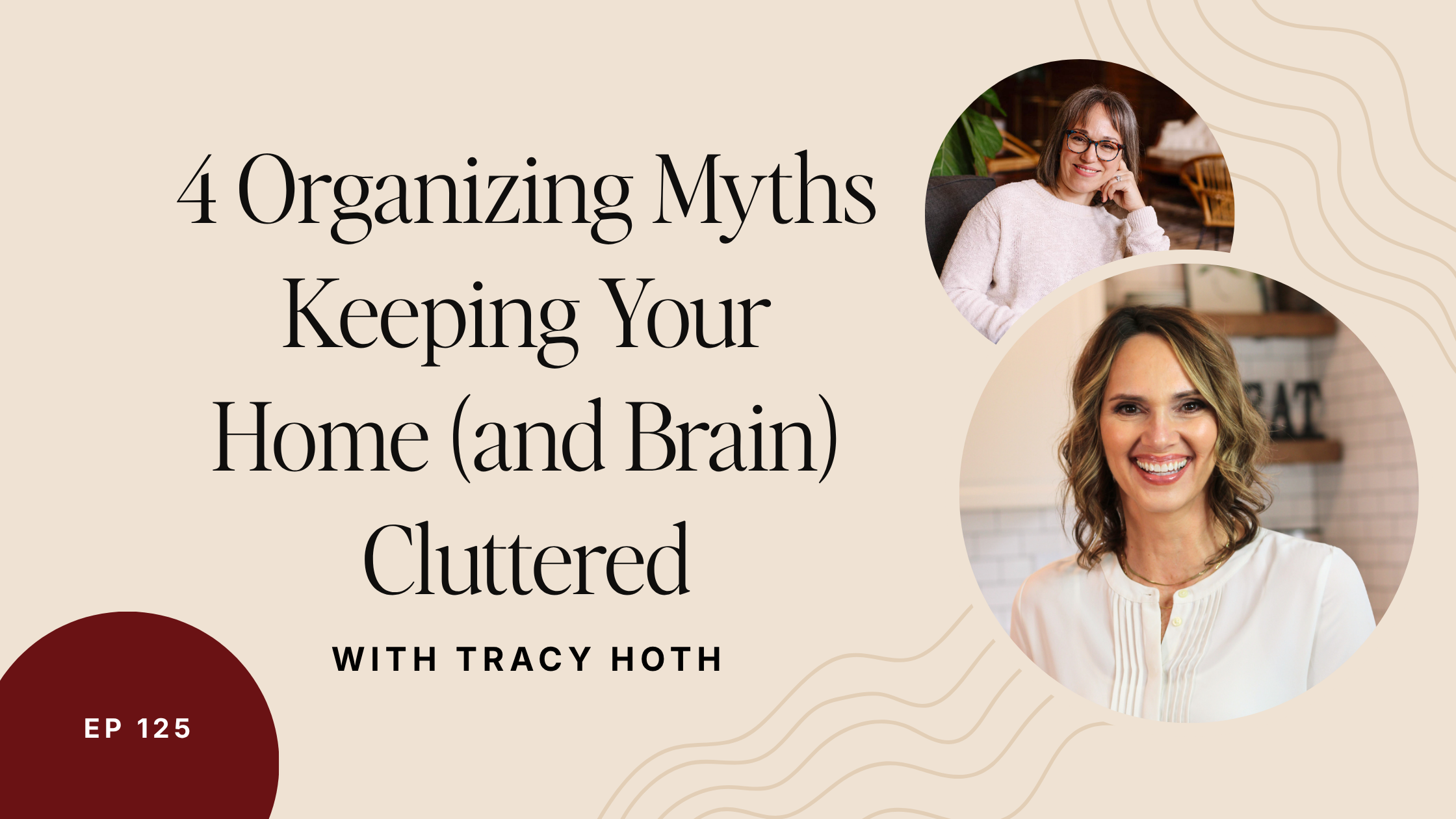
I sat down with Tracy Hoth, founder of The Organized Coach and Organized Life Academy, to talk about organizing your calendar, how to sort before decluttering, and what to do when you're paralyzed by a space that's been cluttered for years.
We get into her SPACE method, the real reason containers should be your last step instead of your first, and how asking what feeling you want a space to hold can guide every decision you make in it.
This episode gave me language for something I already believed: staying organized is ongoing, not a one-time fix. I'm walking away ready to treat my own cluttered spaces as projects instead of proof that I'm failing, and I'll be setting a 15-minute timer this week to prove it to myself. I bet you'll be ready to join me too by the end of this episode!
Links and resources mentioned in this episode:
Listen to Tracy's podcast, The Organized Coach
Grab Tracy's 15-Minute Declutter Challenge at www.simplysquaredaway.com/declutter
Learn more about working with Katelyn at www.themothernurture.com/work-with-me
-
You are listening to the Life Coach for Working Moms podcast, the show where we are talking about what it actually takes to make life work as a working mom. I'm your host, Katelyn Denning, a full time working mom of three and a certified life and executive coach. I'm so glad you're here and I hope you enjoy this week's episode. Hello, hello. Welcome back to another episode of the podcast. I am so thrilled today to kick off a series of expert interviews. I polled many of you on Instagram over the last couple of weeks asking who you'd like to hear from, what topics you'd like to learn about, and while the list is by no means complete I am very excited with some of the guests that I have lined up for the podcast in the coming weeks, and we are starting today with a conversation that has definitely inspired a lot of action in my life since we recorded, and it's on the topic of organization. It's a big, broad topic, I know, but Tracy was just the person to come in and give us some focus and direction. And I know that not just from our conversation, but then sitting down and editing this episode, I feel inspired again. And beyond inspired, I feel motivated to actually go do some things, and I have done a lot. You would be amazed. And so if you are someone who has ever said, "Oh, I just wish I could be a little bit more organized," or, "I wish my home could be more organized," or my space, or my calendar, or my Google Drive, or whatever it is, Tracy has real-life applicable tips and ideas and perspective shifts for you that I think will really land All of the links and everything that Tracy mentions in this episode, as always, can be found in the show notes at themothernurture.com/podcast. Be sure to check out those when we finish. But before we get into the episode, I just wanna quickly introduce you to Tracy Hoth. She's a certified life and organizing coach. She helps women simplify their homes, lives, and businesses through practical systems and mindset shifts so they can focus on what matters most. She's also the host of the Top 1% Globally Ranked Organized Coach podcast, which side note, I do enjoy listening to myself. She empowers women to declutter with confidence, create systems that last, and step into the role of organized life CEOs. I hope you enjoy this conversation, and if you'd like, please find me afterward to let me know what action step you are going to take to become a little bit more organized in your work and life. Hi, Tracy. Welcome to the Life Coach for Working Moms podcast. Aw, Katelyn, I'm so excited to be on here. Talk about some organizing tips and all things organizing. I'm so excited for this. I need my little notepad out just so I can take notes as we go. But I was sharing as we were about to hit record that I have actually known of you for quite some time. So one of my longest running podcasts that I listen to and love is called the Get Paid Podcast. And for anyone listening who's not a business owner, maybe it's not as exciting to you, but I love the show because she brings on these guests and gets really nosy about their numbers. And I heard you on an episode talking about, , calendaring. I guess I'll call it calendaring. You can correct me. I'm gonna turn it over to you in a minute. But it was this mind-blowing idea or concept that I have since shared and put into place for myself as well, where you described taking those recurring weekly and even monthly tasks that you need to do. But for so many of us who have a variable schedule, as in- Mm-hmm ... we don't have the same things happening at the same times every day of the week, it can be hard to say, "Well, I'm gonna reconcile my finances every Monday at 2:00." But you do wanna do that. And so you put all of these onto your Sunday, and then once your week falls into place with your appointments and your meetings, you drag that task into the spot where it fits. Am I describing this correctly? Yes. Yes. And I think I came up with that whole idea because, first of all, I love the power of one. You already go to your calendar. You already look at it constantly, or I do. Mm-hmm. So I don't wanna have to go somewhere else to remember what my tasks are and the things that I wanna get done. And so I just put those things on my calendar. And you can put them on any time. The reason I suggest Sunday is because a lot of people plan their week on Sunday. And you can make them recur. It's very easy to have it set up the way you want. And then when you plan your week, you just can see, oh, here it is. Here's when I can do this task, and you just drag it into place. Are you doing that also with ad hoc tasks and projects, like a one-off thing, or is that a separate step in the process? I would do that with that as well. Okay. Like, throw it on when you think you can do it maybe. Like, when it comes to your mind, get it on there, and then when you look at your day, you'll see, oh, well I thought I was gonna be able to do it today. I'm not gonna be able to, so drag it to the next day or whenever it is that you wanna do it. Mm-hmm. I think the thing that it changed for me most was I would have these things that I only needed to do once a month. Like, I'll give you a silly example. I am on the PTO, , for my children's school, and because I do emails in my business, I was like, "Oh, I can do the PTO newsletter that goes out every month." But I was always scrambling or forgetting, "Oh, shoot, that needs to go out this week." And so I was able to put it on the Sunday before the week when I would need to write it, recurring every month, and it was this visual reminder when I opened up my calendar, oh, this is the week where I need to be putting together that newsletter because it should go out by, Friday or whatever it was. Yeah. I do the same thing for content creation for my Organized Life Academy. I have new content that comes out every month, and so I have a recurring task, but when it shows up, I'm not always able to do it at the time that it's on my calendar, but I can easily move it to when I want, but I d- I'm not forgetting that I need to do that. So it's been great having that. Now, what I have noticed is we become aspirational, and we put 47 things on there, and then our brain just overlooks it and doesn't really plan it in. So you can start like that. I think that's maybe a little bit natural how people wanna do. They put all these on there. But then take them off. After two months and you haven't even done it, take it off and just begin with a couple things that you are consistently moving to where you wanna get them done and doing them, and then go from there, adding additional things as you go, as you get good at that process. Mm-hmm. The thing that I have been working on with so many clients right now is doubling the amount of time that we think a task- Hmm should take. And I know that's so hard to hear. We're like, "No, I can do that in 30 minutes." Yes. Maybe, and then you'd have extra time, but- In a lot of cases when we go to plan our weeks and we think about, , being overly optimistic about our time, I find that if you double it and say instead of 30 it takes an hour, and let that be the block that you're putting or dragging onto the day where you can fit it, you tend to have more success. And then like I said, best case scenario, it goes faster than you thought and you can do something else in addition. Right. And I think that's why so many of us avoid looking at it and planning because we're afraid to see, oh, if I do that then these other 10 things I wanted to squeeze in there aren't gonna happen or they're not gonna be able to get done. So I'm reading the book Essentialism right now and I'm like- Mm ... yeah, then that's the whole point is that we don't need to do those things or we need to choose intentionally which ones we're gonna do. Yeah. That's a great book by the way. I'll put the link to that in the show notes. Highly recommend it. Mm-hmm. Um, and it can be hard to hear or hard to read because we wanna do all the things. Right. But the reality is they just don't all fit. And the reality is too, that I think I'm inspired by because of it, is that we get to finish things. We get to do them. They're moving us toward our purpose and the point of whatever it is in this season of life, and so that's kind of exciting- Mm too, to be able to see it in that way, that it's really beneficial and I am going to reach the most important purpose, goal, whatever you wanna call it right now, because I'm doing that, making those choices. Yes. Yes. I mean, that's such a great way to flip that- Yes ... and think about it. It actually reminds me of something as I was preparing for our conversation today that I saw that you wrote or talk about on your podcast as well, about deciding what you want your space to feel like or the purpose that you want it- Mm-hmm to have before you even get into any of the decluttering or organizing, and I assume you could apply this digitally as well. Yeah. And I think about your calendar also, right? If you do limit things and you're just focused on what you can actually finish and move forward. In, in a similar way, or at least to me it reminds me of that, what is the purpose of my space too? Yeah. And this, that all started recently, well, I don't know, a year ago, when I had this kind of vision for this period in my life. My youngest is 22 now, so it's a new season of my life, and I pictured people around the table, around my table. Having couples over, having family over that's growing. And I all of a sudden just felt so clear about I want a big table. I sold all this big office furniture we had in our front room, and I transformed that room into the dining room. And it has a big table, it has this beautiful piece of art that every time I see it I am so inspired by. It has a beautiful buffet at the end, and pretty curtains and windows. And that's it. There's nothing else. Oh, two lamps. There's nothing else in there. And then the other room that was the dining room, the purpose of that room is for me to sit. There's two chairs. It's to sit with someone and listen to their story. Even the other morning, I just sat on the phone with a friend I hadn't talked to in forever, and just sat and listened. And there's a picture of art up there that inspires me to tell your story, to listen to other people's stories. And I just sat there and I enjoyed that moment of listening. And now every time I know, does this belong in the purpose of this space? And so you could ask that same question for your calendar or your bedroom or your closet, and does it belong in the purpose of the space in this season? And so you get really clear, and then it's not, "Oh, I can't do all this other stuff." It's like it just doesn't belong in the space. Mm. That's brilliant. I, as you're talking, I'm picturing, thinking about the different rooms in my house. Yeah. And we are at a transition point in our season of life in that we don't need the baby toys. We don't need the childproof stuff. We are starting to look at a lot of our spaces, and the question that's so great that you mention that, because the question when I look outside my office door to my kids' play area is, how do I make this the space where my teenage kids, they're not there yet but they will be, wanna bring their friends over and hang out? Right. Like, I wanna be the house that's full of kids up on the third floor of our home just hanging out. And so what stays? What no longer serves that? And how do we create this? And it's- Yeah ... it's exciting, as opposed to feeling maybe sad or sentimental over some of the things that we are no longer in need of. Yes. And don't skip those feelings. Of course you're gonna have time to remember those sweet moments. And, and then with that clear vision, I mean, I see these teenagers hanging out, and what do they want? And then you, uh, you just know what belongs, like a fridge with snacks. Right. All the snacks. A, a big couch, like a place to play games or whatever, gaming equipment- Yeah whatever it is that they're gonna be doing up there. But then you just know, like, this belongs in this space, and it's got a clear purpose, and it makes it so much more exciting. Like, I am so drawn to let things go because I know what belongs. Mm. And the other question I've been asking myself is when I look at an item, does this make me feel elevated? Mm. Now, elevated is a word that works for me. Some other people might not think that's the right word, but I wanna walk into my space and just be floating because I love it so much. And so does it make me feel elevated? So a scrappy piece of something that has no history with me, I mean, it doesn't. It- I'm like, " Ew, I don't want that in here." So now it makes it easier for me to, to say, "No, I don't want this. I wanna feel special." And I think about it with, like, bathroom items, skincare things you bought that you thought you were gonna use. Mm-hmm. And now you have all these half-empty containers. Like, I want only the most things I love to be there. And I open my cabinet and I'm like, "Ah, this makes me feel elevated," like I actually know what I want. Yeah. That's a great question. So is that an exercise that you recommend or that you coach people toward, is thinking about the words or the feelings that you wanna have, not just the purpose of the space? For sure. And I think it kinda ties together, at least for me when I think about it. The purpose of that space gives me a feeling. Like, I can picture couples around my table, family coming over. That gives me this feeling, and then the questions kinda help as well to create, to bring back maybe, to remind myself of the feeling that I wanna have in that space. So then as I go through the organizing steps, I can be remembering, what is the purpose? What's my calling? What does that look like? And do these things belong? And it makes the whole thing more fulfilling. I like to think of organizing as a healing process or a journey that you go on, that even the journey itself is fun and it has purpose versus just getting to the end result. And so that whole process then has meaning. Mm-hmm. What does it even mean to be organized? It's a word that we use all the time- Mm-hmm ... I think without a lot of thought behind it, and I hear it so frequently from the working moms that I talk to as one of the things that they desire most. I wanna be organized. I just wanna get my life organized, or I wanna feel more organized. What does it actually mean? Do you have a way to define it? I love defining the word organized as knowing what you have and being able to find it when you need it. Mm-hmm. So that definition alone, a lot of times people that are listening will, you know, their shoulders will relax and they'll be like, "Oh, well, I actually can think of some instances where I am organized. .. Hey, maybe I'm more organized than I think if I look at that definition." Because I think a lot of the times people think organized means that it looks like a picture, that you have perfection, that you follow everything to a T, and then no one is ever gonna feel organized. So it's just knowing what you have and being able to find it when you need it. That's it. Mm. So If you're talking with someone who has maybe a couple of instances when they hear that definition, like you said, they're like, "Oh, well, I, I could do that in my closet or maybe in my kitchen. I, I have what I need. I know where everything is." But I have these areas, I think we all do, where the shame comes up. I'm picturing my Google Drive, you know- ... that is a total mess. Um, I'm picturing the closet downstairs , in the bedroom that two of my children share, and the other day I went to put something away in there, and it's one of those, like, just slide the door closed. Oh my gosh, that's gonna be a weekend's worth of sorting. Yeah. Where do you start when you've got maybe a couple of examples of places where you can find the things that you need, but then you have this other list of areas in your life where, oh my gosh, that just is an overwhelming project? Yeah. So a couple things come to mind. First, I treat it as a project. Mm. So when you're going to do a project, you just set a date, you set a time. Maybe you set a end date. You get it scheduled on your calendar. You know the steps to get organized, and we can talk about that. My steps spell the word space. But you know the steps. You just follow the steps, and you can get to the end result that you want. So it's just a project. But also note that you knew what to take to the closet. You knew what belonged in that closet and where to put it. I mean, even if you're just shoving it in there. So in a way you are organized because you know what you have. You can find it. It might take a little bit longer to find it 'cause it's not- ... like all contained perfectly. But even in that you can see, well, I know what goes in that closet. I knew to take that thing down to the closet. So I have a- Though I have so much resistance though when you say that. Yeah. Because I'm like, no, no, no, I'm not organized. That closet... Maybe I should rephrase that. That closet is not organized. Yeah. It's a total mess in there. Yeah. And I feel embarrassed. Yeah. Even though no one is looking in my closet. I'm not letting guests in there. My children don't care. Right. But it brings up so much. Yes. Okay, so in that instance you want to make it more beautiful. You want to purge it. You wanna get rid of things. You want them to be more able to be found, and maybe even you want it to be visually appealing. Sure. I then have my clients find something in their life where they're organized. So I have an example of a client who, whose house wasn't organized, and we started talking about... Because we'll never get more organized than our identity. So if we don't even think of ourselves as organized, we're not gonna be able to create organized spaces if we don't think of ourself like that. So I was helping her, , asking her, , "Where else in your life are you organized?" And you gave me a couple instances. She gave me, like, how she, , plans vacations. She always meticulously plans her vacations. At work she was very organized. Mm. So she knew. She all of a sudden is like, "Oh yeah, I actually, I'm really organized in those areas." So what is causing that organization? What are you thinking and feeling? What do you believe about yourself in those instances, and can we pull from that to bring it into another space, another instance? So for her, it was more she also remembered that she always had a messy room growing up. And so for some reason that has stuck with her that she's not really worthy of having a organized home, because she was always the messy one. Mm. But when she saw that she could be organized in these other areas, all of a sudden, , her whole identity shifted. Like, wait a minute, I actually am organized. I now just need to treat it like a project, pick one spot that I wanna work on, follow the organizing steps, get better and better at them, and create organization. , create a beautiful space , that she wants to have organized, and now she's doing it. It's, , so fun. Mm. So it's that identity shift, or using those examples of the other areas of your life. Now that you say that, I hear that a lot too, and I don't know if you notice this as well, but I find I will talk to a lot of people who are fairly organized in their professional life. Mm-hmm. Like their work inbox, they've got folders, and they're on top of it constantly, or they're doing a project for work and they are on it in terms of the deadlines and the different pieces that go into, all of the people that you manage and the deliverables. And then they look at their personal inbox, and there's thousands and thousands of emails in there, right? All this junk that comes in, or, some project that they're working on at home and balls are dropping , and all of the you know, nothing is going according to plan. And I find it so fascinating that we do have these examples- Mm-hmm What do you think is the difference? Is it just we have more time, we're being paid at work and we're not at home- ... we're more exhausted when we get home to do our personal inbox? Like, what's the, what's the split there? Well, I think it's probably a little bit of e- all of those things. We also have five people, or however many people are in your family. I don't know why I said five, five. I have five, yeah. Yeah, yeah. We also have other people that play into it- Mm ... and all of their stuff that's in our space. So if it was just us, maybe we would be way more organized looking at home. But then our time is split too as well. So that's why I say, like, just pick one area or one project and have that be your focus. And I always think of the example of dribbling 12 soccer balls down the field toward the goal. If you had one that you were dribbling, you would be very focused. It would be easy for you to get that ball to the goal. But if you have 12, it's not. Mm-hmm. And so at home it's a little bit like that. So then let's just prioritize what area are you gonna focus on organizing. Remember, that just means knowing what you have and being able to find it, and then go from there. I gotta say too, I think about my own space, and I was just wondering about this. I have a room in our house, it's where we put clutter, which is delayed decisions. Mm. We have that space, and it's a attic space off my boys' room, so we always called it the secret room because it was kinda their play space at one time. And we put things in there. Kids put things in there as they've changed their room around. We put things in there that we don't know for sure if we wanna get rid of, so we haven't made a decision yet, so they're in that space. Now, if you walked in there right now, it's a complete mess. You walk in there and you're like, whoa. Like, all this stuff's crammed in there. But I don't think of myself as disorganized, and I, wouldn't care if someone saw it because that's where we put our clutter. , that's the space designated. If we need to find something, we know it's probably in there if we've put it in there, whatever. But I also know that I can just set a time on the calendar, and I do this maybe once a year, set a time on the calendar and make sure someone's around to help, and then we go in there, we follow the steps, and we take care of it. We get it organized again. But then just the season of life, I think of a garden. Like, it just grows weeds again. Mm-hmm. We bring stuff into our house. We make changes arranging stuff and activities that we do, and it just gets full again. And so that's just a normal part of life. But I, I don't think of myself as disorganized because that's messy. Mm. I just think I haven't put it on my calendar yet to get it done. Yeah, that's a very different thought process or belief that you have about a space that, uh, somebody else might choose to think that supports. I'm a mess. Yeah. Yes. I'm a mess. Yeah. My life is a mess. I don't have my together, right? Well, and that just makes us all consider, like, okay, so if organized as a feeling is what we're thinking- Mm and I'm thinking, yeah, I can organize that any time I want. I can go in there and do it, but it is kind of organized by definition, but it's my thought about myself. I'm, I'm organized. I know the steps. I can do it whenever I want to. I just haven't put it on the calendar Do you have any questions that you ask someone to help them choose the space that they are going to then- Mm turn into a project? You mentioned- Yeah ... just briefly, well, it's just, you know, prioritizing. What if someone feels so overwhelmed at that stage, , how do you help them choose to start with the junk drawer, the sock drawer, or the linen closet, or the kitchen over something else? Yeah. I like to ask a couple questions. First, is there a space that would just make you so happy if you had that done, and feel so accomplished? So that's one thing, like what comes up what's your first answer? The other question is, what's causing the most friction? So if you're getting in fights and you can't get out of the house in the morning because of the kitchen, or maybe because of your closet, whatever it is. Like, whatever's causing you the most friction, start there. And the other little thing is whatever's gonna give you a win, whatever's gonna be easy. So like a bathroom, a half bath might be really easy, 'cause there's no sentimental stuff in there. There's nothing really emotional. It's just like maybe getting rid of some trash. Deciding, again, I want this space to feel elevated. I wanna have three extra hand towels, a spot for toilet paper refills, and maybe like an extra soap. Like that's literally all I need in there, and I can know everything else just goes away. Mm. So that would be easy. I do a 15-minute declutter challenge where it has the organizing steps. It has everything on there, and they can just pick something, work on it for 15 minutes. If they don't finish, that's fine. Come back the next day, whatever it is, and just do a little bit at a time, and that has been so helpful for people. Kind of shockingly to me that they never realize how much you can actually get done in 15 minutes. So let's say the kitchen was your spot. I would just say, "Okay, go drawer by drawer, cabinet by cabinet, or category by category." do all the glasses. Then the next day in 15 minutes, do all the cups. And the next day, do all the baking supplies, or however you wanna do it, just go category by category or drawer by drawer I think a lot of the spaces that probably, at least I hear and I've experienced in my own life, answer that question of what would make you feel really happy to have completed or what area creates the most friction. I often sometimes ask the question, too, of like what area are you really tired of telling yourself, "I need to," or, "I should do that"? Ooh, that's a good one. Like, I'm just tired of hearing myself talk about needing to organize the basement. Let me just finally do it. And so the basement and garage are two... I can think of multiple clients right now, if you're listening, you know who you are, who that has been on their project list. Like, I really just wanna get the basement purged and organized, or the garage, I wanna be able to pull a car in. And those, to me, feel like big spaces. Yeah. And I'm thinking, that would be so many 15-minute blocks of time that I'd have to have. But I think probably the reality for most of the people that you and I both work with is we just don't live in the reality of having an entire weekend to do a project like that, or having even four hours to dedicate. And so maybe, d- I- I don't know if you agree, but it's like you can either do it 15 minutes at a time, or you can just continue to live with it as it is. Yeah, c- spending an hour every day beating yourself up because you haven't done it. Mm-hmm. Well, a good example of this is a woman that had been stuck in that same feeling of overwhelm. Hers was paper. It was all over her house, and she was just stuck there frozen, not being able to do anything. So we made a plan, and we set up the things that she was gonna sort into, like some main categories of paper, and she committed to sorting five pieces of paper every day. And her plan before was, "This is so overwhelming. There's so much. I'm stuck and I'm frozen." Her thought then became, "I have a plan. I just have to sort five pieces of paper." And that literally changed her life because she committed to that and she would do five pieces. Of course, some nights it turned into an hour if she had time, but she worked full-time. She was a caregiver to her husband. She had a teenage daughter. Like, that's what she committed to, and that will change everything. And she organized every piece of paper in her entire house by starting there. Yeah, 'cause five pieces of paper is nothing I know you think that, right? But then it's everything. What if it is everything? Right. Just like 15 minutes is nothing. Yeah. And so it becomes this belief of, "Well, yeah, I can do 15 minutes," or, "I can sort five pieces of paper. Anybody could sort five pieces of paper." Right. And so then you're more likely to do it as opposed to, "There's no way I can sort this entire garage." Yes. In the first 15 minutes might be you walk out with a notepad, and like I think of my garage. I walk out, I turn to the left from in the kitchen, and there is, is shoes. I could do shoes in 15 minutes or I could, grab some people when they're home. Like my daughter was just back at my house. She lives in an apartment, and she came back and I go, "Oh, can you look at your shoes here?" And so she donated three pairs and threw one away and took two with her to her apartment. And so all of a sudden that's done. That took five minutes of just me asking her that. And then next would be there's, , some sports supplies there, like that would take 15 minutes. Request the help if other people have to make decisions. You know, get it on your calendar and just say, "Hey, Saturday , can we go through the sports supplies?" You know, versus- Yeah ... we're gonna do the whole garage and everyone's depressed about it. Right? Nobody's available all of a sudden. Right. Right. Yeah. And you can just go category by category. I love doing that, like in my closet. Just pull out all your pants. Try them on, go as fast as you can, make decisions, put your favorites back first, and give them a home. And then you can go from there, and then the next day you just pull out your tank tops or whatever category you want. Mm. Okay, this is me being selfish right now, but I know I'm not alone. What do you recommend in terms of moving the items out of your home? I have gotten much better at the sorting piece in small pockets of time. In fact, this came up in one of my group programs recently. Someone took a snapshot of their foyer right inside their front door, and it was just lined with bags of things that needed to go to different places, right? We're returning that to the family, or this needs to go to Goodwill, or this needs to go to the Buy Nothing group. And she was like, "How do I get this out of my house? I never can remember." Or mine'll sit in a pile, and It's a delayed decision- Yeah ... of what am I, where does this actually go now? I know I don't need it, but what do I do with it? Yeah. Well, make it as easy as possible. Mm. And some people have resistance to just donating it to the local donation spot. They're like, "Well, they make a profit." I'm like, "That's fine. Someone is gonna go in there, find your expensive item and resell it to make money for her family." , just believe that when you let something go, it's gonna find the right home. Mm. So make it easy, but then also you gotta put it on your calendar or write it down. Like, my one activity yesterday was to drop off, we had 10 bags of clothing from my daughter and my closet. It's a little embarrassing. Her boyfriend was like, "Whoa, this is ridiculous." And our closets are still full. But we had a church does a giveaway every summer, and so it's like, uh, okay, my one thing I'm gonna do is go run this errand. I'm gonna drop those things off on my way to my walk or whatever it was. Mm. And so we just have to get it in our car and drop it off. But yeah, I do notice that people will have like, "This goes to my sister-in-law. This goes over here. I'm taking that there." And that's okay. I mean, it's ... Remember, it's organized. It's there. You know what it is. You can find it. Now you just have to get it to where it's gonna go, which might take a couple weeks because you're not gonna see them or whatever. But put it on your calendar. This is what I'm gonna do. I like putting it in my car because then I'm reminded to- Mm-hmm ... drop it off when I'm out. Yeah, . That was definitely one of the ideas that was tossed out. Um- Yeah ... yeah, I, it really is like a task, , an appointment that needs to go on there. Because you're right, soon it just blends into the background, and those bags in our foyer become a part of the decor in our home. And so- Yes. And that's another. That's a 15-minute task, right? Mm-hmm. So at the end of you finishing that area, the next 15 minutes is go drop this off. Yeah, . You mentioned your space or spaces method- Mm, mm-hmm ... for organizing. Could you take a minute and walk us through that? Yeah. If someone's feeling excited, like, oh, okay, 15 minutes, but how do I actually do this? Right, and this works for every single thing. It works for your digital stuff, your physical spaces, your brain. Every time you feel overwhelmed- Mm ... use these steps. It works for planning a project, everything. The first step is always to sort. You sort everything. As you pull it out, you sort it. So even if I was just pulling out the pants, I would sort it into dress pants, leggings, jeans. You know, sort it into categories. It's not categories like donate, sell, throw. Oh. That's making decisions. It's just what is this? Is it a book, a piece of paper, an office supply? And then sorting it into that. Even when I'm on my mind, I'm sorting into errands I need to run, calls I need to make, this work project, this home project. I'm sorting tasks. Even this worry- There's a worry category. There's a thought category. So you can sort into categories as you take things out of your mind as well. But always sort. That gets you started. And then the next step is to purge. The P is purge. And this is where I like to align it to what your vision is and choose your favorites. Those two methods are really helpful in asking questions like, does this make me feel elevated? Does this serve my purpose at this season of life? And then you can look at the other stuff that remains. Now that you know what you're gonna keep, you assign homes to it. So sort, purge, assign homes. Decide where it's gonna live. And then contain. Contain is where people usually start. They go buy cute containers- Mm ... and they have all this stuff now that they don't even need. It doesn't even fit where they decided that it was gonna live. So don't buy anything, and I always say shop your house first, because you probably have some containers that you just emptied out when you sorted. Totally. A- and then so containing is really good because it gives you the limit of when it fills this container, which could be a, a basket or something, but also could be a shelf, a drawer, whatever it is, then you know you need to go back through the steps. So my sock area in one of my drawers is pretty full. It's a cue to me that I need to go through that and sort and purge again. So sort, purge, assign homes, contain, and the last step is energize. And I first think over celebrate the fact that you just did these steps, and now you have the energy to use it on what's most important to you. Like, what is it that you wanna do or spend the energy on? And then I always think to maintain that energy to be spent in your life how you want, to tie it to something you already do. So at tax time, you do paperwork, so go ahead and clean out your files. When you go to the gas station, go ahead and empty the trash out of your vehicle. When you buy groceries, clean out the fridge before you put the groceries away. When you do laundry, tidy up one section of the closet. So all those little things, you're tying it to being the organized person who maintains that space. Mm. What are your thoughts on organization, going through the SPACE method, being an ongoing or lifelong task? Do we ever reach, like, org- organized and done? I think, I think of this like laundry, meal planning, the garden. I mean, it's just a maintenance issue, 'cause we're always bringing stuff into our house. Which I think then I become a lot more careful about what I bring into my house. Someone will offer me something for free, and I'm like, "Ugh, where is that gonna live? Do I wanna spend the time to manage that thing? Do I really need that thing? Is it essential? Does it fit with my purpose?" And all of a sudden I'm like, "Ugh, I'm tired just thinking about that. I don't wanna bring it in my house." So I mean, people might have noticed that they're purchasing and getting things as a buffer maybe to not feel certain emotions. So maybe they're over-buying, over-bringing things into the house, and that's a totally separate issue that we can address. But maintaining it just becomes then a practice that you do to keep your home the way you want it. Yeah. I just asked that question because I think sometimes we fall into this belief or this idea that once I organize all of my kids' toys and get it- Oh, gosh all into the right basket, right? That's a big one. Or kid clothes, right? When, you remember, when they're just growing- Yeah ... so fast and the seasons are changing. It is like laundry, I love that example- Yeah ... in that you're never fully done. It is not a one and done, set it and forget it thing. And when we shift the way we see that and accept that, it doesn't become this personal failing, it's just, yeah, we are changing, or we bought a few extra things and now that drawer is full. I got a bunch of socks for Christmas. And so it's time for me to let some of those go, that when we see it as this ongoing task or project or whatever- Right ... we wanna call it, that- that it's okay. It's not necessarily something we're doing wrong. Well, 100%. We are living our life. Mm-hmm. I mean, we don't wanna be sitting there doing that all the time. I think about my kitchen counter, and I love a clean counter. I just love it. I have my spray bottle of vinegar and water and my microfiber cloth, and I love polishing and cleaning it. So- I can tell. But people, yes, are a little dramatic. Um, but people think, "Oh, my counter, I'm just disorganized. It's always filling up. It's always messy." And I'm like, "Yeah, I clean it nonstop. Like, I'm always putting stuff away." But it's normal that we come into the house and we drop things on that space. We leave them there so other people see them. Like, that's normal life. It's just the maintenance of putting it away because we love how it feels when it's all cleaned off. Mm-hmm. Yes. That's such an important reminder. Like, we're living our lives. There's nothing wrong with a messy counter or whatever, but it- Right ... there's also nothing wrong with wanting to get back to that clean space, and so doing the work to get it there. Yeah. And I think of the shoe section in our garage. , we have cubbies that people put their shoes in, but yet there's, , 10 pairs of shoes not in the cubby. And I'm like, "That's us doing life." We walk in from working outside or whatever and we just take our shoes off. But if we wanna pick it up real quick, we know exactly where they go. They all have a home. We stuff them in the cubby, not like a beautiful home, but it works and we can get them all put back quickly. Yeah. Oh, that's ... I- I feel- inspired to go tackle some small projects. Um- Oh, I love it. Yeah. Two of my children share a room, and we are going to lose our guest room to allow my daughter to move into her own space, and that has forced us to do a lot of looking at the items, thinking about what she wants that space to look like, going through things that she no longer wants. And I have noticed, this is an aside, that My children have gotten better. They have learned over time the skill of letting- Mm-hmm ... things go because we have worked really hard on that, of seeing that certain things are really fun to make, and it was more about the enjoyment of making it than it was about keeping the thing. Or that we outgrow something and we can share that with someone else who's in the season of wanting a firetruck to play with or, you know- Yeah ... whatever it is. And so it has been fun to watch them grow in that skill, 'cause I think it is a skill. It is a skill, and we can teach them that whole life cycle journey, the whole idea that there is a limited space that we have right now, which is our house, which is then our bedroom, which is our closet, which is a drawer. And I love the favorites method for kids. Like, what is your favorite? And put it in that space, and then the space gets full, and you're like, "Well, I mean, take something out then if you wanna put something else in there." And it just teaches them, , the reality of life. Yeah. Yeah. We have a finite amount of space in our home with five people, and we can't- Yeah all have all of the things or we would not be able to move through the house comfortably. Yeah. Yeah. Are you open for a couple of rapid-fire questions at the end, just for all of us to get- Yeah, let's- ... to you a little bit better? Let's do it. All right. So these are largely around time with some of my personal favorites tossed in, but curious if you are a night owl or an early bird. Night. Oh. Yeah. I hate- I was expecting early bird ... getting up in the morning. I have conversations with myself every day. So yeah, no, I've always been a night owl. Okay. I love it. Um, so I guess to that point, when do you feel like you do your best, most focused work during the day, or is it at night? That's so interesting. I think I've had the freedom to be able to do it whenever I want that I really don't think I have a specific time. Mm-hmm. I do get inspired sometimes in the evening if I'm by myself or whatever, but especially now, I can just make it be whenever. I don't know the answer to that. Okay. I love that. You are fluid in that way. Whenever I feel like it. Whenever you feel like it, that's the best time to do- Yeah ... that focus work. I love it. And then paper or digital when it comes to planning? I'd say first digital. I love my Google Calendar. I would never be able to give that up, but I do have a planner next to me that I love to write down my day and then kind of jot notes on and keep it all in one place. So I do a combo. Mm. Okay. Me too. I'm also a combo girl. Uh, read the book or watch a show? Oh, I'm a wannabe reader, but then I probably watch the show. Yeah. Okay. But I am a wannabe reader. I wanna read more, but it doesn't seem to be happening. That's okay. We love our shows. They're so good. Yes. And if you had an extra hour in the day, what would you do with it? Now I think I would really try to do something... I've been thinking a lot about enjoying my time more. So it would be something hobby-ish, like. , I like to cross-stitch, and so I took a cross-stitch out a while back. And right now I'm desiring to finish that, to get it out and finish it, 'cause I've had it in the cabinet for probably a year. Yep. So I, I want... I'd do something artistic, I think. Yeah. Ooh, I love that. Mm. I'm right there with you. Yeah. That sounds so fun. Mm. This has been so delightful and so helpful. I learned so much. I'm sure everyone listening has as well. Can you tell us where we can follow along, find more about your work? I know you have your podcast as well, and we'll put all of this in the show notes for anyone who wants a quick link. Um, but where- Yes ... should people go? Well, listen to the podcast, The Organized Coach, and then my website is simplysquaredaway.com/declutter if you wanna go get the 15-Minute Declutter Challenge. And you can print out the organizing steps and hang them wherever you are working. So go get that. I love a challenge. Mm. I love a challenge. So definitely go check that out and download it. And thank you so much for being here. This was such a pleasure. I had so much fun. Aw. Thanks for having me. It was fun to talk with you, and all your questions were great. Awesome. Well, hopefully we'll talk to you soon. Thanks so much. Thank you for listening and as always, for being a part of this working mom community. You can find everything related to this episode in the show notes at themothernurture.com/podcast, you can also find information about how I support working moms just like you through one-on-one, and group coaching, as well as access a number of resources and articles all on my website at themothernurture.com. I will see you again next week for another episode of the podcast.
If you enjoyed this episode, you won’t want to miss what’s coming next! Make sure you hit the subscribe button to tune into future episodes.
If you love the Life Coach for Working Moms Podcast, I’d be so grateful if you’d rate and review it on iTunes! Simply scroll down, tap to give it a five star rating, then tap “Write a Review.” Your rating and review will help more busy working moms discover helpful episodes each week!
