
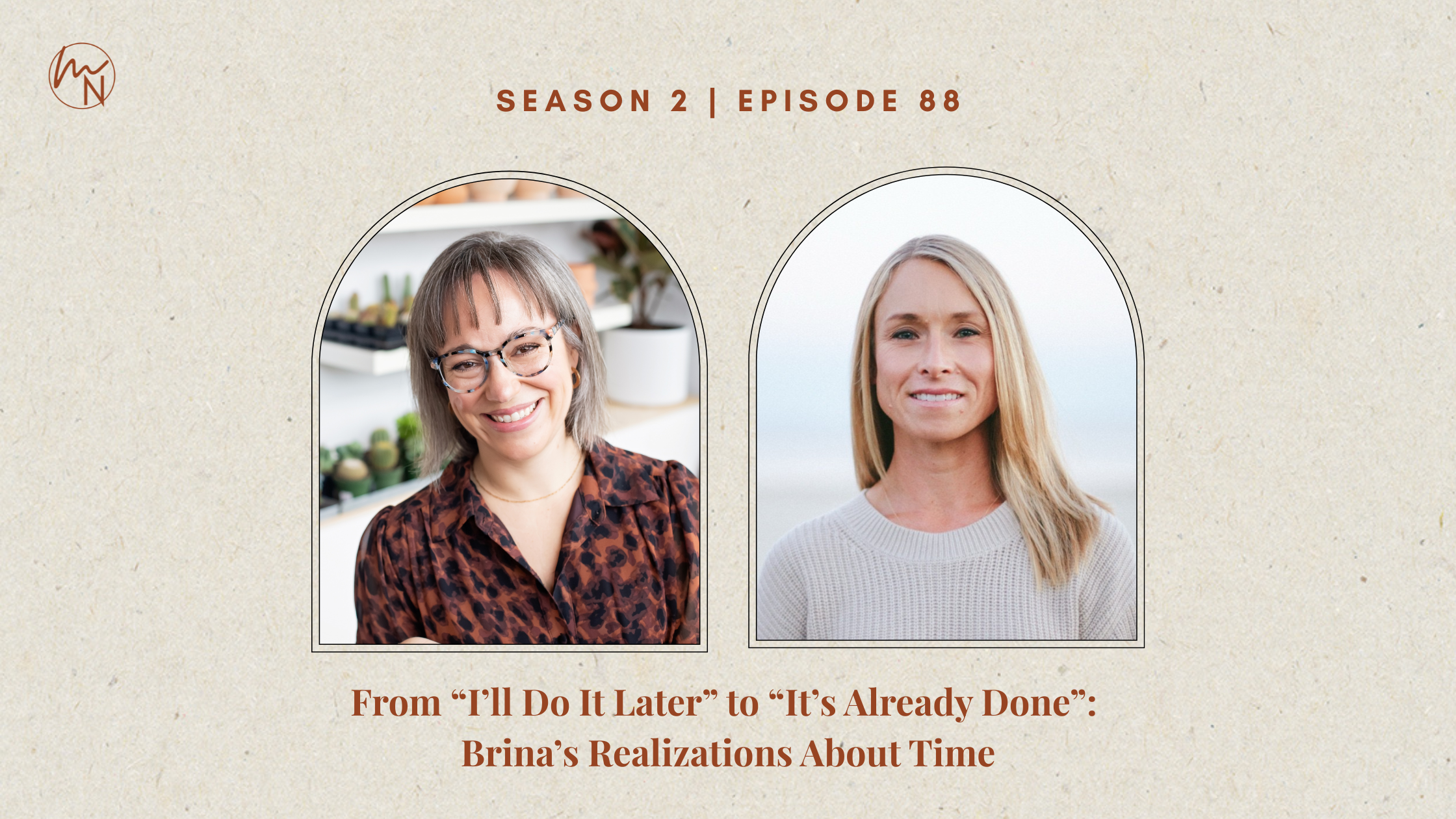
Episode 88: From “I’ll Do It Later” to “It’s Already Done”: Brina’s Realizations About Time
ITUNES | SPOTIFY
You finally have the flexibility you wanted... so why does it feel harder than ever to get anything done? In this episode, I’m joined by Brina, a working mom and member of the Beyond Balance group, who shares how she navigates a full-time remote role, a partner with an unpredictable travel schedule, and the ever-changing needs of her son.
We talk about the invisible expectations working moms place on themselves, the myth of the “normal week,” and how Brina shifted from frustration to flow by building systems that help her get things done and still have time for her family. From scheduling weekends with intention to making invisible work visible—at home and at work—this conversation is full of practical wisdom and deep validation.
To learn how to get things done with the time that you have as a busy, working mom, register for my upcoming free class - Plan It, Do It, Done: 3 Simple Steps to Finally Feel on Top of Work & Life.
Enrollment for Beyond Balance is opening soon. Visit www.themothernurture.com/beyond-balance to learn more.
links & resources mentioned in this episode:
Register for Plan It, Do It, Done - a masterclass on January 29th
Learn more about Beyond Balance - the program that Brina completed
-
Do you feel like no matter how much you do each day, you can never get caught up? If you're anything like my clients and a lot of the listeners I've been talking to, I'm guessing your answer is yes. You live with this nagging feeling that you are behind. If you could just get some time to get organized, get caught up, you'd finally feel like you were on top of things and that would feel so good.
But whether you have a newborn, toddler, or teenager. Large blocks of time like that are hard to come by, and there's always more to do. You need to be able to get things done now without waiting for more time. If that resonates with you, I want to invite you to a brand new training I'm offering called Plan It.
Do It. Done three simple steps for working moms to finally feel like they're on top of things at work and at home. During this class, I'm gonna walk you through exactly how to get organized, how to focus, and how to finally get things done so you can get out of catchup mode for good. It's happening on Thursday, January 29th at 12 noon Eastern, 9:00 AM Pacific.
Head to themothernurture.com/class to register today. Again, that's themothernurture.com/class. I can't wait to see you there.
You are listening to the Life Coach for Working Moms podcast, the show where we are talking about what it actually takes to make life work as a working mom. I'm your host, Katelyn Denning, a full time working mom of three and a certified life and executive coach. I'm so glad you're here and I hope you enjoy this week's episode. .
Welcome back to the podcast and to this very special episode
where I'm chatting with Brina, a client of mine in the Beyond Balance program. I just finished re-listening to this conversation, which is something I always do before I record an intro for you. And I am smiling so big because at one point in the episode you'll hear me literally say, mic drop. And it's true. Brina had so many brilliant quotes. I literally copied and pasted several of them out into quotations that I'll have to share again and again.
But that's not even the best part of this episode. It's certainly a fun part of the episode. Whenever you hear someone land a point or make a statement that just gives you chills because it's so true or so relatable,
but Brina also has so many everyday examples of the shifts and changes that she has made to. Go from someone who felt like she was never getting enough done in her workday, to now being someone who. Has a shorter to-do list each day, and yet is somehow getting even more done. It's freed her up to focus on her personal health goals and to truly be present with her son in a way that she was struggling to do before when she was constantly chasing her to-do list and catching up at work.
I loved recording this conversation. I loved editing and listening back to this conversation, and let's be honest, I'm probably gonna listen to it. After it publishes live for all of you. So if that is not enough of a reason for you to continue on and listen to the end, I'm not sure what is. But for those of you who are here for the inspiration, for the validation and the ideas,
you're in for something really special with this one.
Hi Brina. Welcome to the podcast. I'm so excited to talk with you. Thank you so much for having me. Yes. So, , so much that we can get into today. So for anyone listening, Brina is a current member of the Beyond Balance Group right now.
And why don't you start us off by introducing yourself and telling us just a little bit about you and your work and your family.
Sure. My name's Brina. I live in Santa Barbara, California. And, , I work for a nonprofit. I work from home.
I'm the director of operations, and I am the mom of an 11-year-old boy. He's our only child, and my husband is a photographer, so he travels quite a bit. And that's a interesting variable as well.
I forgot about that. I'm glad that you mentioned that. And we were just talking before we hit record my oldest is the same age as Brina's son and this season that we're in , as they get older, as 11 year olds and what it's like to sit here and watch that and witness that.
Yeah, it's a lot of fun and it's. , requires a lot more than I expected. , when I was, a mom of a younger child, I thought having an older child would be, I mean, obviously , it's all parenting and I, I knew that. But, , he still requires a lot. And, , I wanna be there for him as much as possible.
Yeah, I had that same thought. I was like, once we get through potty training or once we're done waking up in the middle of the night, or once, I'm no longer dealing with these epic temper tantrums on the floor, like I'll have it made. It'll be so easy.
Yeah.
And. Certainly I, I get to sleep through the night most nights.
My child woke me up in the middle of the night last night. Yes.
Okay. Well,
he had a bad dream, so it goes on and on. Yeah,
right. But, it is just, as they say, maybe less physically demanding in different seasons, but it's no less work. Even as they get older.
And the taxi driving is real. , especially where I live things are like always like 10, minutes, 15 minutes and, , there's a lot of going to and fro of different things and scheduling that, it just interrupts a lot of, , my day, which I'm happy to do. I'm obviously the one that put it all in place, but it's definitely a factor that I was told about, but living it is a little bit different,
so that's a perfect.
Transition into what I noticed and what I'd love to hear from you a little bit more about, which is what life was looking like when you first decided to jump into Beyond balance. You just said there the interruptions. So the taxi driving the school day, that ends not when the workday ends, the activities that you have to get them, to and from, and. I know that was one of your big challenges when you came into the group was how do I create enough space and the conditions to focus so I can get the work that I need to get done, done? And I know there were other things as well, but can you share what life looked like for you and what you were struggling with when you decided , to jump into the group?
Yeah, so last October I went full-time, , as an employee. And prior to that I was always self-employed. Freelance could kind of do things as I felt were needed based on deadlines, et cetera. And now I am expected to work, right, like a full day. And I was, I think relating that back to when I worked in an office and expecting myself to.
Sit down and get a certain number of things done and work on a project or whatever from A to Z, like start to finish. And I wasn't able to do that. And I was feeling really frustrated about that. And I remember when we had our first talk before. I started the group and I was like, sometimes I feel like I have to leave and I only have 20 minutes.
So what's the point of starting something and you're like, 20 minutes is plenty of time to start something. And I, I still remind myself that all the time, like 20 minutes or five minutes, it's plenty of time to pick up something that I have on my list , and get it started. And that alone has been a big shift for me because.
Start and finish and complete all these tasks. And, , so I just wasn't meeting this expectation I had, which wasn't a realistic expectation because now I work from home and I have a child that I need to pick up and drop off and, , settle in when he gets home and give him some snacks before I get back to work.
And I have meetings at various times. So it wasn't serving me to compare it to how it was before, either as a freelance worker or as an employee worker back, when I worked in an office before I had my son. So I think that was where I was feeling a little misaligned, , with my current role.
, so I was just looking for a way to feel good in my day to day, and at the end of the day, feel like. Good about what I completed and feel satisfied with how the day went. And I'm feeling a lot more of that now than I, than I definitely been when I first talked to you.
Yeah. So you are an employee now.
Mm-hmm. Contract or freelance, but you still have a fair amount of flexibility or , your workplace provides that, that's the culture. Is that how you would describe it?
Yeah, we are all in various time zones all throughout the world, and, , three of us have kids and people are traveling all the time and they're in the field and so there's a ton of, , variants to people's schedules .
So everyone's expected to work their hours and get their jobs done. The nine to five is the same, nine to five for everybody on our team. So because of that, you're kind of just need to achieve the mm-hmm. You know, get the work done is basically what it comes down to.
And, and I do my best. A lot of times I'll have a meeting, get five or six or even seven, at night. And , and for someone, it's the next day for them. So there's a lot of variance there. So. Me having to work nine to five on my time zone is kind of pointless.
Mm. And yet, it is so easy to have these expectations for ourselves of, well, this is what a full-time employee does, or This is what someone said it should look like, or I tell myself it should look like.
Mm-hmm.
Yeah, and I had to realize everyone else has got their own things going on too. And also the to-do list of what I have to get done never ends. Like I can't keep expecting to complete everything every day. It's just about continually working and chipping away at things the best that I can.
And if I'm doing that. I'm not letting people down, then that's enough. And so if some days I have to work later and some days I can get it all done within the hours, then that's fine. Each day is gonna vary , sometimes meetings take up a lot of my day and I don't have the time to follow up on those tasks from my meetings that day.
But I need to, , build in the time the next day, and that's okay. And so. It's just about a shift of expectations for me.
. Yeah. And you mentioned in your intro too, , not just are you navigating working with colleagues who are across different time zones with different travel schedules and everyone just getting the work done when and where they can.
And that's a big variable, day to day, week to week. But then you also have a partner, co-parent, husband whose schedule varies widely across the month . So , you have flexibility in a way, which so many of us crave. We wanna just be able to get our jobs done, we just wanna get the work done and do it where and when and how we can.
But that does make it challenging to create those expectations if they even serve you or create a plan, especially when you have flexibility. But then your husband might be gone for entire week on a photo shoot and you are doing everything. Mm-hmm.
Yeah. The flexibility is almost sometimes a challenge like.
Because I have the freedom, you know, like I could do it later. What do they say? If you can do something at any time, it will be done at no time, right? If you don't schedule it, it's not going to get done. And so I would be like, well, I could do that later.
And then what happens the next day? If I could do it later, the next day, something else is gonna come in and take that over. So if I don't create the discipline for myself. It's just not gonna happen. And I had to really learn that it's discipline, but also within expectations of reality. And I think taking those two things into consideration.
So yeah, each week my husband, he could be gone the whole week. He could be gone for three days, the whole day. It always is varying and it's really challenging to keep. Ahead of, and to keep on top of, we're always, always talking about schedules. Like I to a point where I'm like, can we talk about something else?
, but it helps us to find the little moments where we can sit down and really focus and help each other out. With the pickups and the dog walks and those types of things are allowing each other to, , take care of ourselves. , and so I dream of the, my husband's home at five and then I get to do this, or he leaves, you know, I dream of that.
And it's not in the cards for us at all. But, , so we are consistently working together too. To figure how we put the puzzle pieces in week by week. And that's something we've had to learn together, but also on our own to create boundaries together, because we're also working from home together a lot and not getting each other's like space where he'll come in to make lunch and chat.
But that's when I have my head down , and setting boundaries without, with by still being able to be connected, , has been, it's been a journey, but I feel like we really respect each other and our work time a lot more now, , than we have in the past.
Yeah, we talk a lot in beyond balance, or at least I feel like I do.
Maybe you can validate that, but I feel like we talk a lot about. There is no such thing as a normal week.
Mm-hmm. And
like you said, I dream of a partner who's home at five o'clock every day, or I dream of a week where I just work from nine to five and then I walk away at the end of the day and really, so much of our experience and how we look at time and planning our time is just to acknowledge and accept that there will always be something else, or there will always be a variable schedule, or there will always be another project or another call at six o'clock at night or mm-hmm.
A renovation or a surgery, just tossing out some examples from mm-hmm. your life. Right. There is always something, and we do ourselves a disservice when we just hold onto the idea that there's a normal week waiting for us and I just haven't figured out how to have it yet. And instead just accept that this is what it is.
And so with the information I have, with the variables, I know, what am I gonna decide? How am I gonna use my time this week?
Yeah, I had a big like lightning bolt moment once when I kept feeling every single week. I'd say, well, after this week or after my husband gets home from this trip, it'll be fine.
And then one day I was like, I've been saying this for two years now, or however long it had been. And I had to just accept that the abnormal was the normal. And I don't know if I was trying to get back to a time. Before, before I had a kid, when there you could live that way, you would have weeks that were the same as the week before.
And that is not it anymore. And I've had a son for over a decade and I really need to shift that mindset that week to week is completely different. You get to school time and kids get sick or they have a performance, or there's half days, oh, those half day weeks where they have parent teacher conferences, they'll sneak up on you and, , they have a day off this or that, and
you can't have the control to get ahead of it. And we're talking about this in , our call this week about control is, comes from a place of fear. Trying to control everything and we just can't. We never, I don't think any of us could say that we've had control over our weeks for a whole week.
That's just not a thing. And surrendering to that is something that is. Super important to do and feel like you're just flowing with the wave of life and it's okay. It's okay if your kid gets sick and you are distracted that day and can't get as much done. But for me, the thing has really been that when I do have four hours, focus for those four hours so that the next day.
If my kid's sick or something happens or something comes up, I had done the best I could, the day that I have that focus time. And that is something I'm really trying to pay attention to. I have a window now. It's completely free to me to use it as I wish, the best way to use it is by focusing, getting some tasks done.
Getting some things completed off my plate, crossing them off, ta, that feels so good. And then tomorrow I won't feel as bad when X, Y, or Z happens because that's happening. It's coming maybe not tomorrow or the next day, but like the hammer's coming down, something's going to take you by surprise. So that for me has been that shift and the like doing this focusing.
Maybe I wanna be doing something else, but I'm not. I'm focusing so that later when I can do something else, I don't feel bad about it.
Mm.
And that has been really freeing for me.
Yeah. So what, has worked for you to be able to, when you have, whether it's 20 minutes, like the example you gave earlier of that's plenty of time to work on something, or you have an hour or a couple of hours.
I mean, you've shared some wins along the way of. Having a couple of deep work sessions mm-hmm. Where you, do get to really think bigger picture or move something forward. What are some of the things that you feel like have shifted for you over the last couple of months that are helping with that?
Yeah, like various systems that I just can put into place when things get more hectic. Or that I can have always in place that I just know that are there. And so one of them that's been really interesting for me is scheduling my weekends. Like it's nothing I ever thought I had to do, or I kind of would think ahead, but your system for, just putting in there a few things feels really good.
Because a lot of times on the weekends I'm like, oh, I have to do all these other things, the house things, the grocery shopping, and then I'd feel like I didn't spend time with my family or do something fun and fill my cup up either. Mm-hmm. And so I remember one day it was Saturday morning and I was at the grocery store and getting in my car and I was like, it's okay.
You scheduled, this this morning, you scheduled these things this morning and then you scheduled some other things for later in the day that you can do and you'll get them done. This was, you're not, I'm not feeling like, oh, I'm getting the groceries on the weekend. Like, no, you scheduled that, so it's fine.
There's time for the other things later. And it was really this relief for me. So I've been doing that every week, so yeah, it's like a little permission to do things for yourself.
And also, those tasks that we put off to the weekend because we're busy during the week. And then I think the other was. The invisible visible. So putting out like there were two areas we've talked about this for me. One was, staff meetings. A lot of times I'm like, these things aren't interesting or important to anybody else, but they are how I'm spending my time.
So it's important for me at least if I don't share them, I've written them down and I know what those things are. Because it could feel like the time went by and nothing really big happened, but a lot of things are getting done. , and the other was within the house, me putting out like, this is when my meetings are.
So when you get home, I'm on a call or this is when I need you to start thinking about the weekend for packing up for your trip. For my son. Like you're gonna have to pack up your books, some things to go on, whatever you're doing for the weekend or, . This thing is happening, therefore these things need to be done first.
So putting that on a Post-it note next to the calendar and being able to say that is there just feels really good so I can point them to that at least. And also for myself, like writing down what I've achieved or done or completed just makes me feel like the time didn't pass by and I didn't really do anything.
So that those things have been. Helpful and also just trusting that it will get done, the things will get done. And if I didn't do it this week, if it's one of those weeks, that's just really challenging. It doesn't mean I'm not gonna be able to show up next week or tomorrow. I trust that I'm capable of achieving that tomorrow or next week.
It doesn't mean I am incompetent or incapable or not, capable of following through means that a bunch of stuff happened this week and made that hard. , but I will pick up where I left off as soon as I can. And so all of those things have been really helpful.
I wanna go back through each of those, but we don't have time to do that.
I, I wanna, I wanna highlight the one about making the invisible visible, which. I wonder if, when I say that a lot of people listening think about household chores, household responsibilities, like your example of the Post-It, right? Getting your husband and your son on board to be thinking ahead or to help prepare and sharing more of that.
And it's a great tool and a great way to think about. Sharing household responsibilities. But your example about in the workplace as well, I think is a more unique one and one that we don't often think of, but that can be really impactful. And so if you like Brina are in a role where maybe you have a lot of projects or tasks that are going, maybe you're doing some of those solo or not, everyone has visibility into that.
I think we can get into trouble across teams or organizations where if no one knows what you are, spending your time on it's very easy to think, well, I can pass something else to her or to him. Mm-hmm. Or this thing is clearly a priority because it's important to me, so therefore everybody else should also think it's a priority and we should all drop everything to work on this project.
Mm-hmm.
And when you take a list of what you are working on, what are the priorities for you based on your role and what you need to get done and your deliverables and what you are accountable for. And you share that with other people, it helps in a way with capacity planning. Then when you say, I don't have the capacity to do that, or are we sure that's the top priority?
I'm working on this over here and this actually has to get done first before we can move on to that stage of the project. It helps everyone, of course, but it also helps you with your workload and how much you have on your plate, and I think that's so important to share, not just at home, but perhaps in the workplace setting as well.
Let me make sure that everyone knows what I am doing with my time and what I am working on, not to prove that I'm worthwhile or I'm doing my job like I'm supposed to, but just so that you have insight into these other things that are important to me and to the organization.
That is so true.
You know, we had a instance with a consultant who felt like we weren't doing their requests fast enough for finding it as important as them. And we're like, we have this big accounting thing we're we're doing over here. And they're like, oh, we didn't realize. It's taking up a lot of our time, and so it shifted their perspective and they kind of softened a little bit.
When you work in the projects or in program work, you're able to say, I did this thing for this. This program that I'm working on, I achieve these outputs for that. But when the amount of small day-to-day tasks like paying bills, like the bills come in, they have to get paid.
If I don't, that's a huge issue for the organization. Do I report that back in my meetings? Typically? No. But the reality is, yeah, that's part of , what's happening. And there's a lot of those types of tasks going on all the time.
They're very important. I don't think they're important. To other people, but they do need to be shared and they're important to the organization. So I'm definitely keeping a lot of balls moving. And , that's important. So, you're right.
It's not just about the value, it's about other people knowing that , I'm busy, my plate's full.
Right, I think it goes hand in hand with this flexibility, , benefit and challenge as well. When we have a lot of flexibility and we sometimes question, am I taking advantage? Am I getting enough done?
Am I working, the hours? I think it can help us as well to own, to name, to claim. I am doing these things that are important, that do make it so that everybody else can do their job, so that our consultants can continue to work with us because their invoices are being paid. And so also just for yourself to feel confident , that you are doing work.
You are getting things done.
Mm-hmm.
Yeah. Because I could easily look back on the
week and be like, what happens? Right. Yeah. It's important for me as well as everyone else.
Yeah.
I wanna ask
you about. The impact of you making some of these shifts of you managing your expectations about yourself and how much you can get done and the flexibility and creating some of these processes that help you focus and get work done on the days where you do have the capacity to do that.
And what that has changed for you in terms of. The time that you're able to spend with your family or with your son and be present without feeling like, did I do enough? Or When am I gonna get those other things done? And I'm thinking specifically of a win that you shared very recently in our online community about having this evening with your family and not feeling guilty about not doing other things or getting work done.
Mm-hmm. Yeah, that like exemplifies balance to me that like at the end of the day I am feeling good. I feel like I did what I could. I feel like I did, , the best I could and can let go of work and be present with my family. And it's just, the awareness has been really important just. Consistently talking about this with other people and with you.
So I have this awareness going on all the time around work and, how I manage my time and use my time. I'm constantly like, I'm not critical of it, but I'm aware of it and I think that's the difference. So I'm not beating myself up. I'm saying like, how can I use this time? And, okay, there's a lot here.
Just go like thing to thing to thing. And then you get a break and you're gonna focus , on these things and use that time. And then go on the next few things. But I'm not like, oh God, this day's crazy. What do I do? There's so much.
And then the day ends and I don't feel like I got enough done. Instead, it's like, this is what it is. So you've got your window here. What are you gonna do? And so it's a little bit of permission or softness with myself but also the awareness allows me to focus more than I was doing before because I feel like I was in a state of like anxiety or stress of wanting to achieve and do more.
And now I just know that I can and I will and I do. So when the windows come, I just know that I get the work done and I do the best that I, and I'm not making these like 40 item long to-do lists that I used to have , the to-do lists have actually gotten shorter. That is something I've noticed.
My to-do list is shorter and I'm getting more done, and I don't know how that's happened, but that is what's happened and it feels so much better. And I feel just a lot more peace around my time I didn't want my time to feel like it was being stolen from me or taken from me.
I wanted it to feel like it was my time to do with. As I chose and I wanted to choose to work when it was time to work, and I wanted to choose to be with my family when it was time to be with my family, and that is ultimately what I wanted, was that feeling of choice and power around my time because like, as I said before, I was freelance and it really was that, but now I, I'm feeling a lot more of that and I think it's simply awareness and permission and it's given me a lot.
, more in the end here.
Mic drop.
What else is there to say?
I feel like everybody listening to go back and rewind to the last, I don't know, 30 or so seconds to listen to all of the quotes.
I mean, you said I can, I will. I do. I feel so much more peace around my time. I choose. Yeah. And I feel empowered. Yeah. And you saying my to-do list has gotten shorter and somehow I'm getting more done. Mm-hmm. I've been saying that for forever and nobody believes me. Now Bri and telling too always.
I'm like, wow.
It's always like half a page really, you know? And it's always been a, always been a full page. So I dunno. Yeah. That's magic. That's magic. That's magic. Yeah. It's been really nice to have other women, talking like, I think that's. I think that's where a lot of the per the permission lies, right? Like, yeah.
Oh, everyone, everyone is juggling and, , managing and that's what's actually normal. Like to be a mom and to work. You still care for your kids. You still care for their emotions. You still care for yourself. You have to, you know, take of yourself. And then give to others. We're constantly giving and work is in another place where we're giving and , it's a work in progress to manage all of that and feel good about that.
And so it's just nice to see that amongst these other women who are, are doing great at it. It's amazing. They're amazing. So it's been really nice to, they're
to be
in that ecosystem of people.
I agree. I have this unique perspective of getting to be in these spaces for my job. It's what I do.
Mm-hmm. And I know that not everyone. Has that opportunity to see how normal, what you're feeling is to look out at a group of women and see everyone nodding their head to hear all of the stories and examples of how we're not doing it all and how that's okay, or how it's more important too. Have that moment with your son or do this thing for yourself, or whatever it is that that is more important.
And you're right, it is a big permission slip and it just makes you then go back into your own life and become so much more aware. Of all of the places where you can trust yourself and give yourself permission or do a little bit less or do things a little bit differently, it's really powerful.
Mm-hmm.
Mm-hmm. Yeah. And you've been just so wonderful and wise. I, I love someone will say something complex and. Challenging for them. And I'm like, what's Katelyn gonna say now? And it was always so wise and so spot on. And it's, and it's not even always advice. It's a lot of asking us back like, well, what, what would be the answer for you?
And allowing us to think through that. And I think just taking the time we go and go and go. We don't sit back and ask ourselves what would work better? Or why we feel this way and getting the opportunity to do that and then hear it reflected back to us and then to work on that is just really powerful.
And it's, I think it's just this creation of, of space not be in it so much, you know, like feeling like it's all happening to you to sit back and go, how am I going to approach this? Manage this. And because it is ours to manage, it's our time, it's our energy and it's ours to, to control and, , do it as we please.
And so I think taking that power back has been really great.
Having the space. Having the space. Yeah. If someone listening to this episode. Is in or or was in a similar place to where you were when you reached out a couple of months ago, what would you say to them about this decision of potentially joining beyond balance or taking that chance on themselves and making this investment?
Again,
it's like the permission slip like we were talking about, and it's very isolating to work from home a lot of the time, and to also be a working mom. Like you're not at all the things. You can't be at all the things , so you're not necessarily the chaperone or showing up to the field trips and that kind of thing because you're working.
And so to be around. Other working moms who are going through this as well, regardless of what age their children are. I think the experience is really similar and we can all offer things to each other, be it like we're the future or reminding yourselves of how it was in the past and , how far you've come and how much time mm-hmm.
You have now than how different it is. , it's just really nice to have that. Katelyn, you have been. Really helpful and like I said, why isn't great at listening and catering to each of us and allowing us to each have the space to talk about our individual situations and the way the program has built from the beginning to where we are now.
Like how you have built it step by step. It's like we can add on each time thinking about things in a more complex way as we get further along has been really helpful too. , so I really like the way it has built and it has allowed me to grow. As the program grows, I have grown also like the Slack channel has been really a great way for us to put things out and support each other and to have a little outlet to know like we're continually working through this together. Because again, like I'm not gonna, it feels weird to reach out to my friends who are like, stay at home moms, which I gr is great.
But they don't always get like, and I don't wanna be like, I'm so busy. I hate that. Like I'm so busy. I have meetings. I'm not trying to flex that either. It's just nice to have other people who are in your situation there for you. So, I don't know, it's just been a pleasure. And it's work and.
That's good too, right? Like yeah, we have to do that work to grow and there are growing pains in there and that's important and I think that's how you get to the other side. but I think it's important to step back and assess what's not working for you. And if you're feeling like things aren't working for you, then this is an opportunity to step back, but also be held and have somewhere to.
Put your thoughts out and have them reflected back and to feel like you're not alone or you're doing this wrong 'cause you're not. Yeah. There's support there for you. So, long answer to say it's been wonderful. It's great answer
TLDR R. It's been wonderful.
Yeah, a lot of that with me. Yeah.
Thank you so much.
I. Love talking with you. When you think of someone who is willing to step in and do the work, not just to put the post-it up for your family to see or share what you're working on at work or restructure your to-do list or how you're managing your calendar, but also to reflect on the stories that you tell yourself about what you should or shouldn't be doing or what's important and what's not important to give yourself that permission.
You have really shown up in all of the ways, and I know that that is work, and I acknowledge you for that work. And I'm also sitting here like a proud mom of where you are today , and where you're gonna take this in the future. It's so exciting. And think of the gift that you've given yourself and your family, and your work and your future self.
Big time. Yeah. Very worth it. Yeah. Thank you so much. Yes, thank you.
Thank you for listening and as always, for being a part of this working mom community. You can find everything related to this episode in the show notes at themothernurture.com/podcast. And don't forget, if you're not signed up for my brand new class, plan It Do It Done three simple steps to help you finally feel on top of work and life.
You can head to themothernurture.com/class to register today. It's happening on Thursday, January 29th, and I really hope I'll see you there. All right, I'll talk to you again soon in another episode of the podcast
If you enjoyed this episode, you won’t want to miss what’s coming next! Make sure you hit the subscribe button to tune into future episodes.
If you love the Life Coach for Working Moms Podcast, I’d be so grateful if you’d rate and review it on iTunes! Simply scroll down, tap to give it a five star rating, then tap “Write a Review.” Your rating and review will help more busy working moms discover helpful episodes each week!
