
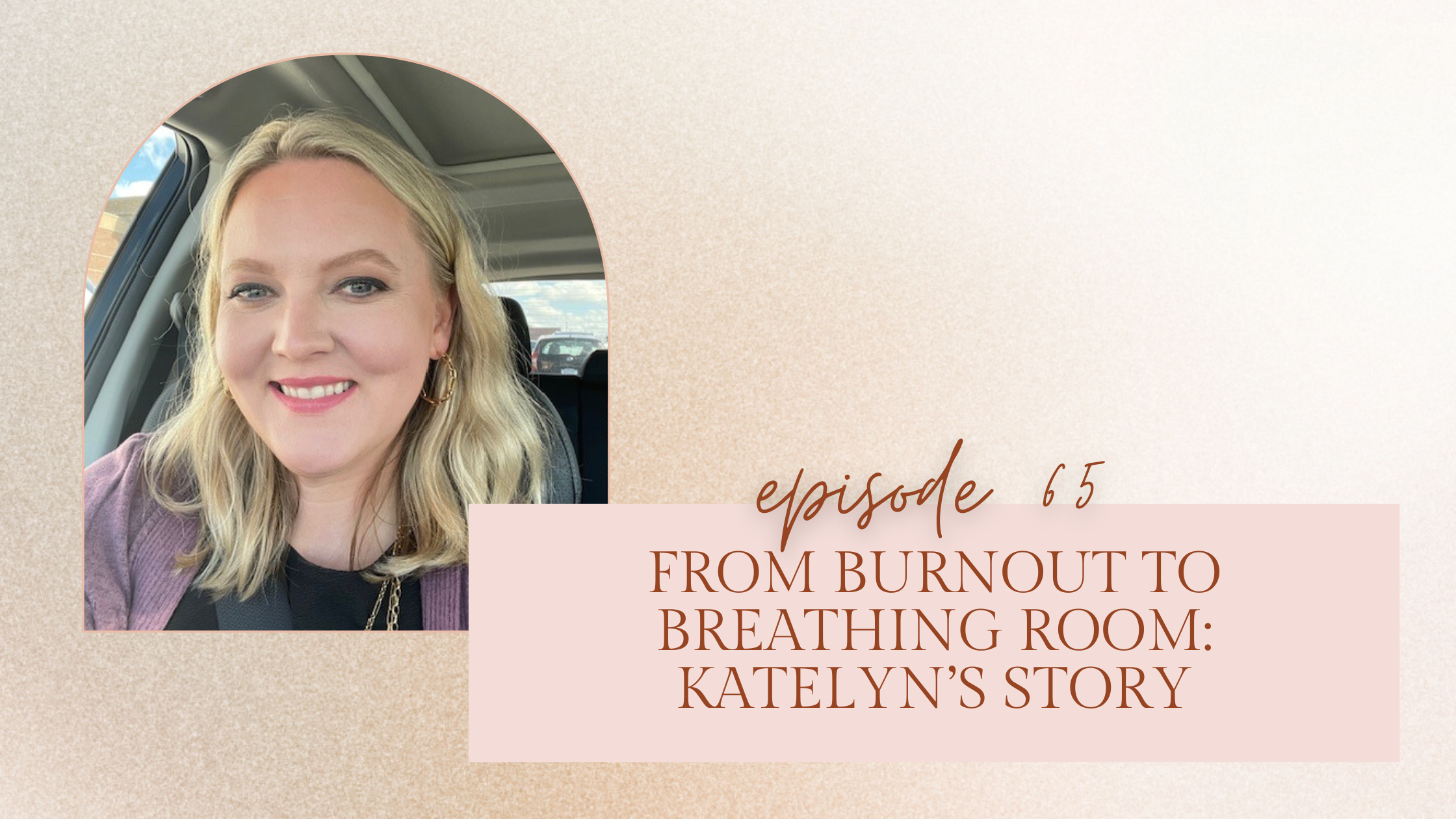
Episode 65: From Burnout to Breathing Room: Katelyn’s Story
ITUNES | SPOTIFY
Katelyn was doing everything—thriving in a demanding career, raising a toddler, volunteering in her community—but feeling the early signs of burnout. In this conversation, she shares the small but powerful mindset shifts and planning tweaks that helped her find time for herself, strengthen her partnership at home, and feel more present with her toddler. If you’ve ever felt like you “should” be able to do it all but are secretly wondering how much longer you can keep it up, this episode is for you.
links & resources mentioned in this episode:
-
What if there was an instruction manual that could walk you through exactly what you need to do to get things done with plenty of time? No more feeling behind on your to-do list, working extra or staying up late to get caught up. Just a simple process that you can do no matter how busy you are or what you've got going on in your working mom life.
Well, there's a solution for that, and it's called Beyond Balance. This is my 12 week time training and coaching program where I teach you the skill of prioritizing and planning so you can create more space in your working mom schedule and finally get things done. No complicated multi-step processes and no drastic changes to your life like quitting your job or outsourcing everything, just realistic strategies that actually work.
And fit into your busy life. If you're ready to get things done while feeling more relaxed about time, go to themothernurture.com/beyond-balance. Today, applications are open for the fall cohort, but only until August 12th.
That's themothernurture.com/beyond-balance. All right, let's get to the show.
📍 You are listening to the Life Coach for Working Moms podcast, the show where we are talking about what it actually takes to make life work as a working mom. I'm your host, Katelyn Denning, a full time working mom of three and a certified life and executive coach. I'm so glad you're here and I hope you enjoy this week's episode.
Welcome back to the podcast. I have a special treat for you today. I sat down to talk with one of the current members of Beyond Balance to really ask her some questions about what I have seen her. Navigate and shift while she's been in this program so far. Now, if you are a little confused by the title, her name is also Katelyn, spelled the exact same way, which we have a good chuckle about as we get into our conversation.
But what's interesting about Caitlin's story is that. Even when she came to me to join the group, she seemed like she had a lot of practices in place that were working. She had systems and routines and a method for managing her calendar and her very demanding job, as well as home life with an active toddler.
Yet behind the scenes, she admits to inching toward burnout. And maybe you can relate to that looking like things are together. Maybe you are not actually missing deadlines or dropping things but. The amount of effort that it takes for you to do all of those things has you completely exhausted.
Katelyn has made a series of shifts. She's had so many aha moments and small tweaks that
she's been able to do to give herself more breathing room. I'll let you tune in to listen to exactly what those tweaks have been, what those shifts have been for her to hear her say it in her own words with some amazing examples.
And so with that, let's get into the episode. I hope you enjoy.
Hi, Katelyn. Welcome to the podcast. It's so strange to say, Katelyn. This is a conversation of Katelyns.
It's.
Yes. A
conversation of Katelyns spelled the same way, which is not a very common spelling.
Not at all. No.
That's a a big reason I think actually how I stumbled on your podcast, because I had accidentally typed my name into Spotify and your podcast came up and that has started my journey.
No way. I didn't know that. Yes, I didn't know that. So for everyone listening, if you want to spell my name or Katelyn's name, it's K-A-T-E-L-Y-N.
When I order my coffee, I just say Katelyn with a k. However else you wanna spell it is fine.
That's same here. I, whenever they say, how do you spell it? I, I will say however you would like to.
Yeah. I do prefer the K though. Don't spell it with a
CI agree.
Anyway, all right. Enough about our names, , why don't you introduce yourself beyond how you spell your name?
Yeah. Well, I am Katelyn with KI, uh, work in the financial services industry, and I am a director of program management. So very active job. Have a two-year-old toddler as well. So active home life. And then I'm really busy in the community as well. I like to volunteer my time and I'm active in a few different community organizations.
Love every aspect of it. But I think to the point of your group, I was questioning how do I balance it all? And that's kind of how I stumbled upon you and this group. Yeah.
Yeah. And I think for context too, it's helpful for everyone listening to know that you are in the office. It's all five days, right?
For you? Or do you have some flexibility?
I have some flexibility, but usually I skew towards four to five days in the office.
Yeah. Which makes a difference when you're thinking about your time and what does fit in that you exactly are also driving and you're not at home.
And a fairly long commute as well.
I think about 20 to 30 minutes each way and commute. Yeah. So this class also gave me some great ways to optimize that time as well.
Yeah. Well, I love that you are a podcast listener. That's so thrilling for me. So when we first talked and you, reached out and were curious about beyond balance.
What, what were you hoping to learn or what was life like for you that had you thinking, I wonder if this could help me?
Reflecting back on it, it was just trying to do it all. I have a job that I absolutely love, but it takes quite a bit of my time. I have a 2-year-old that is so active right now, but it's that fun stage of life where it, it is 24 7 and you wanna be there for every moment.
And then I also wanted time for myself as well, and I took a step back and I, I said, you know what, I'm burning out because I'm trying to do it all, but I wanna do it all and there's gotta be a way that I can somehow manage this. And then like I mentioned, I randomly stumbled on your podcast and said, well, I'll just give this a listen.
Maybe there's some good nuggets. I listen to probably five or six episodes and you had a class, and I thought, well, what do I have to lose? If there's other women who are feeling like this, I'm gonna learn from them. And there's gotta be an easier way to do this so that I don't look back here in four or five years and say, I'm incredibly burnt out because I just tried to do it all.
Yeah.
What were your goals coming into the program? So you just mentioned a minute ago, time for yourself, and that was a big one for you. You obviously made some other changes, which I wanna talk about as well. But when you think about time for yourself, , what was that for you?
What did you want?
Yeah, I think it came down to. Simple items when I reflect back time for myself was did I get everything on the to-do list done for the week? And that was a celebration, but that wasn't really time for myself. It was could I actually work out four times a week and feel like I was giving myself the space?
Could I have lunch with a friend or dinner with a friend? I wanted to catch up with and not feel guilty about it, or have in the back of my mind everything that I was missing or even being able to be actively present with my 2-year-old. And when I was sitting and playing with her, not be going through the list of, and I've gotta click this and clean this, and we have to get this birthday present.
And I knew that those items were important to me. It just was, how did I, I really lean into it and balance it all out.
Yeah. And are those things in your day-to-day life in a way that maybe they weren't 10 weeks ago? They
are.
I, I think there are a few insights, but one, I placed this ideal number of four times a week working out and in my head it was like this, you know, power lifting hit class that had to happen. Aspect of having a community and a group gave me a group of women who gave me ideas of maybe four times a week, isn't realistic.
Maybe it needs to be one or two to start, or does it have to be a HIIT class? Can it be a walk? Can it be extra steps at your desk? And just having the space and people to bounce ideas off of, help me understand. I can still achieve that goal, but maybe it's very different than I thought coming into the class.
Then I think just having the space to, to realize the pain points I was having. Others were having the exact same pain points. It, we, it, it wasn't me on an island saying, how can I do this all? There was a group of like-minded women all together saying like, we have the same problems as well.
Here's a tip or trick or, what I really appreciated was the class where people could just say like, yeah. Life was busy and it didn't happen this week, and that's perfectly fine.
Yeah. I very much remember. Reading your homework at the beginning because in, in beyond balance, you can submit, you don't have to, there's no grade, it's not going towards your GPA, but you can submit things and I love to read that, to just see your reflections on the homework or what you're taking from it and what you wanna put into action.
And in the beginning when you set your goal, and I read four times a week of working out. I think I asked you maybe in the community, like , how did you come to four? Mm-hmm. But , we let it stand and it was so interesting to watch this evolution of you expanding.
Your definition of what. Counts as working out. And then at the beginning it was, yeah, I'm gonna hit four times, I'm gonna break a sweat, I'm gonna just give it my all in those four workout sessions. But oh wow. We had this huge storm come through and all of this stuff happened at home and my daughter was sick and, and, and exactly.
And maybe I could still take a walk during those weeks and oh, that still felt good. I realize , that that still gave me something just like a HIIT class does. And that's not to say hi classes aren't great, they are great, but it gives you that flexibility to roll with the different types of weeks that we have where no week is the same as the one before.
Yeah. And That right there, just that phrase was such a key unlock for me is no week is the same and I very much planned my weeks on it was gonna be a standard week every week, and then I'd be stressed out when undoubtedly my daughter was sick or there was an emergency or a big work deadline that was unexpected.
And all of a sudden that list that I had that I felt like I still had to get done, or the four workouts I had to get in really seemed insurmountable. I think this group really gave me those tools to say, well, here's what is achievable in that week and here's how you can still get, quote, unquote it all done, and help prioritize what needs to happen, which was really helpful.
Yeah. There are so many things I wanna ask you about. I'm having trouble narrowing it down, but could you share about your experience, , when one of the weeks you made the decision to double the amount of time that you thought these projects and tasks should take?
Yeah. I'm smiling as you say this because I. Don't think I was aware of it until I heard this concept of make sure you allow the time and space and reflecting back on it. I'm always the one that when I plan to do something, my husband will say, okay, so I'll add 30 minutes. And I'm like, no, I'll, I'll get it done.
I'll get it done. And most of the time he was right. I needed to add 30 minutes. So what I started to do that week is look at my to-do list for work. Look at my to-do list outside of working hours and say, let's just add 30 minutes. And in our class you said, actually, go ahead and double it and give your time yourself the time.
Well, that made me really prioritize what should get done that week. 'cause all of a sudden I didn't have time to do it all. And then I looked at. Am I taking that entire time? And for the most part, I was. If anything, I had a little extra time, but that was a rarity in the way I used to do it. And it's a concept I've carried through.
Now moving forward is I know myself, I take more time, I get more into the weeds than I probably should. And so if that's gonna be something that'll happen, let's give myself the time and space to do it and double the amount of time that I'm expecting. Or what I do is I'll take a lot of my little tasks now, something I learned, and I'll batch 'em together and say, okay, these are items that I know I can get done in 15 or 30 minutes.
And then I encourage myself that at the end of 30 minutes, these little tasks need to be done. I don't need to go into detail of planning this or doing this, and it helps me just keep things moving. Those two concepts really have helped both work and personally just keeping things moving and not spending too much time.
And I remember when you said that out loud in the group, and there were several others who then said, I need to do that too. Mm-hmm. I am just like you, Katelyn, and things always take me longer than I think they should. And so why am I continuing to set myself up to feel like. Oh, I never got this done, or I didn't have enough time.
You could give yourself the time by doubling or adding 30 minutes. Yeah. And then what you said, it does make you have to make some choices. And for some people that feel really uncomfortable, well, I can't get all of these things done when I double how long Everything on my list takes, it doesn't fit.
Mm-hmm. And the reality is it never fit before either you just thought you were going to get it all done and then you didn't. And this way you make the choice upfront but I think so many people find what you did is that if anything, you finish a little bit early.
Great. Clear out some emails, tackle one of those small things, make a quick phone call or allow for the colleague to drop by. I mean, you have so many interruptions in your day. I know that was another big piece for you as well. How do I get things done when my team is always needing me? Yeah,
and I think the additional time helped.
And I think I came into the class. Saying, well, I feel like I've got a lot of this in place. I'm, I have the to-do list. I already time boxed my tasks to try to get things done, and if anything it validated that some of my practices do work and they work well. But then it gave me these nuggets on, you have the time box to-do list, but you're putting too much into that time box.
And then what other tools can you layer in so that when you do have that time box, you're actively focusing on big work? So one tip that I pulled through the group is doing no meeting times. So we have across the group now a few days a week that there's no meetings that take place and that is active working time.
And it has helped so much because everyone knows that's a space where we're not gonna drop by. Have conversations where I'm gonna get the work pushed through, and it's helped me quite a bit. I would've never even thought of that concept if I didn't have the group to kind of brainstorm and say, here's what's worked for me, or You should try this example.
Did you set that up like you were the one to implement the No meeting time I'm so curious now. Tell me
more. I did and I feel like sometimes these conversations are just like the unspoken conversations you need to have. I brought a group together and said, I'm struggling on getting some of this deep focus work done, and that would really benefit me if we do a no meeting time.
But I think for this group to be successful, we all have to do it because if I do it , and the team doesn't, then we're all still gonna be team seeing each other dropping by offices and just opening the door to that conversation. Everyone said, oh my gosh, I'm having the same pain point.
I would really benefit from having a no meeting time. And so we've been trying it now for probably about a month and we've had a lot of success. And we're actually now looking at, well, at the end of quarters, do we do a quarterly no meeting time where we can do more strategic planning? And just that stuff that kind of sits there that you always say, I hope I'm gonna get to
Yes.
And it nags at you. Why don't we give ourselves the space to do it, but it's gotta be the group that's leaning into that and it's been super helpful.
That is so good. So if you're listening and maybe this could be applicable in your work scenario, let this serve as inspiration. It is possible.
And what I love about that too, and it's a perfect segue into what I also wanted to ask you about, is just opening up the door for a conversation. Like you said, Hey, I'm struggling with this. I have an idea. Could we test it out? I think of you also , in a similar way, having.
Conversations with your husband about the planning that you do outside of work for your family, for the evenings, for the weekends, and just like you go to a team or to colleagues and propose something, here's the potential benefit, let's test it out. You can bring those same practices home. And yet so many of us treat our home lives different than we do our professional lives.
And I'm not saying that we need to, create business processes out the wazoo for home, but there is a lot that we can borrow from both settings. So, I don't know. Can you tell everyone a little bit about your partnership at home and how you plan the time outside of work?
Yeah. I think that this is probably the most impactful change I've had from the class is working with my husband outside of the home. And I, I kind of laugh as I say this because every week after class I would, you know, sit down and talk to him one evening after the kiddo went to bed , all excited, here's what I learned in the class this week, and here's how it's gonna be so great.
And on and on and on. One week we went over planning and I was like, the plans that I do, it's validating that what I have in place is, is helpful and here's these tweaks that I wanna do. And he said, yeah, but when do we not need the plan? Like , we have so many plans in place. And it kind of caught me off guard.
And I remember bringing it to the class and saying, well, how should I approach this and what do I need to do? And everyone started kind of giving little. Tips and ideas, and you and I walked through, well, what's the why behind that? Why is he saying that? And what I uncovered is I really wasn't involving him in the plans.
I just assumed that he appreciated that I could get it in place and done. And the group encouraged me to have a conversation with him, ask him how he wants to be involved and what that would look like and what that unearthed was. That he actually did want to be involved in a certain way. He really appreciates that I can do the planning piece and that is in my wheelhouse, but he would love to know what the plan was maybe in advance of the weekend so that he could also layer in.
I'd really like a relaxing weekend or, , one weekend when we had the conversation, he said, I'd just like to take an afternoon and smoke , some ribs. What would that look like? Just knowing that it would make sure that I didn't plan multiple errands or being out of the house. It was huge. And then little things like putting the meals for the week in an area where he could see 'em so that if he had the time and capacity to help with some pre-prep of meals or cooking, if I was running a little bit late, it wasn't him being flustered on where items were.
And then what I really appreciated is one of. The women in our group said, Hey, I have a notes pad on my phone with my husband. It's a shared notes pad, and we just brain dump our to-dos there. And we both know that we can tackle 'em as we have capacity. There's no time box. , we did that and it's been huge because he'll have little bits of time that he'll pick up something , and knock it out.
, and historically I was putting that on my own to-do list and thinking, when am I gonna find time to do it? He was more than willing to do it. He just needed to have the visibility and so that's been great for just being able to collaborate and it's really helped us as like this is a partnership that we're tackling it together.
And those weeks that are crazy for one, maybe another can jump in.
Yeah. There's so much there. We could do multiple podcast episodes on each of those topics. I do the notes with my husband. There's actually, I'll put it in the show notes for anyone listening who can go to themothernurture.com/podcast, and there's an episode that I have on note taking.
I think it's so important when you set up , a system like that to jot down things that we might wanna do or even just notes on. I have back to school on the brain, you know, what are , my kids' teachers email addresses or their student ID number. Set it up so that you can share it. Yes, because so much of it is just about.
Creating visibility, whether it's meals that you post on a whiteboard so everybody knows what's for dinner, and no one person has to be responsible. Anybody can chip in to things that we wanna do to asking ahead of time, Hey, what are your expectations for this weekend? I wanna smoke ribs. I wanna take a nap.
I was hoping we could go out and do something fun. Okay, well that's great information to have. So that when I go to make a plan or make some reservations or I don't know, buy tickets or do this thing, I'm not bulldozing over what you wanted to do. Exactly, exactly. Which then just creates resentment or a feeling of like your husband said, why do we have to be so planned?
Mm-hmm.
He didn't actually have a problem with the plan. He just wanted to make sure that he could have a say in it. Yep, exactly.
That's so good. It's been, a huge help for us and, , also having me take a step back , and say he actively wants to be involved. He has so many other pieces.
He helps with in our, partnership of life that I just assumed that he was at capacity and I just needed that conversation of. Well, I might be at capacity this week, but another week I might have an opportunity. I just need to know what that looks like and vice versa. Same for me. I can pick up items from him as well.
Yeah,
I mean
you're essentially doing fair play without necessarily knowing or actively thinking this is fair play. And all of this starts with conversations. Hey, I have this idea, or I'm feeling this way, or I'm noticing this. . Can we try something? And then if it doesn't work, it doesn't work.
But at least you are experimenting and you're having the conversations.
Exactly. And I think all of those really help with going back to one of my goals, which was being able to be actively involved , and in the moment with my toddler when we were playing mm-hmm. By task sharing, by giving that visibility, by boxing in my time at work and valuing it.
Do I Yes. Have days where I need to work later? I do, but I've made the choice on that and I've planned for that. So that that time between daycare and bedtime, we can play a family game and it's fun and we're not thinking about the to-do list. It is, let's go for a family walk, or it's been the summertime, so randomly going to the pool in the afternoon because we can, and it's not chore time or trying to get stuff done.
I mean, that's what it's about.
Exactly.
That's what it's about. , time for you and time to just be. Which when you said at the beginning, you felt like with everything that you were trying to fit into each of your days, you were feeling like you were edging toward burnout. It's because we don't give our brains a break from thinking about everything that we have to do.
And so now if you can be present. You're not thinking about all of those other things and you're feeling so different about work, about life.
, and I think the women in our group also allowed me to have the space to say, , you do need me time. And me time might be prioritizing that you can read a few pages of a book in an evening.
Or going and grabbing that lunch with a friend, or maybe it's you're walking together because it accomplishes two things. Yeah. But prioritizing that and scheduling that just as though it's another family or work to do is meaningful and it helps you not burnout. And I. Working in a busy career, having a young kid, it's so easy as a mom just to say, well, I've gotta do everything else for everyone.
And then you take a step back and you're like, I'm completely drained. And having a group say, A, it's normal. And B, prioritize you, like it's okay to spend some time on you. And it doesn't have to be a whole half a day, but do the small stuff and, and have that be part of your planning. I think you and I just recently talked about, uh, you have a podcast episode that's about your monthly plan, and that's was one of the first ones I found when I was listening to you and I thought, wow, this is a really interesting concept of, it's that batch grouping, those tasks together, get them done at the beginning of the month so they're off your plate.
And I instituted that. Love it. It's, we're coming up to my next one here that I'll be planning. Yep. And it's been wonderful for the family and for myself. But I never took that time to plan for me. Mm-hmm. And so this month I'm planning for me and I'm actually saying, okay, I'm going to value getting together just once a month with a friend who I haven't seen in a while and doing an hour long dinner while I know that there's another activity going on.
So it, it works well. And that type of stuff brings me joy. It helps with the balance of everything. And I don't think I would've given myself the permission or realized that it can be just a small. Lunch or dinner or a phone call to my friend who lives in another state on the way home until I had the group saying, oh, here's ways that I do it.
Yeah. This group of women, , in this cohort of Beyond balance, I feel like have really taken that and, and run with it. There are so many examples. Everyone is doing different things from, like you said, reading or walking or. Meditating or watercolors or I can't even think of all of the examples, but in just these small ways, and like you said, you could have the thought or the perspective.
Oh, once a month to get together with a friend. That's not very much. But if you don't plan it, the reality is a whole month will go by and you'll do nothing. Exactly. And so even just one time a month, setting the intention, finding the time, scheduling it, reaching out, saying This is important to me, that's 12 times a year that you could do dinner or a walk or coffee with friends.
And that's something, especially with young kids and a busy demanding career.
Yeah.
There's , so many great ideas in this conversation. , so many things that I love that have changed for you. I will say too, I'll put the link to that monthly planning episode in the show notes as well 'cause it's another one of my favorites.
I love that so much. But as we wrap up, is there anything that you would say or would share. For maybe someone who's listening like you were back in, what was that, April or May, earlier this year. Who's thinking, I wonder if this could work for me. I wonder if this would make a difference or if something I should consider.
That's a good
question.
I would tell everyone that you'll probably be surprised. I came into it saying, I think I have a lot of this in place already, but I'm still struggling. Like there's gotta be a better way to do this. And I feel like if I don't figure it out, something's gonna break down the road. And so I took a chance thinking well.
What do I have to lose? I might pick up some tips. I might not, and I've been so surprised at the tips that I have picked up. I think it helped validate that some of the things I have in place are great and I can lean into 'em further. It helped me realize that what I thought some items were great.
Maybe the concept was there, but I needed to. To take a step back and really look at them like my time, do I need to double my time? Do I need to really think about what I want to prioritize? And then it also just gave me a community where I could say, , it's not just me. Others have very similar pain points and we're in a group that we can learn from each other.
And there were so many times where there would be classes and you would say, you're a little quiet, Katelyn. It was just me sitting and listening and and saying like, wow, I can exactly relate to what she's going through on the phone. And just listening to someone unpack their thoughts. I was writing down tips of like, I need to try this, and this is great for me as well.
Yes. I'm so glad you said that because you are sometimes quieter in the groups, which I just wanna normalize and is always okay. Some people come to group coaching like that and they get so much just by listening, and you're the perfect example of that. You don't have to have a problem. Or a challenge that you need to bring and get some help with.
Of course, that's what it's there for. But when you listen to someone else's story, you can't help but compare it to your own experience and think, oh, I wonder if I did that, what it would do for me, or I so relate to that, or, that's just so reassuring. I love looking out in the zoom room and seeing.
All seven heads nodding or smiling or people laughing even though they're on mute. Like, yes, I get that totally. A hundred percent. That's me.
Yeah. So many classes I'd come to with, okay, here's a topic I wanna talk through, and then I'd find myself not talking to it because somebody else would be speaking.
And I thought, well, I would've never thought about that. But now that I hear it. Yes, I have this pain point , or yes, I, you know, I wanna change X, y, z concept of mine. It was really helpful and I, I have a whole notebooks off to the side here of just tips and tricks and things that I've pulled through that if I didn't have that group to bounce ideas off of or learn from, I, I would've never thought of 'em on my own.
Yeah. And you'll revisit those I'm sure. Again, and again and again, or, I hope you do. Yeah.
And I'm finding myself as well, like, what was it the other day? , I was with the mom group and people were talking just about the pain points of dinner and planning for dinner. And I said, well, here's a few concepts of, you know, picking a theme for dinner for the week and cooking to it.
And have you thought about putting a board and just new concepts and everyone was saying, wow, this is. Little things that I would've never thought of but could save me 2030 minutes of meal planning.
Yes, yes. Beyond balance, its arms are are wide reaching as we go and
share, and you do great little nugget podcast episodes as well.
So I find myself sharing those and saying, Oh, you're struggling with monthly planning. Here's a quick, because we're all busy moms. Here's a quick 20 minute podcast that you can listen to. On your commute to work or while you're walking, and it's been great.
I'm so glad. I also don't have a lot of time to record long episodes.
These are the longest episodes I do because I just can't stop talking to you all. I have so many questions, but yeah, when it's just me, I'm like, let's get in, get out, make our point and go about our day. Yeah, I love it. Thank you so much for being here. I love talking with you and learning from you, and I'm just in awe of.
Everything that I've seen you take in and absorb and then go and implement in your life for what seemed like small tweaks, 📍 but have gotten you some really big results
they have. Yeah, the last 12 weeks have definitely caused me to take a step back and say, look at this new quote, unquote, found time that I have just with small tweaks along the way.
Ugh.
That's a dream. I love it so much. Thank you. Thank you.
If you enjoyed this episode, you won’t want to miss what’s coming next! Make sure you hit the subscribe button to tune into future episodes.
If you love the Life Coach for Working Moms Podcast, I’d be so grateful if you’d rate and review it on iTunes! Simply scroll down, tap to give it a five star rating, then tap “Write a Review.” Your rating and review will help more busy working moms discover helpful episodes each week!
