
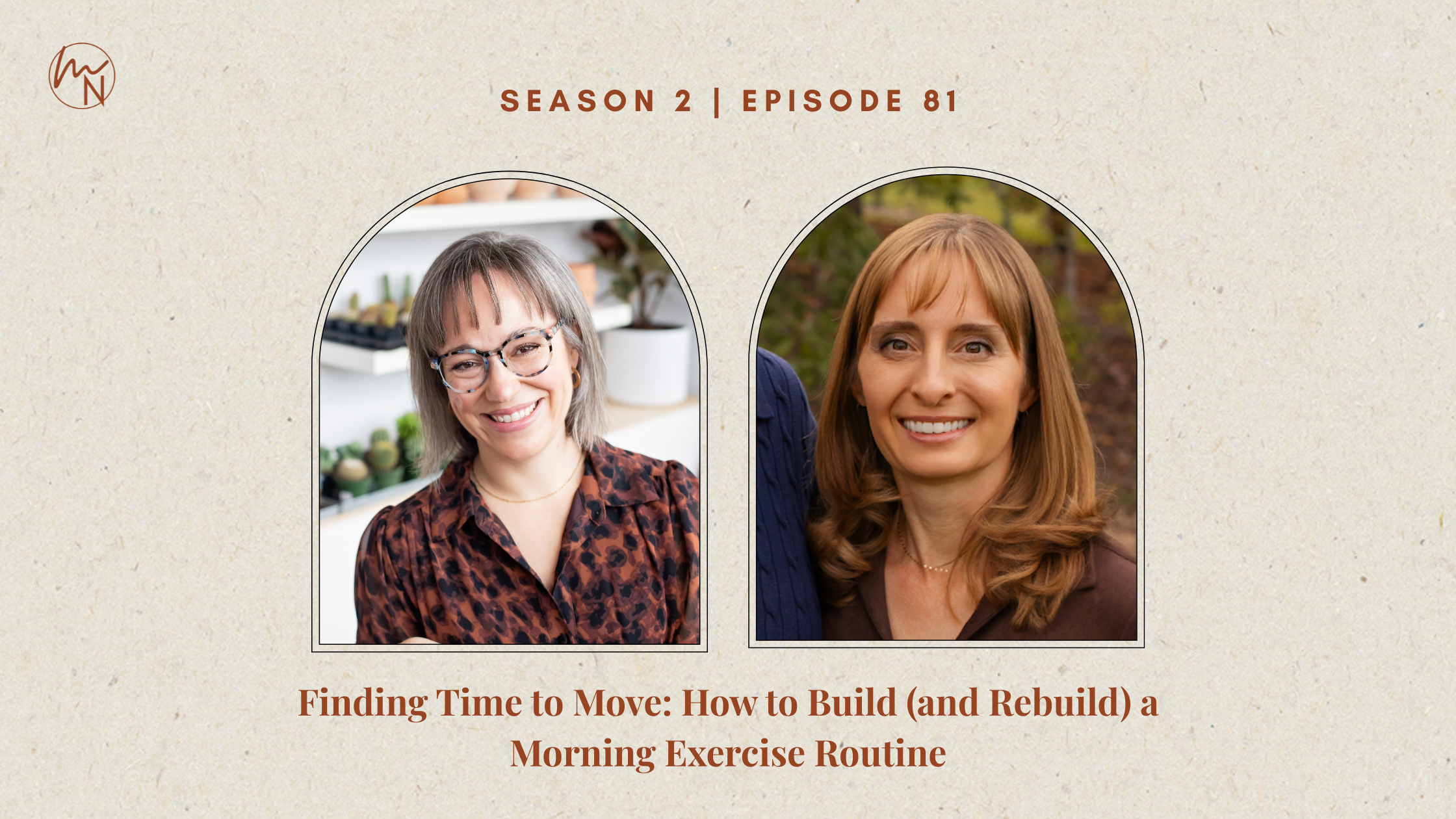
Episode 81: Finding Time to Move: How to Build (and Rebuild) a Morning Exercise Routine
ITUNES | SPOTIFY
If you’ve ever tried to build a consistent exercise routine while juggling work, kids, meetings, meals, and the everyday chaos of family life, you're going to want to listen to this episode.
Today I’m talking with Allison, and she shares the real (not Instagram-perfect) story of how she slowly built a morning workout habit—one that has broken down, disappeared, and been rebuilt more than once over the years.
We talk honestly about seasons when everything falls apart: the years with toddlers, job changes, unpredictable schedules, and the weeks when you’re just too tired to do anything more than survive. And we also dive into what helped her find her way back to movement each time, even when she felt like she was starting from zero.
In this conversation, you’ll hear:
How Allison created a morning routine that actually fits her real life, not an idealized version of it.
Why her first attempt at a workout routine completely collapsed—and what helped her rebuild.
How she and her husband communicate about their schedules so both people get time for exercise, rest, and parenting breaks.
What it looks like to recommit to yourself in the middle of a busy season, without guilt or judgment.
If you’re craving more energy, more consistency, or simply permission to start small, you’ll love this episode. It’s full of practical ideas, gentle encouragement, and the reminder that caring for your body is not another item on your to-do list—it’s something that can actually make your life feel easier.
links & resources mentioned in this episode:
-
You are listening to the Life Coach for Working Moms podcast, the show where we are talking about what it actually takes to make life work as a working mom. I'm your host, Katelyn Denning, a full time working mom of three and a certified life and executive coach. I'm so glad you're here and I hope you enjoy this week's episode. .
Hello, and welcome back to another episode of the podcast. This is episode 81, and I am joined this week by my neighbor, my friend, and most importantly, my Tuesday morning walking buddy, Alison English. You all know that I love my morning workouts and I've gotten into a pretty good routine in this season of my life, but I have gone through many iterations to get here and so has Allison, and so I wanted to have her on, not just because we share our love of morning walks around the neighborhood, but because she has. Different and interesting journey through movement, and I wanted. To hear another example of the twists and turns and ups and downs that it can take to really try to fit and hold on to space for movement in your busy life, in the different seasons and the different curve balls that life throws at you.
And I think Allison has some really great perspective and ideas , on what that can look like, especially if you are someone who maybe has struggled with physical pain or injury. Allison herself has navigated a lot of that while also managing a demanding career.
Both she and her husband are leaders of churches here in our community, and I think it's such a fascinating glimpse behind the scenes of what that schedule and those responsibilities look like. So I can't wait for you to learn from Allison to listen in on this. Very fun and very I'll say inspiring conversation.
I left feeling very inspired and motivated to continue to show up for myself, and I hope that you will as well. So without further ado, please enjoy.
Hi Allison. Welcome to the podcast. Thanks, Katelyn. It's great to be here. I am so excited to talk with you. So Allison is a neighbor, a fellow parent. How? How do I say that? Our kids are the same age as we live in the same neighborhood and we met. Years ago on the playground, right after you and your family had moved to Cincinnati from California, which was a big move and you still had all of your furniture, I think, in a truck maybe making its way here which was, very fun and exciting.
We were glad to welcome you and now Allison and I are. Walking buddies. We walk once a week through the neighborhood in the pitch, dark in the rain mostly these days, and so we get to catch up on life and I'm so excited to chat with you here in this capacity.
Well, it's great to be with you, Katelyn. I'm excited to talk about how we got to this point and how we survived all these years of having these little kids.
We did it through a pandemic and then we found this opportunity to walk with each other on Tuesdays and we've. Held each other accountable to it. Pretty well.
We have. I love it so much. So why don't you start with just a quick introduction of yourself, what you do for work, what your family structure looks like, and then we'll get into it.
Well, I am a priest in the Episcopal church. I'm sitting in my office right now during a work week. the chimes are ringing behind me. You may or may not be able to hear those. I have two children. They are eight and 11. , so third grade and sixth grade, both still in elementary school.
And I have been working since before they were born and, , just had short maternity leaves and then worked full-time a day in the life. So, being a priest and my husband is also an ordained pastor, , means our weeks are a little bit different from a nine to five. Our weeks start on Sunday mornings.
, we're both up at 5:00 AM We're finishing touches on our sermons. , while other people may have gone out the night before, we don't usually go out on a Saturday night. , or if we do, we come home early because we have an early morning. It's like our, it's like most people's Sundays or our Saturday.
Yeah. We bring the children with us to church. We each serve a separate church. So if they're in a special, , group like the choir or if they're aco, they come to whichever congregation they're doing that, so while we're leading and preaching and serving, the kids are with us.
Yeah. We're home by, you know, midafternoon on Sundays. Then we have a Monday through Thursday. And those look really different depending on the day. , Mondays like today are often a quieter day for me when I can do some study and preparation for the week ahead. I have, you know, like other people have staff meetings.
Projects I'm working on. But in the middle of those, somebody, , may call a want their child baptized, and that could be in the coming weeks, somebody could be looking for a wedding. , there are people who have medical emergencies and so I drop everything and I head to the hospital. That could be if it's a major emergency in the middle of the night.
Same goes for my husband. And so we really have to work as a team. And we knew going into this that if we had children it was going to be a juggling act. And it is. But there's a lot to be said for the flexibility of the schedule. And we both also take a full Sabbath day. We do not work. On Fridays, , with the exception of a life or death emergency, which is, you know, you just, it could happen.
But usually we have full Fridays off and then we're back at it working on a sermon on Saturday morning, enjoying the day with our family and back to church on Sunday again.
I have learned so much. . Through talking with you on Tuesday mornings while we're walking. Of all of the things that you do that probably the average person does not even grasp that is within your job description.
And it is fascinating and I'm sure, like you said, there are benefits to the variation in your schedule, but then I'm sure there's also challenges in that you can't necessarily predict that. Oh, I'm gonna work on this project during these hours, or I'm gonna be here and doing this on this day. It is a lot of times probably changing for you.
And we throw kids into the mix where school calls or they have this thing, or whatever's happening during the middle of the school day. Can you come or can you be a part of this that you're also navigating just like the rest of us?
I mean, I was thinking back to when the kids were first born.
We lived, at least 1500 miles away from the nearest grandparent. Yeah. We had a great friends, but friends aren't the same as having a grandparent nearby. Mm-hmm. So we realized really quickly that if we were gonna make this work there. , we were going to need a system of support and we are also going to have to be rock solid in our communication with one another.
, so if, if Robert, my husband and I weren't in solid communication with one another. , none of this would really work, , or would I be able to add on things like movement and exercise and wellness. And, , so it really, I, when I look back on the past years, it was a series of building blocks of, okay, how are we going to make this life work in a way that gives us a sense of vitality that lives into like, we're supposed to be models of what it looks like to be, , healthy.
Moral people. If we don't have our lives together, we can't model that. And so it's been a series of building blocks over the last, over a decade now.
Yeah. How do you communicate so you, aren't working, like we said, traditional hours necessarily. I know both of you and know that there are evening things happening at the church or both of you're active in the community as well.
Do you have a shared family calendar? , how are you navigating conflicts when you both have something? What does that rock solid communication look like?
Well, we do have a shared family calendar. We keep our own work calendars and then any hours that aren't Monday through Thursday, nine to five.
Or Sunday mornings we put what's going on at the beginning of the month on the shared family calendar. So whiteboard, we are like old school. We start it like a week in advance every month. We also know there are some things you can, we can just expect. So it's not like everything is freeform.
Okay. There are board meetings that are on certain days of the month. There are, school obligations that my husband volunteers for. I know it's gonna be every. Month at a certain time. , so we know there are certain things that are anchors that we know what to expect. And then whenever there's anything that's out of that organizational flow or just what we expect, we are texting each other and making sure that we both have it on our personal calendars.
So, so last week there was a special program at the school on Thursday morning for kids. One of us had forgotten about it. And so we checked in, it was like, okay, how are we going to make this work? What needs to be done? Just, knowing we can get ahold of each other via text message. I don't know if everybody has that, , freedom in their workspace, but, , we do have the freedom to check our text messages and
we're constantly communicating and there are times we mess up too and we double book. We both have something going on. So it used to be we'd have , a list of babysitters we knew we could call. Yeah. And, or we just bring them with us. Yeah. So again, not everybody has that flexibility and freedom. It works a lot better now that they're not two.
Right. Right now they're eight and 11. But , if all else fails, they come with us to work. Yeah. And one of the building blocks has been, , my husband's mother moved here a couple of years ago, and it was a game changer. , now, again, not everyone has the, I, I see it as just a great gift, but yeah, , communicating with her too and being clear about what boundaries are has been really important.
Yeah, so I am smiling because. I'm glad to hear you say, , you have a whiteboard and you're old school in that way. So are we. But I'm going to share very vulnerably right now that it failed us in a pretty big way a week ago, and I don't know, I think I might be instituting. A digital shared calendar. It was, it was one of those, you know, we were not where we were supposed to be, and it was because something got added to the calendar at the last minute.
But of course that doesn't sync to your phone if it's at home and. , even with text message and communication during the day, it was not a fun experience. So we'll see. Well, there
are times when it's like, didn't you look at the calendar? Right. And then it's like, when did you write that on there?
Well, two days ago. Exactly. No, I haven't looked at it. So, yeah. , and I don't have a great solution for that yet. I do think all of this, if we're honest, has to be a work in progress because it is messy.
It is, and it is interesting as well to shift into a season of parenting where now the kids are having just as much in some ways on the calendar as we do, and I know when they're young.
And it's not easy to bring them along or to scramble at the last minute that has its own set of challenges. But now that we're adding extra activities or school things or deadlines for kids stuff as well, it is becoming a lot to manage.
It is. And I have a, my oldest daughter wants to be in everything.
And so that's the thing I hope what we're modeling is you can do a lot, but you can't do everything. Mm. And, but I watch her, she's like, well, I wanna be in this and this, but they're on the same day, and so she's having to figure out how to negotiate. How often she has to be somewhere. Is it fair to not be somewhere you've promised you to be every time you've promised to be there?
And, it is interesting to watch it from her perspective and trying to learn it and then trying to actually guide her in, have you thought about this? So,
yeah. And it's hard. And it's hard to put those limits on their time. If they are interested in lots of things, it is hard to choose and we're a family and we also have to take into consideration the schedules and commitments and constraints of everybody else as well.
Yeah, the, that's been a hard thing my daughter was at a slumber party this past weekend and it was on Saturday night and I didn't know for sure if someone was going to be able to get her to church where we work. Right. So that's like a Monday morning for most people. Our Sunday mornings, like Monday morning, right?
It's the biggest day of our work and, We had to prepare our daughter for, if nobody can pick you up, you will have to come home early from the party. And this is just what our family life is. And so, you know, that can be painful in any family. I think having to say, these are the limits of what we're able to do and this is what we have to do.
Yeah. I mean, painful is a fair word to use there,
especially for kids. Yeah. And, and she was working through that. And then somebody offered to take her over to the church. So we built Oh, great neighborhood. We have a great neighborhood, as you know.
Yeah.
, great friendships, a level of trust and so. I came out of worship and there her slumber party stuff was in my office and she was rocking and rolling here just fine on very little sleep.
, but it wasn't without those, building blocks that we've built, friendships and family and communication over years and plenty of arguments that have gotten us to this point.
Sure.
Yeah.
How do you and your husband divide up responsibilities? You both have demanding roles and lots of things that you're doing, and then just like any household, you have to get the kids to school, you have to get 'em home afterward to activities.
You have to get dinner on the table, make sure everybody has breakfast or lunch or whatever. Do you have a system for that? Are you also just in constant communication about it? What does that look like?
I think we're in communication. Robert is a. Super Dad. , I feel very fortunate he, he saw that I was back then, now I'm not so young, but back then a young woman in a demanding profession where not a lot of young women were doing the work.
Hmm. And so in a lot of ways he made sacrifices When we moved here, he took a part-time job so I could take this tenured rector position in a church. . He really took on a lot of the roles of the providing. The preparing and if anything, there's been conversations after he started working full time, it was what do I as a woman need to take on in this, in this marriage?
Yeah. And it wasn't, it was, it felt like non-traditional roles, especially during that move and transition. And some of it was just. I'm grateful for the humility on his part of saying, I see what you're doing in this role and the demands that it has. I think, I think he'd be okay with me saying that he's seen that sometimes in traditionally patriarchal roles.
Men have it a little easier. He said he sees it. Yeah. And he's like, we're doing essentially the same job and the demands are a bit higher for you. Mm. Also, I mean, from my perspective, he doesn't put makeup on in the morning. He doesn't shave his legs. Yeah, he makes lunches and so, but we had to get to a, an agreement about, look at the extra time I'm putting in.
Oh. And that sometimes that's still a sticking point. Can you help with the lunches ? And so I try to be grateful for what he does put in. Yeah. I don't know if that makes sense, but
Absolutely. And then
I think also understanding or seeing the transition then that you went through again as a family and as a partnership when he did scale up his work. Yeah. All right. Then we do have to come back and rebalance some of this, and I see that a lot in reverse. When a mom goes back to work or scales up their work, there is not always that redistribution of tasks as I think there could or should be.
Right. And so I've seen that
with people I care about very much. Yeah. And unfortunately, I think that there are so many demands on women, and I guess for me, like knowing that as a woman, . I was like, okay, what can I do to help , as he jumped back into full-time work. And , not only did I jump in and do more things, helped with more things, he still say it's probably 60 40 and he's doing 60 and I'm doing 40, which interesting.
He hears this, he'll laugh. But, but but I have seen folks really struggle , and so it does require a conversation like, looking at it, I have a spiritual director and the spiritual director would always say, don't be in it.
Look at it. Like, look at it. Or if you're in it, step back and look at it. And so we did a lot of looking at it along the way and saying, , what needs to shift here so we are all in a better spot?
Yeah, that's one of the reasons that I utilize some elements of the Fair Play Method, right? Where you look at all of the different tasks and responsibilities that it takes to run a household and you do step back.
Take some perspective, look at it, and choose or recommit to what you own and what the other person owns. And I think too, maybe a fair point to make here is that it doesn't have to just be. A job change or a part-time to full-time change to force you to reevaluate those.
We can change those at any point. And if you happen to be in a season or maybe you're just tapped out, like, I don't wanna make lunches anymore. I'm so bored of making lunches. Could you take that over for a little bit and in exchange, I'll take on this thing instead. Could we just swap it for a breath of fresh air?
Let's face it, chores and household responsibilities are a little monotonous. Yeah. That we can reevaluate that or change that up at any point and it just takes being brave enough to initiate that conversation.
Yeah. Robert does laundry. He does it on Fridays, which I don't work like, except for gonna the grocery store on Fridays.
So my thing is grocery, he is laundry. Okay. And I realized I had some space in the past couple of weeks and he's been pretty amped up with work and, and I sat down and I took some time and I folded the laundry. I thought he does not have to be the only one folding this laundry. And so some of it was like just looking at.
where are we right now and how can we help each other?
Yeah. Isn't that so nice when someone just does your chore, your quote unquote your chore, the thing that you usually do. Yeah. And you
show up,
it's
done. And it's great. It's great having, making sure , the dishwashers unloaded or whatever.
It's just, it is a way to, I think it's a way to love. And, , my husband's, . Enneagram, , I don't know if any of your people have done Enneagram, but he lots of
people have,
he's a helper and I'm an achiever, so he's, he like, gets a lot of fuel from being helpful. And if I can make it into a game or a list, I'm that, so that's how I get extra stuff done is to say, how can I achieve this?
Uhhuh
being, being helpful doesn't go as far with me, but so, I don't know. That tracks.
I, I can see that for both of you.
Yeah.
Yeah. What do the girls do in terms of responsibilities? Are they also taken into consideration when you think about who owns what or how we can all be helpful?
They do.
You know, I grew up in a house where my mom did everything, and so, . I felt like it was really important that our kids learn to not have that done, because when I went to college, I had to learn, oh, somebody picks up your dish and puts it in the, ah, I mean, it was that level of like, wow, you know, she was just super mom in the house and , so they put their dishes away.
Sometimes they'll unload the dishwasher. , they put their clothes away. They'd get a small allowance every week, but they have to complete those chores , to get it. , sometimes, like they did all the weeding of the side of, of the house and we'd pay extra, you know? Mm-hmm.
So , we try to incentivize or we try to make it like, this is what you do when you go to work. Yeah. So there's stuff you just do because you're supposed to do it, and there's stuff that you can earn more money for if you go above and beyond.
Hmm.
Yeah. That's how we've done it.
Yeah. So everyone plays a role here.
So. I wanted to talk with you because as we said, getting situated into our conversation, we walk every Tuesday and I know when we were deciding what day of the week would work for you to consistently, get out in the morning and take a walk, you had to kind of fit me in to your week.
'cause you have all of these other things that you do on certain days and then. The more we were talking, I learned about some of the other things that you do, like the stair challenge that you take on in the fall and the different iterations of what movement has looked like for you since the girls were really young to now when they're obviously.
Very independent in a lot of ways. , and so I wondered if you could share, what does your schedule look like today when it comes to wellness and taking care of yourself, and how has that changed over the years?
Yeah. So, right now, and I, again, like it is building blocks, right? Mm-hmm. So this did not happen overnight.
I was, I was telling somebody about the schedule and they're like, how did you do that? And I was like, it took like months, years to build like a wellness routine. So, okay. What it looks like right now is, on Monday, Wednesday, Thursday. My best friend and I get online on Zoom and we do a 20 to 40 minute workout.
We started getting into lifting heavy. , 'cause we started reading about the preventative ways that, , that just helps us you age we're like facing down the realities of perimenopause in the coming years. And. We've just read about how strength really helps.
Yeah. So we've been prioritizing strength and some cardio on those mornings. , Fridays I like to work out with my husband. We go over to a walking space near our house and do oftentimes like a three miler and just talk. And it's almost like a date. So that's a fun way. I love that.
And then you and I work out on Tuesdays, so that's, you know, that's five days a week and it feels great. I have, I was thinking this weekend I have so much energy and feel the best I've felt in years. , and I think part of it's because of the building blocks that have added up to this routine. Yeah.
And so, yeah, it's great.
So we are walking on Tuesdays just for anyone who's trying to picture this. We meet at six 30 in the morning and walk for about 45 minutes. Is that about the time that you're doing your other things as well? And then I think the question that comes up for me and probably for a lot of people is you said it's taken you time to get to where you are.
So were the building blocks, like getting yourself to a place where you could wake up consistently that early, or was it like building up to five days a week like you're doing now? Or maybe both?
Yeah. I can give you a little narrative. I mean, the, , the other days of the week, my friend and I have been friends since kindergarten.
It was in the pandemic. I had gained significant amount of weight. I had back problems. I was in physical therapy. It was March of 2020 and like I hadn't moved much. I was, it was hard. Yeah. I mean, we all, we both had little kids. Yes. And and I, and physical therapy ended and so I was like, I don't know what I'm gonna do.
And it was one day. . I was like, we've gotta move. It was some afternoon and it was another tough day with a 2-year-old and a 5-year-old and yeah. , we played kids BOP kids on YouTube and just started moving our body and I was, and I like it. I think I was in such a rough place that I could feel the endorphins and I thought, oh my gosh, I need whatever that is.
I mean, it was like, it felt like. A drug I needed and okay, how do we get more of this?
Yeah.
And so I kept doing the kids Bop kids in the afternoons with the girls and it was fun 'cause I connected with them. I got away from Zoom and all the online work. Yes. And then , my friend and I, at some point during that year, we realized you could do things like that on Zoom.
Yeah. And I'd never conceived of any of that. I didn't really even understand Zoom before the pandemic. Right. And so, along the way we, we learned this term accountability partner in middle school or high school, and we decided we were each other as accountability partners and we held each other accountable for all these different things and whether it was schoolwork or ways we were living our life.
And, and we've kept doing that for, since then on and off over the years. And we're like, let's, let's do this with movement. And we committed in 2020, I think it was 2020, like sometime in the middle of 2020. After I started moving again.
Yeah.
And the moving to the kids bop like my back started to heal.
I started getting stronger and then I thought, I wanna prevent getting a back problem again. Mm. And I had somebody to hold me accountable. And then, before that I just had Amelia, this was like almost nine years ago. And, same thing. I was just like, man, I've gained 50 pounds in my pregnancy.
I, I have, I have back problems then too. And it was like. I, I've got to do something and I found a friend. I, it is like I need a friend. Mm-hmm. And that's too, I'm not gonna do it on my own. And so I had a friend, had a baby the same month, and in like month three when we went back to work, we said, let's meet, we met in the dark in the park.
Wow.
Two or three days a week. And we did this little routine that she had put together in college, and , she resurrected it. And there we were in the park in, in Santa Monica, California, jumping around, trying to , get well, and we did.
Hmm. Yeah. So accountability is a big piece for you. Accountability , and I guess. Like I had to say to Robert, I need some time in the morning. 'cause there's no way I am gonna get this done unless it's before the kids wake up.
Yeah.
There's just no space for it.
I'm not gonna do it at night. Like regularly, ever.
It's gonna happen. I know.
So what does it look like to prioritize going to sleep earlier the night before? , turning off screens ideally at a certain time. Mm-hmm. And then getting up at the same time every morning and, , starting the routine. And so yeah, that was probably 2020 when we started that, but , it's frustrating.
You wanna sleep in, you don't wanna, yeah. It's like, why would I not just stay up later and sleep? But, , now it's just, part of the routine.
Yeah. So what time are you going to bed these days?
And waking up, I should say sometime between nine and 10, which is pretty early, I think.
Yeah. And then I'm up at 5 45, , every day, but Friday.
Yeah. So you allow yourself to sleep in a little bit on Fridays? Yeah.
I sleep till about seven, so I, I don't, wow. Is that, is that real? Sleeping in? I don't know. Maybe it'll be more whenever. When I'm retired,
I dunno, I slept until seven, actually, I slept until seven 30 today.
I needed it after the weekend that I had. And so normally I would wake up on a Monday morning and work out. I'd meet my friend at a gym at six 30 in the morning and I just told her last night, this is what my body needed today. And I've gotten better at that over the years as well. As much as I like my routine like you do, I'm.
Utmost mornings, I'm working out in my basement gym or I'm meeting a friend, or I'm walking with you there are some days where I just know that that's not in my best interest to push through that, and I've gotten better at allowing myself that and trusting that just because I do it one morning doesn't mean it's gonna become my new norm.
But yeah, it is interesting how once we get into these routines and rhythms or we get to a place where we are waking up early, that then oftentimes we don't allow or allow ourselves a break.
I think you have to take breaks, you know, if you need 'em, like I stayed up late last Tuesday night, it was like I didn't have to work the next day. I'd taken a day off before Thanksgiving.
Yeah. My
husband and I put on a movie and I was like, I'm not gonna get up after staying up till 11 or 1130.
I'm gonna enjoy sleeping and a day off. Like, yeah, routine's great, but it's also good to listen to your body and there's sometimes when things just happen like, you know, I, you and my parents have had health challenges over these past months and Yeah. And there are times when things get off the routine and trying to push through that sometimes is actually, maybe unkind.
Mm-hmm. And unfair to our, like, it could be harmful to our bodies to not listen to what we need.
Yeah. And that it is listening. There are times where things are really stressful or you have a lot going on, and what your body does need is to move or to lift some real heavy weights and get out some of that stress or whatever it is, and then.
There are times where you'll listen and your body will say, no, actually we just, we need a break or we need to rest. And so it can be either as long as you're honoring whatever it is that you feel like you need. Yeah.
I think last week we've been adding weighted vest to go back the weighted vest club to our walk some days.
And, and there are some times when I'm just like, man, this has been a really tough week. Adding the weight is like metaphorical for adding weight that it don't need to add to this week. Yes. So the vest is not go on 'cause I don't need to add weight. And then other times it's like, yes, let's get stronger.
Let's add this. and let's , push each other and it's great.
Yeah,
agreed.
I do that so often. It's okay to leave it at home and it's okay to grab it. How do you know when you're ready to challenge yourself even more? Like I, I am thinking about your. Oh, the stair routine.
The stair routine, yeah. Tell, tell us a little bit for anybody who doesn't know what we're talking
about, what you do. every fall. Well, every year at University of Cincinnati and around the country, there are stair climbs for nine 11, and they're tributes and they start, and I think it's 6 56 in the morning when the first plane hit the World Trade Center.
And then they recount the events of the day while you're climbing the stairs and they go for, , the duration from the time the plane hit to when the towers fell. And I think it's, I think it's 50 some odd minutes. And the first year. I did this, I was , new to the church that I'm serving, and , one of the leaders said he's a professor over the college, and he said, why don't we all meet and we'll do the stair climb together?
He was in his seventies and he just, he just tore me to shreds. I thought, man, this 70-year-old guy. Can haul up these stairs and I am pitiful. Yeah. So, you know, I think this is something where I'd have to build strength and stamina over time. And so you learned about this I think this year or last year and through you?
Yeah.
Yeah. And so. I still do this with some folks from the church and, , we gather at, you know, we meet at six 30 in the morning on nine 11 at the stadium stairs at uc, but it's the training before that. You know, for a few years I'd just go and I'd do it cold. Yeah. And that's why I couldn't do it, because it's like trying to run a marathon, right.
Without training. It's not, it's really stupid and you're miserable the next day. So I thought, well, I don't wanna be miserable and I want to see if I can climb all the way at the top and down in steps. Mm. In the timeframe. Okay. Which is actually pretty challenging. So in the summer this past summer I started, , one step at a time, going over to the stadium stairs, learning the cadence of the uneven steps of the stadium and building the stamina.
And, , again, that took like a different rhythm. It took saying, okay, I'm gonna take some time out of these slower summer days when work's not as demanding, and I'm gonna go demand more of myself. Mm. And and it became a way to see how strong I could be in my forties. You know, can I do this?
And when I was, I mean, I don't know what the guys look like. They're football players. I don't know. I decided, in my mind they were football players, but one of 'em was behind me at this past year and was. Going to pass me and they say, go get her. And I was like, oh no. And I, I sped up and I had the energy to, and it was near the end of this, so I know everybody's exhausted.
'cause we've been going almost 50 minutes up and down stairs , and I got ahead of 'em. We couldn't catch up. Nice. But I, you know, again, it took years and work and getting up and just doing it
Yeah. To,
To get the strength. So next year I wanna. I think , I didn't quite finish before the close.
I was like maybe one, one set of stairs away. Ooh. I'm gonna do it again next year so I can challenge
accepted. Yeah,
do it.
Yeah. I would love to try it with you. I've been thinking about that lately about having a personal challenge or, or professional challenge. I guess It could be either, but something that we are.
Pushing ourselves a little bit to, to do, to improve on, and I work out with a trainer once a week and he's big into triathlons and races, and my body does not like running anymore, and I'm okay with that. I've made my peace with it. I did all of my running pre-kids and. And I do though, there's a part of me that misses that feeling of, of having worked and trained for a half marathon is the most I've ever run.
And you show up and you're with all these people in that community setting and then you know, they. Tell you to go and everyone takes off. And then that feeling of crossing the finish line as well. And so I've been thinking a lot about what could that look like for me in this season of my life? And so whether it's a stair climb that I am training for, that you are training for to just get a little bit better each year or.
I don't know, a dance that I wanna learn or a physical challenge of some kind. I think there is value in, in having something that. We are working toward that we get to see ourselves achieve . I don't know. Do you think about that ever? Oh
yeah. I mean, I, I think for me, like the achiever mindset, but of course I'm also type A, so I like lists.
So I have a list or like , check boxes. It's like. I wanna, I, I'm really, it's like, it's like catnip for me. It's like, give me those check boxes and I want to check everyone off. To me, that's how it's like, that's exciting. Now, if somebody just says, let's do this, and it, and we're, and there's no plan, but let's meet.
I'll never, I'm never gonna do it. I'm not even interested. Like I need the checkbox. Mm. Yeah. I don't know what it, but I think other folks, like, I don't, I don't even know the mindset. Some people can just say, woo hoo, this is gonna happen and I'm gonna go have fun. And I don't. It has to be a checkbox for me.
It has to be a checkbox. Yeah.
I, I read this book. I probably mentioned it before on the podcast, so I'll put a link to it in the show notes. It's probably been about a year since I read it, but it was called The Comfort Crisis and it just has really stuck with me about how we have become so comfortable in our lives and, and that's not to say that we all don't have hard and challenging things and seasons that we're going through of course, but you know, from just the mundane, everyday parts of our life we have.
Heated homes and air conditioned cars and filtered water at our disposal and all of these things that, , there is something to be said for what it takes to be uncomfortable. I don't, I don't know how else to say it. And so I'm picturing you climbing up these steps, which, oh my gosh, it's gonna be so challenging for me.
Steps are. My nemesis, but something to be said , for taking the steps and going up and down for 50 minutes. That is very uncomfortable and it is so easy to stop these things, but like what you prove to yourself of what you're capable of doing when you put yourself in these uncomfortable situations.
Absolutely. I, I've been actually reading this I was a philosophy student in college and I, I read more like epicurean philosophy. Like, you know, you're in college and like epicures are into food and drink and like that's, I was into food and drink in co I still am into food and drink, but I don't think I'm an epicure.
I, I found, I think I'm a stoic and that speaks to what you're saying. , or I want to be a stoic. Mm. I, like, I strive to be stoic or in this. Phase of my life. And, , stoics have the virtues of wisdom, justice, courage, and moderation. And I think the courage and moderation are the, key to something like achieving a, a wellness goal.
Courage. It's like I'm gonna have the courage to break out of. The mold that I'm just comfortable in. Mm. And moderation is like, I'm not gonna overdo it. So I do myself in and I don't know. I've got all these wisdom taps for this, and this is about church, but I think it applies to life.
There's an archbishop, I, I serve a pretty traditional church, and the archbishop once said, the duty of the church. And you could say, , the duty of ourselves to our lives is to comfort the disturbed. And to disturb the comfortable. Mm. And, , I don't know. I think when we get too comfortable, we need to ourselves or ask some kind of a higher power to disturb us, , because otherwise we start to get stale or even disintegrate.
Mm. Interesting.
And same with the same with an institution or a, group of people. Sure.
I love the moderation piece as well. Because if I think back on my journey of parenting so far, if I think about my community and anyone who has a newborn or a toddler or in a different phase that yes, it is about.
Moving and reminding ourselves of our own strength and perhaps pushing outside of our comfort zone and doing something that is out of the mold of what we're used to doing, but also to what we said about listening to ourselves or your morning routine that has taken you years to build that. It's only gonna be sustainable if you do it.
One step, one change, one addition at a time.
I have on my bulletin board in my office, \ there's a bishop who runs marathons and she's in Indianapolis. And and she was preaching and \ I heard her, I wrote it down because I was like, man, this is really good. And I have it on my, just a reminder, stress plus rest equals growth.
Mm-hmm. And I think that, yeah. That's the moderation piece. \ but it, it has to be, it's not all or nothing. It's not everything all at once. And it's not nothing either. Stress plus rest equals the growth.
Yeah. I love your story of you're here today. It's the end almost of 2025 and you started this five years ago.
Or longer even. Right. With your first out of falling out of it too, right?
Oh, yes. You know, starting, falling out of it being a mess, then starting over again, and then I think it's really been five years since really. Recommitting feeling recommitting and be feeling really healthy and good.
Yeah. Yeah.
And so it does take time and you're not doing anything wrong if it takes time.
Yeah. And, and you can have a period where it does fall apart a little bit or even a lot, and you can come back and it, it's okay.
Absolutely. I love that. Yeah. My mornings, which is also when I work out, because like you, I, I dunno where else to put it.
Have looked. I've had so many iterations of what it looks like and that is just. Understanding that circumstances have changed, schedules have changed, needs have changed. And so what I'm able to do, or what I feel like my body needs or how I wanna push myself also changes. , just like going back to the beginning of our conversation, just like.
The things that we own and the way that we share responsibilities also changes. It's all changing always. Right? That is life. That is especially life with kids. And that's totally normal.
Yeah. I mean, I've thinking about, so five years ago we started doing the routine and, then my uncle, I'm his, main provider of care and he was living alone.
He was having a medical crisis. I was 90 minutes away and you know, I had these routines, but suddenly I had someone with a great need in my life and it stretched everything to the limit, and I threw my back out again. It was when we were moving all the stuff out of his house.
To sell it after we'd gotten him into care. And I just pushed myself so hard and and it was back, it felt like, oh man, am I gonna go back to zero here? And, and I could have, you know, gotten, I did get down about it. I thought, man, after all this work, I'm back to this pain and this struggle. And, you know, there was a foundation built, there was a routine.
It was like, you can return to it when you're able to do it, and, and my back healed again. And who knows when it's gonna go out again. But in the meantime, it's , keep getting stronger. Keep doing the best you can.
. Yeah. One step, one change at a time. Yeah. Well, I love walking with you every week. I enjoy that so much rain or shine.
It's so good to move first thing in the morning and I loved chatting with you here as well. Thank you so much.
Thank you. I think it's, especially like doing it with somebody else means you also get the benefit of this kind of conversation and friendship. So yes, thanks for that.
Yeah, that's so true.
, I had another conversation on the podcast recently about friendship and community in busy seasons of parenting, and that was one of the suggestions was if you wanna move or you're gonna be doing something anyway, why not do it with someone else? And you both get all of the value out of it.
Yeah. Yeah. So thank you.
Thank you. Really grateful. Thanks for, , having this chat today.
Of course. All right. I'll see you
on our next
walk.
Thank you for listening and as always, for being a part of this working mom community. You can find everything related to this episode in the show notes at themothernurture.com/podcast,
you can also find information about how I support working moms just like you through one-on-one, and group coaching, as well as access a number of resources and articles all on my website at themothernurture.com.
I will see you again next week for another episode of the podcast.
If you enjoyed this episode, you won’t want to miss what’s coming next! Make sure you hit the subscribe button to tune into future episodes.
If you love the Life Coach for Working Moms Podcast, I’d be so grateful if you’d rate and review it on iTunes! Simply scroll down, tap to give it a five star rating, then tap “Write a Review.” Your rating and review will help more busy working moms discover helpful episodes each week!
