
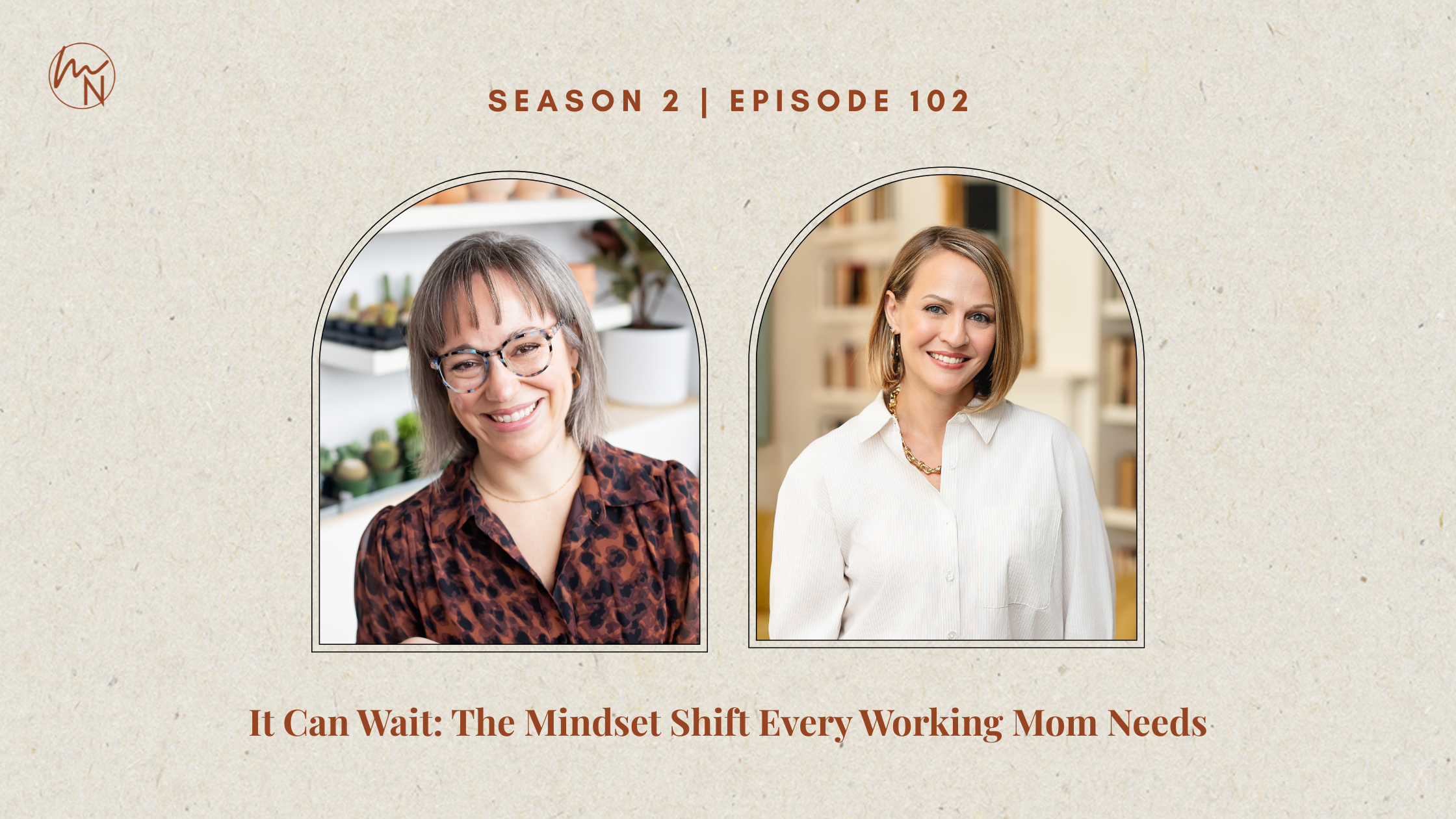
Episode 102: It Can Wait: The Mindset Shift Every Working Mom Needs
ITUNES | SPOTIFY
If you’ve ever felt like dropping something wasn’t an option because it all feels like it "has" to get done, this episode will challenge everything you think you "have" to do.
I’m talking with estate planning attorney and mom, Whitney Ellison, who built a 4-day workweek that fits her life—not the other way around. Her mantra? It can wait.
But this isn't just about working less. It's about:
How to say no without guilt
Letting go of the pressure to do it all - for work, your kids, and your home
Redefining what rest looks like in this season
Setting boundaries that actually stick
There’s a moment in this conversation that I can't stop thinking about - when Whitney opted out of something in real time because it didn’t serve her. That one decision completely changed how I think about permission, priorities, and what it means to be a “good mom.”
And yes, we also cover a few estate planning basics every parent should know—because that’s one thing that can’t wait.
If you’re tired of rushing, overcommitting, or feeling like you’re always behind, this episode will help you rethink your time and remind you that you get to choose what matters most.
links & resources mentioned in this episode:
-
📍 You are listening to the Life Coach for Working Moms podcast, the show where we are talking about what it actually takes to make life work as a working mom. I'm your host, Katelyn Denning, a full time working mom of three and a certified life and executive coach. I'm so glad you're here and I hope you enjoy this week's episode.
Welcome back to another episode of the podcast. This is episode 1 0 2 and wow, am I excited for you to hear this interview. Whitney is someone that I recently met in my real life at a retreat. She's someone whose name I've known about for years, but was so excited to finally connect with her in person and.
As soon as we started in on our first conversation, I knew I would be inviting her onto the podcast because what I learned from her was just too good not to share it with all of you as well, so. You'll hear about the, the fun story that has forever left a mark on me, the example that Whitney has set for me, and, and I hope for you as well after listening here about saying no, about protecting our time setting boundaries, which I know can be so challenging for so many of us.
And to top it all off professionally. Whitney is an attorney and she practices in the area of estate planning. And so not only does she give us all of this great life advice, at the very end, she goes into some of the most important conversations and documents and decisions that as parents we.
Are in a position to, to really consider seriously, and, and the items that would be smart for all of us if you haven't already, to be thinking about putting into place for your family. So be sure to listen all the way to the end for those professional tidbits and, and pieces of advice if that's something that you know is on your radar to check off of your list.
But. For everything else, this conversation is just pure gold. I know it's a little longer than I typically do for these podcast episodes, but there was just nothing I could cut out. It was all so good. So please enjoy this conversation and as always, you can find everything related to the episode and ways to connect with Whitney.
If you happen to be in this area and are looking for an attorney to help you with estate planning, you can find that all in the show notes at themothernurture.com slash podcast. All right, with that, enjoy the episode.
Hi, Whitney. Welcome to the Life Coach for Working Moms podcast.
Thank you, Katelyn. It's great to be here.
I'm so excited for this conversation. I have so many questions, so many directions where we can take this and we'll just see where we land today. . As we get started, could you give the listeners just a quick introduction, who you are, what you do, anything else that you wanna share, and then of course we'll uncover the rest as we get into it.
Sure. , my name's Whitney Ellison. I live in Northern Kentucky, which for listeners that aren't local to this area is, , just across the river from downtown Cincinnati.
, I, , have three kids and a husband. My kids are 13, 11, and. Six, and I have three Boston Terriers and I'm, I'm what we call a Boston Terrier enthusiast, and I also am an attorney. I practice estate planning and probate law, and then I also am a writer and do poetry.
I love that I didn't know about the Boston Terriers fun.
So Whitney and I have circled each other in different communities in Cincinnati for a while, and then fun story. We both signed on to a retreat earlier this year that a mutual friend of ours was hosting a rest and realign retreat, and, , you reached out to me right after the announcement was made and we saw who all was attending because I don't know, I saw up without really knowing who was going to be there.
And you said, I'm going to, and I'm so excited to get to know you better, and I was also very excited and got to hear your poetry and more about your work. And so. It was great to connect in that way.
That was a fabulous weekend. It was just hands down. It was so much fun. And I, I do recall we had a wonderful conversation on books and what we liked to read.
We did. Yes, we did. And I had my first, , experience doing would, do you say holotropic? Holotropic. Breath work?
Oh, yes. I, you know what? I don't know the correct way to say that. I just call it breath work.
Breath work.
It wasn't, I know expert. I'm just an enthusiast.
You are. I, I think that helped me. I was definitely a little nervous going into it.
I wasn't sure what to expect. And you were like, oh, I love this. This is gonna change your life to all of us there who were newbies. So, , it was, I wanna do it again because I feel like I didn't quite fully relax into it, even though , our facilitator did such a great job of preparing us for what to expect.
I still, that part of me that was like, but I don't know, so I need to do it again.
Yeah, I think with breath work it is like the first time you do it, it's a total mystery and we're still really in our heads just because the unknown is the big elephant in the room. So definitely to me, the more effective, , times are not the first time, you know, second, third, whatever .
Yeah. I mean, 'cause now you know what to expect so you can let go of that and make space in your head to really let go and it's pretty great.
Yeah. And it was work. I mean, it definitely felt hard.
Yeah.
At, at times.
Yes.
I loved it. There were so many great moments from that weekend. Anyway, so one of the first things that I wanted to have you share with us, I know a number of attorneys.
I think oftentimes I picture someone practicing law and I, I think of an attorney and I picture extreme stress and pressure and billable hours. Maybe it's all of the suits shows that are out there when you have to hit all these quotas and. I found it so refreshing to hear about your current situation, practicing estate planning in your boutique law firm and the schedule that you've created for yourself.
And I wonder if you could share with everyone part what a day in the life looks like for you and also incorporate into that your work schedule and how you've designed that more recently.
Yeah, absolutely. First I will say yes, you probably do know a lot of attorneys 'cause there are a lot of us out there and my apologies.
Just joking. I love attorneys. I am one. But, , what I will say is, , I often will kid, yes, I'm an attorney, but I don't identify as one. And what I mean by that is, one of the things I love about our law office is that we are intentional about dismantling the. Idea, the assigned narrative, , that was very much structured around the patriarchy and men, working as attorneys before women were allowed to practice.
And the idea that, aside from , the standard formalities because of course in the courtroom and so forth, there, , is certain process that in respect that you have. For the judicial proceedings. But in terms of the space, in terms of the interactions with clients, in terms of the way that we treat each other, if we have opposing counsel, we've really not bought into that old traditional narrative.
we've really shifted into a direction of having a more comfortable, warm, casual environment instead of, , having a very. Prescriptive, , almost sterile place that you come into that feels intimidating. Mm-hmm. , and that's not to say that nice big wall practices are not good.
That is just to say that we have changed the format because there are a lot of us out there and a lot of clients out there for which that. Prescriptive space is not a fit, right? Mm-hmm. And so what we seek to do is create a really comfortable, pretty happy, warm space that when our clients walk into it, they say, oh, I feel safe here. Or, you know, oh, this is not what I expected. I like this. And that is really nice because it creates this. Space to talk about hard things. , but it feels more like you're in your living room comfortable and not across a desk with, somebody possibly seated higher than you are, your backs to the door, things like that.
Mm-hmm. So you know that that is, , both by design and also because my law partner and the owner of the law practice, Ellen Keller, who you also met at the retreat, likes pretty things and she's very. Good at making space warm and comfortable. , that being said, the other thing that. We do not do is we're not typically in suits.
You mentioned the show suits. Right. , you won't usually see us in suits. , we are in jeans and cute tops, and we're comfortable, we're presentable. , but we're not interested in going to the dry cleaners every day. So, you know, we're gonna be dressing very similarly to our clients usually.
And then the other thing that I personally think we do well is talk about those hard things without talking about it over our clients' heads. You know, really trying to ensure that when we're communicating with them, they understand what we're talking about. We're breaking down what estate plans look like, what would be the best option for them and why.
And they're speaking directly to us, the attorney, and not. To, administrative folks, which again, we're just not a large firm, so we don't need that. And that can be to our benefit
In terms of my work schedule this has been something that I feel like the word curate comes to mind. Yeah. You know, I love the schedule that I have, and it does change. Day. Currently I am working from home Monday from nine to three, although I will take in-office client appointments on Mondays for those that need it.
, I'm in the office Tuesday, Wednesday and Thursday from nine to three, and I do not work Fridays. I have, , zoned that off for my mental health, for tending to family stuff that needs to get done and for whatever the heck I want it to be for.
Yeah,
and I love that because that means that my Thursdays are now my Fridays, I can exhale.
, now that being said, there are weeks where I may have more work than those hours a lot, but that's few and far between because I have agency over what kind of work I take and to whom I take it from. If there are clients that come to me that. I feel like would be a better fit elsewhere. I will refer them out if I am at capacity.
I have law partners that can take the work. So we really are very intentional about our time. . We have the full intention of remaining a woman owned practice and women run practice and it's fantastic and it does change the narrative.
None of us feel, exhausted by our hours. We enjoy our work. We're discretionary about what we take, and we have time for our lives.
Mm-hmm. I do wanna ask you some questions later on about estate planning, but one thing that stands out to me is even on your working days, whether that's in the office or your Mondays from home, the nine to three hours, which.
As a parent myself, I'm guessing is aligned around the school day. So is that what you've structured to allow yourself to either be with the kids or do the drop off and pick up? What does that look like for you?
Yeah, that's exactly it. So I will say, because I live in northern Kentucky, our offices are located in Madeira, so that's a solid 20 minute commute without traffic, , no complaints.
I never mind a quiet car ride with an audible and some coffee. Yeah,
so that's
fine, but that makes it hard to get here by eight 30 because my, , kiddos need to be at school at eight for the middle school and eight 15 for the elementary school. And yes, my husband also shares that load, but it's not predictable every week who's gonna be able to take the kids to school?
So I feel confident that with my clients. I can be here by nine. I will say I usually don't start scheduling appointments until nine 30 because I don't like the jolt of coming in and having people waiting on me, and I haven't even set my bag down. I need to get my coffee, I need to get settled in, look at my day.
And so, appointments typically start at nine 30. Kids get outta school at three o'clock and so I'm not quite home in time for, , pickup. But their school is in walking distance to my house, so. Oh, nice. They are just walking home. , and they could walk to school, but we kind of like giving 'em a ride.
And then I have really awesome friends that if it's pouring down rain or the weather's really bad, they will give my kids a ride. 'cause they know I'm not there. So that's pretty great. That's our, that's our village. And you know, my husband, when he's not traveling for work, he works from home too, and he can also pick them up.
Nice. And are you just deciding morning of, are you looking at the week ahead together to see like who's available for drop off? I'm always so curious the conversations that go on behind the scenes.
I wish we could own that being that organized. But it is always the morning of. Yeah. Unless, you know, unless he tells me, Hey, I've gotta be in Florence for a meeting at eight, I know I'm taking the kids.
Right, right. But for the most part, , it, I would say like 80% of the time we're just on the fly going, Hey, can you take him this morning? I gotta go. You know? Yeah.
Yeah. I love that you called out as well. The people who can step in and help you with, you know, driving home in the rain or rides, I'm sure, to other things as well.
What does your village or your help ecosystem look like in addition to that?
Man, I have the greatest squad and I mean, just across the board, I have friends that are just unrelated to my kids, but if I need something, they've got my back. Like a meal, whatever. I mean, they're out in the business world mentioning my name in rooms,
you know, just like I have that squad and they know who they are. I've got my sons. . Friends moms who, we've got a little group that we text a lot, and I love those gals. They're really great. , my youngest daughter, I have some friends from, , her Montessori school that we've stayed in touch and we've, , actually created a local book club and brought in more moms.
And, , so that's been a big thing. , my closest. Friend her son is, has been my son's best friend since they were little bitty, and she is always there for a ride or pick up if I need her, and likewise for her. And then, my oldest daughter, she's got a group of friends with parents that, if they need to break, drop her off or whatever, they're always down for it.
So, . It really is nice. And I will also attribute that to, partially to the fact that we live in a really small town and , it's easy to get places in that area. , and so that helps, you know, it's a small community and I'd like to think that you can cultivate that in a larger community as well.
I don't know 'cause I haven't been there, but in that. Smaller community. I feel like that helps curate that setup.
Yeah. Those are all great examples, and I think for anyone listening, it's, it's about making those connections. And I know I've talked about it before of just asking. So many other parents that you, you've mentioned, right?
, the parents of this kid's, friends , and each of your different kids at the different ages. They have different needs, different rides, different requirements, and finding the other parents or just asking the other parents, how do I get connected? Or who can help me out? Or, I'd be happy to offer this.
, it really does just take. That initiation in a way, like they don't have to be your best friends, but you can absolutely have each other's back. And when we think about help or support, so many people think about hiring, which if you have that as an option, it is great, but there's so many other ways to build that.
Yeah, I, I totally agree. I also think that as much as I love my village and being able to ask for help, I also like it when people ask me for help, you know, and, and I can, I can return that. It becomes very circular , and not in a, , self-serving way, but more just in a community way.
I, I have. , a group of women that I've become really good friends with in my workout class, and we're all different age ranges, and I was able to host a baby shower for a gal who wasn't from Fort Thomas, and that was her friend group in Fort Thomas. And it felt really good. And all the women came together, all these different ages and were like, I'm here if you need, I haven't held a baby in forever.
If you need a break, just call, drop the baby off. Go take a nap. You know, so it it's reciprocal. And I think there's something really fantastic about it. And you're right, you don't have to be best friends with everyone, and I'm certainly not, but I will say that. It, you easily start to become friends through it and that is really nice.
You know, there are certain folks that you just jive with and how lucky you are to have been able to connect through your kids.
Yeah, absolutely. I have made some new parenting connections and friends just in the last few months with my oldest who's 11, and it's just also a reminder that. Those people who can help you or you can help, can show up at all of these different stages.
it doesn't just have to start when they're in preschool or daycare or kindergarten, that these people will come into your life at different stages. And so, you know, I have a sixth grader and now I have new mom and parent, not just moms parent connections that are brand new to me.
And I love that.
Yeah, I will give a shout out to the dads too. Right. My friends, my friends that are married have some pretty great husbands and that's fantastic too because when I bring my husband along or when he's doing , the leading, , he knows these guys and they all get along and they may not always hang out, but when we hang out together,
They have a good time and that's awesome.
Yeah, that's a a great point. I caught myself as, I was like the mom and I'm like, well, actually. It's not just moms , like you said, I love that there are all parents, guardians, family members that we can include in our village.
Yeah. And just a reminder to all of us, I catch myself.
Sometimes I'll just text the mom when I need to ask about, Hey, can you pick up? Or Could my son get a ride to soccer tonight? Or whatever. And I try to do a better job of including both parents and not just assuming who is gonna be the one responsible. And I think that also helps.
Yeah.
Can we dive into like how you use your Friday time and go a little bit more on the personal side and then we'll jump back into work stuff. Is that okay?
I love my Fridays. I'm happy to talk about them as long as you want to.
Okay.
, so you mentioned in your schedule, at least for now, and I don't know if you've always had a day like this, but that you have your Fridays. For you, and as I think I mentioned earlier, I got to hear you read some of your poetry at the retreat, which I love that you make space for. And so I don't know if that's a part of your Fridays, but can you give us some examples of, aside from having to pinch hit on, you know, a sick kid home or family, things that you need to take care of, which I know you've had a lot of that this last month.
What kinds of things do you use that time for?
Yeah, I, I love the topic of, , Fridays and my hope for all individuals is a four day work week someday. Yeah. Bye. Golly. I'm holding out for it anyway. So when I started curating the schedule originally, , I was coming off as were most of us, the heels of the pandemic trauma.
And not only that, but I had also had a baby six months prior to the pandemics. So I was having some very serious postpartum depression and anxiety. My third baby I was homeschooling a first grader and a kindergartner, and I had a full-time job as a corporate executive. , and I had to let go of that identity and, and figure out what I needed to do.
Long story, less long I found Ellen and I have, I've done probate and state planning, , before and I love this work. And she asked me if I could just work two days a week as a probate attorney. So my original schedule was just Tuesdays and Thursdays and it worked great and it was how I was able to have the rest of the time to recover.
And, , I did, I truly took that time to exercise nap. I, I'm a huge fan of napping take care of myself and my kids and completely recalibrate. It took therapy and time. And so originally my Fridays, , for up until about really 2024 we're very simple. I would. There's, there's a place called Flourish Ayurveda on the East end, it's wonderful. So I would get up, get the kids to school, and then I would get my writing things and go out to my deck, , if it was warm, or go to my living room and just, , write poems. And I wrote a lot of poems and, , eventually that transition to driving to Day Lilly, which is right next door to the yoga studio and working there or having coffee with a friend.
And then I would go to yoga and I would come home and I would nap until my kids got home from school. And that's literally all I had in me. And I how privileged that sounds. That is not something that everyone can do. And I, and I wanna recognize like. I didn't take that time for granted. I literally was in a state of not a whole human being at that time, and so there are still.
Weeks where that is what my day looks like. 'cause I'm worn out and I've been everything to everyone. But more frequently now I am out and about on my Fridays and sometimes I will meet a client if they need help, but I really try to keep my boundaries strong with not working on Fridays. You know, sometimes it can't be helped.
If I get scheduled for a court hearing on a Friday, I have to go, you know? But that being said, as long as it's not that, and it's not family related for dental appointments or so forth. , one Friday a month, I spend four hours of my day volunteering with Project Connect at Taft Elementary School, providing legal consultations for families experiencing homelessness.
, and it's specific to the areas of practice that I practice in as well as helping them find resources for other areas of practice and also just kind of visiting with the staff and answering questions for them. Yeah, that is really wonderful. I love doing it. I just started doing that this year and it's a great use of my time.
Other times I will meet friends for coffee or lunch. I will mentor last Friday I sat with a, , newly minted graduate and she was just looking to talk about what adulting looks like and needed some mentoring. So I sat with her and did that. So I really try to use my time. To get out and connect, , in a way that's helpful.
I'm doing really well right now. I'm in a position to be the helper, not be the one receiving the help, and that's gonna change in ebb and flow as it does with life. So I'm trying to be the helper in ways that speak to how I can.
Mm-hmm. How did you know you were ready? To transition into that position of helping others as opposed to needing that space, like you said, to just restore yourself and be a whole human again.
I just started feeling like I don't need this as much anymore. Mm-hmm. Like it didn't feel like a need. Mm-hmm. Before it was like. Survival. And it became more feeling more like a luxury, which is nice, but also it becomes indulgent to a point where I, I personally, there's no guilt. I just don't feel like it might be the best use of my time.
Mm-hmm. And so when restoration and, . Self-help is needed, then it's an absolute great use of my time. And I'm all about fun too. So it's not that I'm not okay with not having fun, it's just that fun may look different than that. Now, fun may be grabbing coffee with a friend I haven't seen in a quarter, or fun may be like checking out a new park and going for a walk, or I, I did a walkthrough at, , the Queen City Book Bank.
And learned about their nonprofit. And I had a blast. I saw a play with the American Legacy Theater and it was a dress rehearsal and I learned about the work that they're doing, and that was wonderful. And that was a Friday afternoon.
So there's just. A lot of really cool things we can do with our time if we're just kind of opening up to what's available and receptive about it. And I think the real big sign for me was I always like to come up with a word for each new year. Not really an intention, but just like maybe a little sets the direction of my compass for the year.
, and the first word that popped in my head this December was service.
Hmm. I've been researching for a class that I recently taught about rest and the different types of rest and, and going beyond just. Including rest and sleep as the same definition and thinking about all of the other ways that we can categorize our rest from creative rest and spiritual rest.
And all, all of these, there are like seven types I think I found. Who knows if that's totally accurate or not. And it's interesting your description of how these Fridays have evolved from a place of needing physical rest and mental rest to nap, or to do yoga, or even to write. To now shifting into noticing that these other types might fuel you in a different way, but still can be categorized as something that I'm guessing maybe you can share fuels you for the other work in your life as well.
I think of fun as being such a great underutilized tool that we have to bring meaning to the rest of the work that we're trying to do.
Yeah, I definitely am at a place where. I still would say rest is in my top five values, and I think you're right. It's kind of a versatile idea of what that looks like.
, I still take a nap every day. I get home at three. I say hi to the kids. I go upstairs and I take a snooze for 30 to 45 minutes. , because I've worked all day, I've used my brain all day at work, and I'm getting ready to have to use my brain all evening to take care of my babies, and whatever logistical gymnastics that entails.
And so I pause and it may be I just lay there with my eyes closed or I take a snooze. , so definitely a very literal. Direction with that is sleep. And you know, I am getting more sleep at night, but I'm also perimenopausal and my eyes are often wide open at three in the morning for no good reason. And so, you know, it helps to like just fit that into my schedule.
And if I don't need it, I don't take it. But it's set aside. For that if I need it. And then, you know, just using my own agency to spend time how I want to spend time in the hours that I have to myself. Which again, is why I think having time during a work day or a school day is really good because there's no tethered obligations to your children or your spouse.
, it literally is your time, you know, assuming that things are going well. , and so that is part of why that time is slotted on Fridays is because I know that that is, that time really, truly belongs to me. And so, you know, rest could be reading a book, rest could be, , going for a walk. I work out a lot and that's not rest, but that's really good for me and I love endorphins and, and so I feel like that fuels recovery, , and I think rest and recovery are kind of cousins, you know?
Mm-hmm. Mm-hmm. So maybe it's not always rest. Maybe sometimes it's things we do for recovery too.
Mm-hmm. My mom took a nap every day. She was a school teacher, and we would come home from school together, and she took a nap every day. And when you said that, I don't know why. That's never dawned on me that I could do that too.
I, I love that you do that. And that's a core memory that I have of her.
I get it from my mom. We come from a long line of nappers. So I remember I lived in Japan as a child for , three and a half years, and it was from age 10 to age 13, and people on the trains, we took the trains everywhere, including myself.
We would just nod off while we were sitting there on our ride, and it was perfectly socially acceptable to grab a few Zs before you got off at your. Stop, you know, just don't sleep through your stop. Obviously that be my fear, but it was totally common and totally acceptable and I am completely unapologetic and I sometimes I will get frustrated with folks who will like their spouse.
Might need a nap, and they will be like, I don't understand. They shouldn't be taking a nap. Or, and I'm like, why don't you let 'em rest? They, they might actually be really tired and need that, you know? Mm-hmm. And that's one thing I will say about my husband is, , he is perfectly fine if I want to go take a snooze.
There's no questioning. There's no concern. It's more like, yes, please do, because you will be so much better when you wake up.
Yeah. I find, I don't know what are your thoughts on this, but I find. Often people who, I'm gonna use the word judge or, or . Can't quite fathom why someone else would need a nap or look at them just resting on the couch or taking that time often comes from someone who will not let themselves do the same thing and it's, it's like a million
percent
right?
We judge actually what we desire.
Yep.
And so. I, I'm curious if you can name or share with anyone listening who. Finds, whether it's napping or just sitting down to read or do nothing, who finds that really challenging when you know so many of the women that I talk to feel like they have a huge list of things to be doing, whether it's for work or just around the house or for kids, and when they sit down, when they nap, when they rest.
Those things don't get done and then they feel further behind. Like, how do you put that aside or do you even have that challenge?
I, I love the mantra. It can wait.
Mm.
I mean, I just think the world's not gonna stop if that one thing doesn't get done. And.
Nobody else typically notices. , least of all our children and possibly our spouses. The only person that notices it is us. And yes, of course there are certain things we can't put off. Right? Of course there's taxes. You can phone my extens. Yes. But, you know, there are certain things we can't put off and I get that, but sometimes.
It's too much and it can wait, and I'm not just talking about doing the dishes or vacuuming the floors or whatever that looks like around the house. I'm talking about my kids' dance class that week. We've done something every night and I can't possibly drive and pick up one more time, and so
you know what we need to rest tonight, you know, and, and we sit it out and it's okay. Like the world doesn't stop. She's six,
you know? Yeah, I was gonna say, how do your kids, are they like just used to that, that sometimes mom says.
Yes, you
need a night at home. And that's just a part of your family culture.
And guess what? They're not sad about it.
Yeah.
Like they're like, oh, okay, that's great. Because they're tired too, you know? And on the weekends we don't go, go, go, because we have gone. Gone. Gone. All week, and we may go to dinner, we may do an activity, but we're not packing our days. We like to be at home. We like to sit around and chill.
We like to go outside and well, we, I'm not a big outdoor baby. Like I will go on hikes and I like sitting on my deck, but that, that's not my thing. But my husband loves to get outside with the kids and shoot hoops. Or throw a football or whatever and he and I go for walks. But we're not trying to be the hero of staying busy to constantly entertain the kids.
I'm cool if they're bored every once in a while. I'm cool if they have to find something to do themselves. , because. We gotta slow down just a little bit as a society, I'm just not buying into that. And I, I'm not buying into it with sports either. And so, you know, I've.
I taught my children. I, I think that that culture is too competitive at this age. It's toxic and it's really hard on our bank accounts. And so we'd rather do other things with you, , than constantly drive you around for those things. Mm-hmm. , and I don't have the energy for that. And, you know, call me a bad mom if you want, but that's just.
I feel very strongly about that.
I mean, I, I'm, I'm eating it up. I, I just love the example that you gave and I'm, I'm a little maybe embarrassed or I'll be vulnerable to say that. I'm not sure that crossed my mind, which is why I love talking with you. 'cause I'm gonna give another example too, of something that you like exploded my brain on, but to say that.
We've been going all week and we're just gonna sit dance class or sit soccer practice or sit this lesson out this week. What a huge permission slip. I think so often when I first heard you say it can wait, my mind went to. All of the like household tasks that we could spend forever doing and never finish.
But to even say we don't have to honor every single external commitment because you're right for a 6-year-old, what is one dance class or what is one soccer practice across the season what? What a gift to be able to have an evening at home. To not be so busy.
Thank you. I just feel like the world keeps spinning, you know?
Yeah, it does.
It
really does. And it's okay. It's okay.
It's okay. Yeah. When we were at that retreat together, and I think this ties into everything that we're talking about in terms of permission to do things a little bit differently than what we see everyone else doing. Whitney and I, along with everybody else, we're doing, , an afternoon or evening session, kind of a discussion around a particular topic, and we got, I don't know, maybe five or 10 minutes into the intro and you just raised your hand and very respectfully said.
You know, this isn't really landing for me and I think what I need right now is a nap, and I'll see you guys later for dinner or whatever the next thing was. And Whitney just got up and walked out of the room and. To you, it may have seemed like something that you, of course, that's just what we do, or that's what I do and my brain just went, and the next day there was a session scheduled.
That may maybe, it would've been really impactful. I don't know. I don't second guess my decision that I felt. What I would rather spend my time doing is doing some focused work by myself. And so I opted out and it was all because I had seen you say no. So I guess when we think about whether it's saying no to a practice or an invitation or a chore or a task or a project, that it can wait this.
Ability and, and what I think so many of us think is going to be uncomfortable, but really is not. I, I did it and I lived and it was okay that you can just say no, or you can just say, this isn't really working for me right now, or doesn't feel as important to me as taking a nap or having an evening off or whatever.
Well, and I ironically, the topic that I was leaving was saying no.
Okay. That's what I couldn't remember. I thought so.
Yes. So I was like, I really don't think I need this.
Yeah. And and she got you said no and walked out and we were all like, yeah, she, she need that. That's actually what there's the whole lesson right there.
Yeah. Well, my, my wall partner, Ellen was in it and she was like, no, she doesn't need that.
Which I, I mean, I will just reflect, I, I'm, maybe you know this, probably you do, but I'll just reflect that, you know, I coach hundreds of women who are working professionally, growing careers, raising families, and saying, no. Giving yourself that permission, I would say is easily in the top five of of challenges that if we could be comfortable with being uncomfortable, as we learn that skill has one of the greatest opportunities to open up time and space and capacity.
Yes, no is a complete sentence. And you know, I, I will say that it's not like. It always was like that for me, it is a practice and there are times I will find myself trying to find a way to make something happen that I don't really wanna do, and as soon as I can name that I will stop. Like an example would be a potential client saying, I can only meet.
After four 30, so I'm gonna need an appointment after four 30 and for a minute I will start the mental gymnastics of trying to accommodate that Before I'm like, no, this client, if that's the only time they can meet, then this is not the right fit for us.
And I will simply say I can't accommodate that. I'm happy to provide a referral. And oftentimes, lo and behold, they will be able to meet during my work hours. Yeah. But you know, but I think that we catch ourselves going down that rabbit hole and if we can pause and name it, we can stop ourselves from doing that.
But I'm certainly not immune to it. I'm just better at it than I used to be.
Yeah. Probably from lots of practice.
Yes.
And I will say too. It makes your yes, feel so much more meaningful. So when I sent you the invite to join this podcast, there was a part of me that thought she might say no. She has no trouble saying, no, this might be too much.
She might have really busy schedule right now. Any, for any reason, you wouldn't have to give any of them to me. But the fact that you said yes made me feel like, wow, this is really valuable for her and a valuable use of her time. So.
Absolutely, and you know, I actually recently declined to be on a board I really wanted to serve on, but I couldn't deliver what they needed from me, and so I had to be really honest with myself and them and like completely.
Kill my ego and say, , I can't do exactly what you're asking me to do. I'd be happy to be a friend to the organization, but unfortunately I'm already overextended and what you need is not a match for what I can offer. And that was a hard no to say no to. 'cause I really wanted to be that to them. But you also know is not just because you don't feel like it sometimes.
It's acknowledging your limitations and honoring those too.
Totally. Yeah. So practice, practice, practice is, is what I'm hearing. I could talk to you forever, but I can't let you go without asking you for a little nugget of your professional experience knowing. Who this audience is.
You know, we're, we're talking to parents largely. And so when I think about estate planning and I think about the season of life that I am in and probably most of my listeners are in, it feels like a big, daunting task. What is the one thing that.
People in this season of life need to know or can take as a next step when we think about this big project of, of setting up, our plans for our family, for our legacy.
Yeah, I mean, I could spend a whole hour on this. I know. I'm, so, I'm gonna, I'm gonna try, try it, doing a disservice
by making
you
condense it into such a short tidbit.
Well, I, it's helpful to know my audience here. We're talking about families that likely have children that are still under the age of 18, and that's an important factor. So I can think of a few bullet points that are very important to know. , without going into everything. Thing. The first thing to know is that the biggest concern parents of children have with estate planning is who would take care of my kids if something happened to myself and my children's other natural guardian if they have one.
When I say natural guardian, I just mean the other parent, whether they're your spouse or not. Okay. And so for that reason alone, I would recommend that you get your estate plan done because a last. Will and testament is exactly where you would put that information, and it's a nomination.
It's not an appointment. The court has to approve that individual to be a guardian, but that's what you want because they do a background check and all those things. Okay? So that's number one. Number two, if you have the means or the access to do a revocable living trust. As part of your estate plan, that includes a will.
It also includes power of attorney, healthcare, power of attorney, and living will in our office. But a revocable living trust is the best option for parents with minor children for a couple of reasons. One, if your children are minors, or even if they're young, like say they're in their early twenties
not ideal if something were to happen to you if a big lump sum of money or even a modest lump sum of money was just to fall on their heads, right? They don't have the bandwidth to manage financial assets properly. A trust allows somebody that you've appointed,
to be the trustee and manage those assets and help grow them for the benefit of your children when they reach a certain age. So that would be a reason to have a revocable living trust if you have minor children.
Additionally, people think that a trust is a tool to avoid probate. The answer to that is yes and no. Probate is the court process for which estate are administered through if they don't have the assets transferring on death to a beneficiary. So if your trust is your designated beneficiary or your spouse is your designated beneficiary and your trust is your secondary beneficiary, then those assets will avoid probate.
But if you don't have any beneficiaries designated, even if you have a trust, they're still gonna go through probate. But the difference is that what won't be a matter of public record is how they're distributed. Because your will, which will be called a poor over will, if you have a trust, will pour all of those assets into your only designated beneficiary, which is your trust.
So if you have it going to different people in different amounts. Nobody sees that as public record, but they will see an inventory of your assets if your assets are not set up to transfer on death. Okay, so those are two really important things to know as parents of young children. There are other reasons to have a revocable living trust, and that is primarily just the privacy of distributing your assets in accordance with your wishes without being a public record.
But you may have specific wishes that are nuanced or beneficiaries that have special needs and need some discretionary language or even a special needs trust.
Mm-hmm.
, other documents that I will touch on very briefly that are extremely important, your durable power of attorney. This is a document where you're appointing an agent. If you're married, it'll be your spouse, and then a backup. Mm-hmm. , to be able to sign and make choices on your behalf for business or financial reasons, if you're geographically unavailable or if you are mentally incapable of making decisions.
Healthcare Power of Attorney, the most important document you can have during your lifetime. This is your advocate when you cannot advocate for yourself, for your healthcare.
And then of course your will, your trustee, and your executor, if you had a trust, would be the same person. An executor, trustee, and guardian can be the same person as long as you don't feel like it would be a conflict. If your guardian's not that great with financial stuff, you may wanna have your trustee be a different person.
If your trustee's not great with kids, you might wanna have your guardian be a different person. But if they're awesome at both. That's okay. Yeah, so those are some hot tips to understand. And I'm happy to answer other questions. We do free consultations for both estate planning and probate. I do a state administration as well.
We love our work. We really do, and we align our values with living and our work such that you get a really happy person when you have an appointment with us because we take care of ourselves and we take care of our clients.
Yeah, so helpful. And I know I put you on the spot to rattle that off so quickly. That's okay. But I,
oh, one more, one more really important thing. Yeah. Especially for parents. Legal insurance. We do take legal insurance and if your employer offers it, it's really worth it.
Those insurance companies have a network of attorneys that sign up to help , their members get their estate planning, and there's typically no to very reduced cost for the individuals to get that. It could save you a couple thousand dollars. Definitely, if your employer offers that and you're ready to do your estate plan, do it at your open enrollment.
Yeah. And I don't know, I mean, would you, the opposite of your other phrase, it can wait, I'm guessing for, for these documents, especially if you have children, as so many of my listeners do, don't wait.
I would say this. Sometimes I tell my clients jokingly, planning for estate.
Planning is kind of like scheduling your colonoscopy. You really don't want to have to do this, but you know that you will get great peace of mind after it's done and we check on you every three to five years. So. So it's up to you. You have to feel ready or you won't do it. So I encourage you to do it as soon as you feel ready, get it done, and knock it out while you're in the vibe to do it.
Yeah, I love that. Thank you for those tips and just what you bring to challenging conversations around these topics. And also just. All of the permission and ideas that you gave us today for what rest can look like, what saying no can look like, , how to use your time as someone who's holding a lot as you are.
It was such an honor to chat with you.
Thank you. Well, thank you for having me and I'm so glad we finally got to connect in real life. That was pretty great.
It was so great. Next time we'll have to talk about books and poetry and even more. ,
so thank you again. I appreciate it so much. Thanks
Katelyn,
and I'll see you again soon.
Yes, thank you.
Bye-Bye.
📍 Thank you for listening and as always, for being a part of this working mom community. You can find everything related to this episode in the show notes at themothernurture.com/podcast,
you can also find information about how I support working moms just like you through one-on-one, and group coaching, as well as access a number of resources and articles all on my website at themothernurture.com.
I will see you again next week for another episode of the
podcast.
If you enjoyed this episode, you won’t want to miss what’s coming next! Make sure you hit the subscribe button to tune into future episodes.
If you love the Life Coach for Working Moms Podcast, I’d be so grateful if you’d rate and review it on iTunes! Simply scroll down, tap to give it a five star rating, then tap “Write a Review.” Your rating and review will help more busy working moms discover helpful episodes each week!
